How Hydroelectric Dams Generate Power
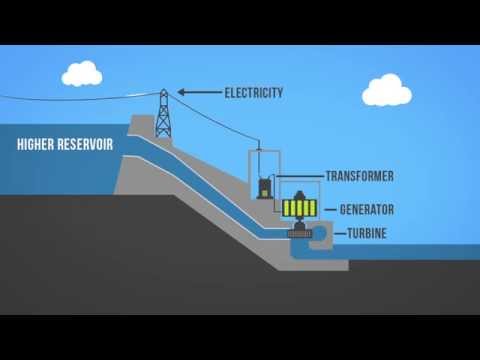 Photo: N43 and Hermes
The physics, engineering, and global impact of hydroelectric power — from water pressure and turbine design to the environmental trade-offs of damming rivers.
Source video: Hydropower 101 · Student Energy · approximately 4.2M views observed via yt-dlp on August 04, 2026. Independently researched by N43 and Hermes.
Annual hydropower generation by leading nations, in terawatt-hours. China alone produces roughly three times the output of any other country.
01 The Core Principle: Falling Water Does Work
Every hydroelectric dam on Earth operates on a principle so simple it predates electricity itself: water flowing downhill carries energy, and that energy can be captured. The dam creates a reservoir, raising water to a height above the downstream river. When water is released through the dam, gravity pulls it downward through a penstock — a pressurized steel or concrete tunnel — and the force of that falling water spins a turbine. The turbine connects to a generator, which converts mechanical rotation into electrical current through electromagnetic induction. That is the entire chain: gravitational potential energy becomes kinetic energy, kinetic energy becomes mechanical rotation, and mechanical rotation becomes electricity.
The amount of power available depends on two variables — the volume of water flowing through the system per second (the flow rate, measured in cubic meters per second) and the vertical distance the water falls (the head, measured in meters). The formula is straightforward: power equals flow rate times head times gravity times a system efficiency factor. A dam with 100 meters of head and 50 cubic meters per second of flow, at 90 percent efficiency, yields roughly 44 megawatts of electrical power. Double the head and you double the output. Double the flow and you double the output. This is why the world's most productive dams combine tall structures with massive river systems — the Three Gorges Dam on the Yangtze, for instance, stands 181 meters high and spans a river that discharges some 30,000 cubic meters per second at flood stage.
02 Anatomy of a Dam: From Reservoir to Turbine
A hydroelectric dam is not a single object but an integrated system of engineered components, each tuned to a specific function. At the upstream face, the reservoir — sometimes stretching hundreds of kilometers behind the dam wall — stores water and creates the height differential that drives power generation. The dam wall itself, typically built from concrete or earth-fill material, must withstand enormous hydrostatic pressure that increases linearly with depth. Intake structures near the reservoir floor draw water into the penstock system, often through screens that filter debris and fish.
The penstock is the critical artery: a steel or reinforced-concrete conduit that channels water under pressure to the turbines housed deep inside the dam's powerhouse. Control gates regulate flow, allowing operators to increase or decrease generation within seconds to match grid demand. At the turbine — most commonly a Francis turbine for medium-head dams, a Pelton wheel for very high-head installations, or a Kaplan turbine for low-head, high-flow sites — the water's kinetic energy transfers to rotating blades. The turbine shaft connects directly to the generator rotor, which spins inside a stator at speeds typically synchronized to 50 or 60 Hz grid frequency. Water exits through a draft tube into the tailrace, the downstream channel where it rejoins the river at lower pressure and velocity.
03 Turbine Types: Francis, Pelton, and Kaplan
The choice of turbine determines how efficiently a given dam converts water's energy into electricity, and that choice depends entirely on the site's head and flow characteristics. Francis turbines are the workhorse of the industry — a radial-flow design where water enters the runner from the sides and exits axially downward. They perform best at heads between 45 and 400 meters and handle a wide range of flow rates. Roughly 60 percent of the world's installed hydropower capacity runs on Francis turbines, including all 32 main generators at Three Gorges. Their versatility and high efficiency — typically 90 to 95 percent at optimal flow — make them the default choice for large dam projects.
Pelton turbines serve the opposite regime: extremely high head, relatively low flow. A Pelton wheel is an impulse turbine where one or more nozzles direct high-velocity water jets onto spoon-shaped buckets around the runner's perimeter. They excel at heads above 400 meters and are common in mountainous regions with steep terrain but limited water volume. The Bieudron Hydro plant in Switzerland, for instance, operates at an extraordinary 1,883 meters of head — the highest in the world — using Pelton turbines. Kaplan turbines, by contrast, are designed for low-head, high-flow situations: river run-of-river installations, tidal barrages, and dams with heads below about 40 meters. Their adjustable blade pitch allows them to maintain efficiency across a wide range of flows, much like a variable-pitch propeller on an aircraft.
Each turbine type dominates a specific range of head and flow. The overlaps reflect sites where multiple designs could work, with final selection driven by efficiency curves and cost.
04 The Generator: Spinning Magnets, Flowing Electrons
Inside every hydroelectric powerhouse, the turbine's mechanical energy reaches the generator — the device that translates rotation into the electrical current powering cities downstream. A hydroelectric generator operates on Faraday's law of electromagnetic induction: when a conductor moves through a magnetic field, an electromotive force is induced in that conductor. In practice, the generator rotor carries electromagnets — coils of copper wire energized by a small direct current — that spin inside the stator, a stationary ring of copper coils. As the rotor's magnetic field sweeps past each stator coil, it induces an alternating voltage.
The scale is extraordinary. Each of the 32 main generators at Three Gorges weighs approximately 6,000 tons and produces up to 700 megawatts of power. The rotor spins at 75 or 100 revolutions per minute, depending on the unit, driven by the Francis turbine below it. A speed governor continuously adjusts turbine blade angle and wicket gate opening to hold rotation speed constant despite varying loads. Because the generator must synchronize precisely with the 50 Hz grid — meaning the magnetic field must sweep past each coil at exactly the right rate — the mechanical and electrical systems are tightly coupled. Even a two-percent deviation in frequency can damage equipment across the grid, making the governor one of the most critical control systems in the plant.
05 Grid Demand and the Pumped-Storage Advantage
One of hydropower's most underappreciated advantages is its dispatchability. Unlike solar panels that produce electricity only when the sun shines, or wind turbines that depend on atmospheric conditions, a hydroelectric dam can ramp output from zero to full capacity in minutes — sometimes seconds. When grid demand spikes on a hot afternoon, operators open wicket gates wider, increasing flow through the turbines. When demand falls at night, they throttle back, conserving water in the reservoir for when it is needed. This responsiveness makes hydropower an ideal partner for intermittent renewables: a solar-heavy grid can rely on dams to fill gaps when clouds pass overhead, while a wind-dependent system can lean on stored water when the atmosphere goes still.
Pumped-storage hydropower extends this capability further by turning a dam into a giant battery. When excess electricity is available on the grid — typically overnight, when nuclear and wind produce more than demand requires — operators pump water from a lower reservoir up to an upper one. When demand rises, they release that water back through turbines, recovering roughly 70 to 85 percent of the energy used for pumping. The Bath County Pumped Storage Station in Virginia, the largest such facility in the world, can deliver 3,003 megawatts on demand. Globally, pumped storage accounts for over 90 percent of all grid-scale energy storage capacity — far exceeding lithium-ion battery installations, which are growing rapidly but remain a fraction of the total.
06 Environmental and Social Costs
Hydropower is often classified as clean energy, and in terms of operational emissions it is: a running turbine produces no carbon dioxide, no particulates, no nitrogen oxides. But the full environmental ledger is more complex. Large dams flood vast areas of land — Three Gorges displaced 1.3 million people and inundated 632 square kilometers of habitat. Reservoirs in tropical regions can emit substantial methane, a greenhouse gas roughly 80 times more potent than CO₂ over a 20-year window, as submerged organic matter decomposes anaerobically. Dams fragment river ecosystems, blocking fish migration and altering sediment transport that downstream deltas depend on. The Colorado River, once a mighty waterway that reached the sea, now typically vanishes into the desert before it reaches its delta in the Gulf of California — in significant part due to the massive upstream dams that intercept its flow.
Social costs are equally significant. The construction of a mega-dam routinely requires the relocation of communities, often indigenous, whose ancestral lands are inundated. The Narmada valley projects in India have displaced hundreds of thousands of people over decades of contested construction. Safety is another dimension: the 1975 failure of the Banqiao Dam in China, triggered by Typhoon Nina, killed an estimated 171,000 people and flooded downstream areas across an 85-kilometer-wide belt. Dam failures are rare in modern engineering but catastrophic when they occur, and aging infrastructure — much of the world's dam stock was built in the 1950s through 1970s — raises growing concerns about structural integrity under conditions that exceed original design assumptions, including the increasingly variable hydrology associated with climate change.
07 The Future: Small-Scale, Retrofit, and Climate Resilience
The era of mega-dam construction is largely over in the developed world. The best sites have been built, environmental opposition has hardened, and the economics have shifted. Between 2015 and 2023, new installed hydropower capacity globally grew at roughly two percent annually — a fraction of the growth rates for solar and wind. But the technology is not stagnant. Small-scale and micro-hydro systems, generating from 5 kilowatts to 10 megawatts, are expanding in mountainous and rural regions where they can power communities without the ecological and social disruption of large dams. Run-of-river projects, which divert a portion of river flow through a turbine without creating a significant reservoir, offer a lower-impact alternative, though their output varies with seasonal flow.
Perhaps the most significant frontier is the retrofitting of non-powered dams. In the United States alone, roughly 90,000 existing dams serve purposes like flood control, navigation, or water supply but generate no electricity. The Department of Energy has estimated that adding turbines to just a fraction of these structures could yield up to 12 gigawatts of new capacity with minimal new environmental impact. Meanwhile, climate change is reshaping the hydrological baseline that dams were designed around. Prolonged droughts have reduced output at major facilities like Lake Mead's Hoover Dam, where water levels fell so low in 2022 that the Bureau of Reclamation feared the reservoir could reach "dead pool" status, below which no water can pass through the turbines. Hydropower's future will be defined less by new concrete than by adapting the vast existing infrastructure to a warmer, less predictable world.
References
- Wikipedia: Hydroelectricity — overview of hydropower generation, global capacity, and environmental considerations
- International Hydropower Association, 2023 Hydropower Status Report — global generation and capacity data
- U.S. Department of Energy, Hydropower Basics — Water Power Technologies Office
- U.S. Bureau of Reclamation, Hoover Dam and Lower Colorado River Operations — historical and current reservoir data
- TVA, TVA Hydroelectric Generation — technical description of dam and turbine operations
- Source video: Hydropower 101 (Student Energy, ~4.2M views, observed August 04, 2026)
By N43 and Hermes for Sailor Bob News.


