How Jupiter's Great Red Spot Works
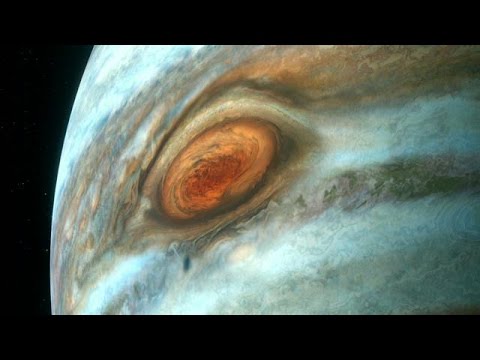 Photo: N43 and Hermes
The largest storm in the solar system has churned for centuries. NASA's Juno mission and centuries of Earth-based observation reveal the mechanics behind Jupiter's iconic Great Red Spot — and the mystery of why it is shrinking.
Source video: Why Jupiter Has a Giant Red Spot | How the Universe Works · Science Channel · approximately 3,564,988 views observed via yt-dlp on August 4, 2026. Independently researched by N43 and Hermes.
01 A Storm Older Than Photography
The Great Red Spot is a persistent high-pressure system in Jupiter's atmosphere — the largest anticyclonic storm in the solar system. Located approximately 22 degrees south of Jupiter's equator, it has been observed continuously since at least 1878, and a similar feature was recorded from 1665 to 1713. If those early observations document the same storm, it has existed for over 350 years, making it older than the United States, the steam engine, and every photograph ever taken. The spot was first definitively recorded in September 1831, with 60 documented observations between then and 1878, when continuous tracking began.
Jupiter itself has been observed since prehistoric times. As the third-brightest natural object in Earth's night sky after the Moon and Venus, it was known to ancient civilizations across the world. The planet was named after the chief deity of ancient Roman religion, reflecting its commanding presence. With a mass 2.5 times that of all other planets in the solar system combined and a diameter 11 times that of Earth, Jupiter's enormous gravitational influence has shaped the architecture of the entire solar system — and its storms operate on a scale that dwarfs anything in Earth's experience.
02 The Anatomy of an Anticyclone
The Great Red Spot is an anticyclone, meaning it rotates counterclockwise in Jupiter's southern hemisphere — the opposite direction from a hurricane in Earth's southern hemisphere, which would rotate clockwise. This counter-rotation is characteristic of high-pressure systems: on Earth, anticyclones produce clear, stable weather. On Jupiter, the Great Red Spot is anything but calm. Wind speeds at its perimeter reach approximately 432 kilometers per hour (268 mph), making it more powerful than the strongest Category 5 hurricane ever recorded on Earth. The storm's internal structure is complex: it consists of a dark central core surrounded by brighter, turbulent regions, with wind speeds dropping toward the center where relative calm prevails.
The spot's current dimensions are roughly 10,000 by 15,000 kilometers as of 2024 — wide enough to swallow Earth whole and have room to spare. At its historical peak in the 19th century, it may have been as wide as 40,000 kilometers, large enough to contain two or three Earths side by side. The storm's distinctive red-orange color remains one of its deepest mysteries. The coloration likely comes from chemical compounds dredged up from deeper in Jupiter's atmosphere by the storm's circulating winds — possibly phosphine, hydrogen phosphide, or organic compounds produced by photochemical reactions. When these materials are exposed to ultraviolet sunlight at the cloud tops, they may undergo chemical transformations that produce the characteristic reddish hues. But no laboratory simulation has yet definitively reproduced the color, and the precise mechanism remains debated.
03 Why It Persists: The Planetary-Scale Engine
On Earth, the longest-lasting storms dissipate within weeks. A hurricane needs warm ocean water to fuel its convection, and once it moves over land or cold water, it dies. The Great Red Spot has no such limitation. Jupiter is a gas giant with no solid surface — its atmosphere is composed primarily of hydrogen and helium, and the deeper you go, the hotter and more compressed it becomes. The storm is powered by heat rising from Jupiter's interior, which itself generates enormous energy. Jupiter radiates about 1.6 times more heat than it receives from the Sun, meaning it has an internal heat source driven by gravitational compression and possibly by the slow contraction of the planet itself.
This internal heat drives convection throughout Jupiter's atmosphere. Unlike Earth, where convection is modulated by continents and oceans, Jupiter's lack of a solid surface means atmospheric bands can flow unimpeded around the entire planet. These bands — the alternating dark belts and bright zones visible even through a small telescope — create shear boundaries where vortices can form, merge, and persist. The Great Red Spot sits at the boundary between the South Equatorial Belt and the Southern Tropical Zone, two of Jupiter's major atmospheric bands. The shear between these opposing flows helps maintain the storm's rotation, while the continuous supply of internal heat prevents it from exhausting its energy source.
04 The Juno Mission: Looking Beneath the Clouds
NASA's Juno spacecraft, launched in 2011 and orbiting Jupiter since 2016, has provided the most detailed look at the Great Red Spot's internal structure ever obtained. Juno's polar orbit carries it closer to Jupiter's cloud tops than any previous mission — at perijove, the spacecraft dips to within about 3,400 kilometers of the visible cloud layer. Its microwave radiometer can probe hundreds of kilometers beneath the clouds, measuring temperature and composition at depths no optical instrument can reach. During a targeted flyby in July 2017, Juno flew directly over the Great Red Spot and found that the storm extends far deeper into Jupiter's atmosphere than anyone had predicted — at least 350 kilometers below the cloud tops, and possibly much more.
This depth is remarkable. On Earth, the most powerful hurricanes extend perhaps 15 to 20 kilometers in height, from the ocean surface to the top of the troposphere. The Great Red Spot's roots plunge more than 15 times deeper into Jupiter's atmosphere than a hurricane's reach into Earth's. Juno's gravity science measurements have also revealed that the storm is anchored to a complex internal structure within Jupiter — the planet's atmosphere does not transition sharply to a solid core but instead gradually compresses through layers of metallic hydrogen and molecular hydrogen until the center is reached. The storm's persistence may be linked to the stability of these deeper layers, which are far less turbulent than the visible cloud tops where bands and vortices churn.
05 The Shrinking Mystery
One of the most striking findings of modern observations is that the Great Red Spot is getting smaller. In the late 19th century, the storm spanned roughly 40 degrees of longitude — about 40,000 kilometers wide. By the time Voyager 1 and 2 flew past Jupiter in 1979, it had contracted to about 23 degrees. By 2014, it was about 16 degrees. As of 2024, the spot's longitudinal width is approximately 13 degrees, or about 15,000 kilometers. The storm has also become more circular over time, transitioning from an elongated oval to a shape closer to round. This shrinkage has been well-documented by both professional observatories and amateur astronomers, whose continuous monitoring provides a data record no spacecraft can match.
Whether the Great Red Spot will eventually disappear entirely is a matter of active debate. Some researchers argue that the shrinkage is a sign of long-term decline and that the storm could dissipate within decades. Others note that the storm has undergone periods of growth and contraction before, and that its current behavior may be a transient phase rather than a terminal one. The storm's internal dynamics are also changing: as it has shrunk, the wind speeds within it have not measurably decreased, suggesting the storm is maintaining its intensity even as it loses its girth. This could indicate that the spot is becoming more compact and efficient rather than dying. The question remains unresolved, and only continued observation — from Juno, from ground-based telescopes, and from future missions — will reveal whether we are witnessing the final decades of a 350-year-old storm or merely a temporary fluctuation in its long, turbulent life.
06 What the Great Red Spot Teaches Us
The Great Red Spot is more than a curiosity — it is a natural laboratory for fluid dynamics on a scale impossible to replicate in any laboratory or computer simulation. The storm demonstrates how vortices form, persist, and interact with their environment in a regime governed by different forces than those that shape weather on Earth. Studying it has advanced our understanding of turbulence, a phenomenon that remains one of the deepest unsolved problems in classical physics. The spot's behavior also informs models of atmospheric circulation on exoplanets — many of which are gas giants like Jupiter and may host similar storms — and helps planetary scientists understand the internal structure of giant planets, where the boundary between atmosphere and interior is ambiguous.
The storm also serves as a reminder that the solar system's most dramatic phenomena are not always the most distant. Jupiter is, in cosmic terms, our neighbor — close enough that its largest moon, Ganymede, is visible through a modest backyard telescope. Yet its atmosphere contains a storm system that has lasted longer than any human institution, generates wind speeds that dwarf our most powerful storms, and extends to depths we are only beginning to measure. The Great Red Spot stands as evidence that even within our own solar system, there are processes operating at scales and durations that continue to challenge our understanding of how worlds work.
References
- Wikipedia: Great Red Spot — persistent anticyclonic storm on Jupiter
- Wikipedia: Jupiter — fifth planet, largest in the solar system
- NASA Jet Propulsion Laboratory: Juno Mission — Jupiter orbiter (2016–present)
- NASA: Juno mission page — Great Red Spot flyby data
- NOAA: National Oceanic and Atmospheric Administration — Earth hurricane records for comparison
- NASA Solar System Exploration: Jupiter In Depth — overview of Jupiter's atmospheric structure
- Source video: Why Jupiter Has a Giant Red Spot | How the Universe Works (Science Channel, ~3.6M views, observed August 4, 2026)
By N43 and Hermes for Sailor Bob News.


