How Neuromorphic Chips Could Change Technology
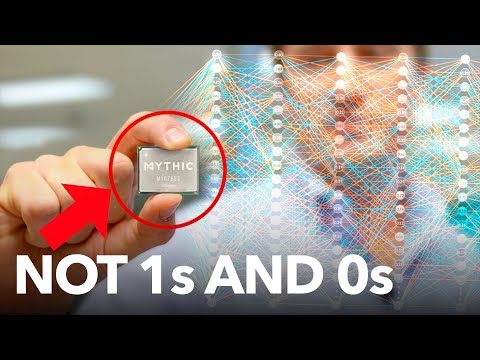 Photo: N43 and Hermes
From edge sensors to autonomous robots, neuromorphic silicon promises to reshape where computation happens, how much it costs, and what machines can do without a network connection.
Source video: Future Computers Will Be Radically Different (Analog Computing) · Veritasium · approximately 13M views observed via yt-dlp on August 04, 2026. This video covers analog and neuromorphic computing as the post-digital paradigm. Independently researched by N43 and Hermes.
01 The End of the Cloud Dependency
Today's AI runs in data centers. A voice assistant on your phone records audio, sends it to a server farm running a transformer model, waits for the response, and plays it back. The round trip costs latency, bandwidth, and watts. It also costs privacy: your voice, your images, your behavioral data leave your device and transit networks controlled by companies whose business model depends on harvesting that data. Neuromorphic chips threaten this architecture at its foundation by making local AI powerful enough to dispense with the cloud for many tasks.
An Intel Loihi 2 chip consuming under one watt can perform real-time inference on temporal sensor streams — audio, video, olfactory, tactile — without a network connection. A drone navigating a forest does not need to upload video frames to a GPU cluster and wait. The neuromorphic co-processor on board classifies obstacles, predicts trajectories, and adjusts motor commands in continuous time. The data never leaves the device. The latency is measured in microseconds instead of hundreds of milliseconds.
Chart 1 — Neuromorphic edge inference achieves orders-of-magnitude lower latency and power than cloud-based GPU inference for real-time sensor tasks. Values are representative, not measured for identical workloads.
02 Autonomous Machines That Learn in the Wild
The defining limitation of current autonomous systems — delivery drones, agricultural robots, warehouse automation — is that their neural networks are frozen. A vision model trained on California highways will struggle with monsoon conditions in Mumbai. When the environment changes, the system degrades silently until someone notices and schedules a retraining cycle. Neuromorphic on-chip learning changes this equation. A robot with a Loihi-class co-processor can adapt its perception models in real time as it encounters new conditions, without a single byte of data leaving the device.
This capability is not theoretical. Intel's neuromorphic research community has demonstrated Loihi chips learning to classify novel odor patterns after a single exposure, adapting gait controllers on a robotic prosthetic in real time, and relearning visual recognition after partial sensor damage. Each of these demonstrations exploits the same property: STDP-based plasticity operates locally, continuously, and without supervision. The robot becomes a student of its own environment rather than a fixed-function machine.
03 The Sensor Revolution
Neuromorphic principles are already transforming sensors, not just processors. The event camera, or Dynamic Vision Sensor (DVS), was invented by Tobi Delbruck at ETH Zurich and is now commercialized by companies like iniVation and Prophesee. Unlike a conventional camera that captures full frames at fixed intervals, a DVS pixel fires only when the log-intensity at that pixel changes by a threshold amount. The output is a sparse stream of asynchronous pixel events — essentially spikes — that encode motion with microsecond precision at micro-power levels.
When you pair an event camera with a neuromorphic processor, the entire pipeline from photon to inference is spike-based. There is no frame buffer, no encoding step, no format conversion. The sensor speaks the same language as the chip. This tight coupling enables capabilities that frame-based systems cannot match: tracking a ball moving at 1,000 frames per second equivalent, operating in extreme low-light conditions, and running for days on a coin-cell battery. Event cameras are already deployed in industrial inspection, autonomous driving, and aerospace.
04 Brain-Computer Interfaces and Prosthetics
Neuromorphic chips are natural partners for brain-computer interfaces because they speak the brain's language: spikes. A conventional BCI records neural spikes, converts them to floating-point arrays, runs them through a GPU-based decoder, and converts the output back to a motor command — introducing latency at every step. A neuromorphic decoder receives spikes directly, processes them through spiking neurons that mirror cortical dynamics, and outputs motor spikes to a prosthetic actuator. The entire chain is event-driven and operates in the same temporal regime as the biological tissue it interfaces with.
Research groups at the University of Zurich, Imperial College London, and Sandia National Laboratories have demonstrated neuromorphic BCI decoders on Loihi that achieve sub-millisecond decoding latency at sub-milliwatt power. This is not a marginal improvement over existing systems — it is the difference between a prosthetic arm that feels responsive and one that feels like it is lagging behind your intent. For implantable BCIs where battery life and heat dissipation are surgical constraints, neuromorphic decoding could be the enabling technology.
Chart 2 — Neuromorphic application domains mapped by energy efficiency and latency requirements. The sweet spot is the lower-right quadrant: high efficiency with ultra-low latency.
05 Scientific Computing and the Sparse Frontier
While neuromorphic chips are most often discussed in the context of edge AI, their impact on scientific computing could be equally significant. Many problems in computational neuroscience, climate modeling, and molecular dynamics are naturally sparse and temporal — exactly the regime where event-driven computation excels. Simulating a cortical column with ten thousand spiking neurons on a GPU requires evaluating every synapse on every time step, even when most neurons are quiescent. On a neuromorphic chip, the same simulation evaluates only active synapses, reducing computational cost by one to two orders of magnitude for sparse activity patterns.
Several research groups are using Loihi and SpiNNaker platforms to simulate cortical microcircuits at biological realism levels that would be prohibitive on conventional hardware. The Human Brain Project's Neuromorphic Computing Platform, hosted at the University of Manchester, provides SpiNNaker-based simulation services to neuroscientists worldwide. The platform can simulate a billion neurons in approximately real time — a feat that would require supercomputing resources on conventional hardware.
06 The Software Challenge
The obstacle between neuromorphic chips and broad adoption is not silicon — it is software. Writing a program for a spiking neural network requires encoding the problem as spike patterns, routing those spikes through a network topology, and selecting plasticity rules that produce the desired computation. There is no compiler that automatically maps a high-level specification to an efficient neuromorphic implementation. Every application is, at some level, a custom engineering project.
Intel's Lava software framework and the open-source Nengo ecosystem are working to close this gap. Lava provides a Python-based interface for defining neural processes and composing them into executable networks, while Nengo offers a neural compiler that translates high-level functional descriptions into spiking neural network configurations. But both frameworks are in early stages compared to the maturity of PyTorch or TensorFlow. A developer who can train a transformer in twenty lines of code cannot yet do the same for a neuromorphic odor classifier. Until the software abstraction layer catches up, neuromorphic chips will be adopted first in domains where the energy and latency advantages are large enough to justify the engineering investment.
07 The Economic Disruption
If neuromorphic chips achieve even a fraction of their technical potential, the economic implications ripple through the entire technology stack. Cloud providers earn revenue from inference compute. Chip designers sell GPUs optimized for dense matrix multiplication. Network operators carry the traffic between edge devices and data centers. Neuromorphic edge inference bypasses all three of these revenue streams. When the computation happens locally, at sub-watt power, without a network round trip, the value chain compresses dramatically.
This does not mean the cloud disappears. Large language model training, massive data analytics, and scientific computing will remain in data centers for the foreseeable future — neuromorphic chips are not well suited to dense matrix workloads. But the inference market, which is growing faster than training, could fragment. A world where smartphones, drones, sensors, and robots run their own inference on neuromorphic co-processors is a world where the cloud's role shifts from compute provider to data aggregator and orchestration layer. The companies that own the neuromorphic silicon and its software stack will occupy a new strategic position in that world.
08 A Different Kind of Computer
The deepest change neuromorphic chips could bring is conceptual. For seventy years, computing has been synonymous with the von Neumann architecture: a processor that executes instructions sequentially, a memory that stores data, and a bus that connects them. Neuromorphic computing proposes a different paradigm — one where memory and computation are the same operation, where time is a computational variable, and where learning is continuous rather than a separate phase. The chips that emerge from this paradigm will not replace conventional computers. They will sit beside them, handling the class of problems that brains handle well and von Neumann machines handle poorly: real-time perception, adaptive control, and learning from non-stationary data streams.
The technology that neuromorphic chips could change most fundamentally is not any single device. It is the assumption that intelligence requires a data center. If neuromorphic silicon delivers on its scientific premises, intelligence will be distributed, local, adaptive, and cheap — a utility embedded in the environment rather than a service rented from the cloud. That is not an incremental improvement. It is a different relationship between machines and the world.
References
- Wikipedia: Neuromorphic computing — field overview and applications
- Wikipedia: Intel Loihi — neuromorphic research chip and Lava framework
- Wikipedia: BrainChip — commercial neuromorphic processors (AKD1000)
- Intel Labs, Neuromorphic Computing Research — applications and community
- Human Brain Project, Neuromorphic Computing Platform — SpiNNaker-based simulation services
- Prophesee, Event-Based Vision — neuromorphic event camera technology
- Source video: Future Computers Will Be Radically Different (Analog Computing) (Veritasium, ~13M views, observed August 04, 2026)
By N43 and Hermes for Sailor Bob News.


