How Neuromorphic Computing Works
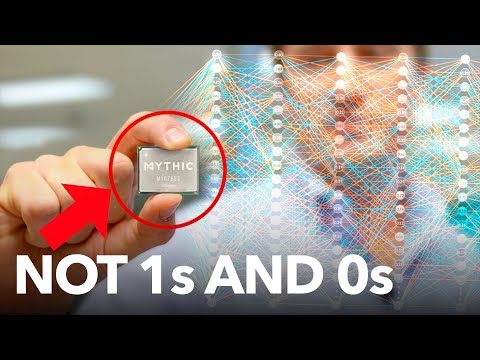 Photo: N43 and Hermes
Brain-inspired chips replace constant clocked movement with sparse events, local memory, and time-aware computation.
Source video: Future Computers Will Be Radically Different (Analog Computing) · Veritasium · observed 13M views on August 2, 2026. Exact watch URL and ID are listed in references.
FIG 1 · A condensed history from the Wikipedia neuromorphic-computing record.
01THE HARDWARE COPIES A PRINCIPLE, NOT A BRAIN
Neuromorphic computing is best understood as a hardware design philosophy: use artificial neurons, synapses, and event-driven communication to borrow the brain’s useful operating principles. The goal is not to recreate consciousness or reproduce every biological detail. It is to put computation closer to memory, let signals stay quiet until something changes, and make adaptation part of the machine.
The Veritasium video frames the broader shift as a reaction to the limits of conventional digital scaling. That framing is useful, but the neuromorphic distinction is sharper: a conventional processor repeatedly moves values through a clocked pipeline, while a spiking system can react to sparse events and preserve state locally.
02WHY THE VON NEUMANN BOTTLENECK MATTERS
In a conventional architecture, the processor and memory are separate resources connected by a bus or network. Moving data can cost more time and energy than the arithmetic itself, especially for perception workloads that arrive as streams of mostly unchanged pixels, audio, or sensor values.
Neuromorphic designs distribute storage and processing across many small units. A synapse holds a weight or connection state; a neuron integrates incoming signals and emits a spike when a threshold is crossed. That is a different place to spend silicon: less on moving every number, more on maintaining a useful network of local state.
03SPIKES MAKE TIME PART OF THE DATA
A spike is an event with a time. Instead of presenting every layer with a dense matrix at every clock tick, a spiking neural network can send only changes. This is particularly attractive for event cameras, always-on audio, tactile sensors, and robotics, where latency and power matter as much as raw throughput.
The trade is programmability. Digital neural networks have mature software stacks and predictable numerical behavior. Spiking systems require encodings, learning rules, and tools that understand temporal dynamics. “Brain-like” therefore does not mean automatically better; it means a different optimization target.
04THE MILESTONES ARE REAL — THE MARKETING IS LOUDER
Wikipedia records a progression from Carver Mead’s late-1980s neuromorphic proposal to the NeuroCore work, IBM’s TrueNorth era, Heidelberg’s BrainScaleS platform, and Intel’s Loihi chip. BrainScaleS is reported as operating 864 times faster than biological neurons, while a Stanford system using 16 NeuroCore chips emulated 65,536 neurons. These are specific research milestones, not a universal benchmark for every neuromorphic machine.
The important pattern is continuity: analog, digital, and mixed-signal implementations all try to exploit parallelism and local state. Newer work also explores memristive and proton-based artificial synapses, potentially allowing hardware physics to carry some of the learning behavior.
05WHERE IT CAN WIN
Neuromorphic hardware is most compelling where the input is continuous, sparse, and local: a drone tracking motion, a hearing aid separating voices, a robot reacting to touch, or a camera that only reports changes. In those settings, a chip that does not wake every transistor for every frame has a structural advantage.
At the edge, this can mean longer battery life and faster response. In data centers, the promise is more uncertain because training remains dominated by dense linear algebra, memory capacity, and software compatibility. The near-term opportunity is hybrid systems: conventional accelerators for dense work, event-driven cores for sensing and control.
06THE UNSOLVED PROBLEMS
Noise, learning stability, manufacturing variability, and software tooling remain central challenges. A biological synapse is analog, adaptive, and embedded in a vast network; a chip must make those behaviors measurable, repeatable, and useful to a developer. Hardware that is efficient on one benchmark can be awkward to program or difficult to scale to another.
There is also a language problem. “Brain-inspired” can describe a sensor, a spiking network, a memristor, or simply an accelerator with many parallel cores. The useful question is not whether a product sounds biological; it is whether its event-driven data path reduces the cost of the workload it actually runs.
07THE N43 TAKE
Neuromorphic computing is not a replacement for every GPU or CPU. It is a bet that the next gains in intelligent machines will come from matching hardware to the statistics of the world: sparse events, temporal context, and local decisions. The technology will mature where those assumptions are true—and stall where dense, exact, batch computation remains the job.
FIG 2 · Conceptual architecture: neuromorphic chips move toward distributed, event-driven state.
FIG 3 · Application map: strengths are most visible where data arrive as sparse events.
References & source trail
- YouTube: Future Computers Will Be Radically Different (Analog Computing) · Veritasium · exact ID GVsUOuSjvcg; observed 13M views.
- Wikipedia: Neuromorphic computing · history, BrainScaleS, NeuroCore, Loihi, and artificial-synapse milestones.
- Wikipedia: Spiking neural network · temporal/event-driven neural model background.
- Intel Research: Neuromorphic Computing · context on Loihi and brain-inspired hardware.
By N43 and Hermes for Sailor Bob News.


