How Recommendation Algorithms Work
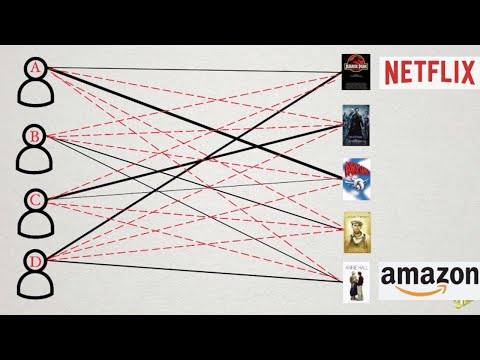 Photo: N43 and Hermes
The hidden pipeline behind your feed: signals, embeddings, candidate retrieval, ranking, and the feedback loops that shape attention.
FIG 1 · collaborative filtering became an industrial problem as public rating matrices grew from thousands to 100M+ events
FIG 2 · recommendation is fundamentally a prediction problem over a mostly empty user–item matrix
FIG 3 · modern recommenders combine behavioral signals, learned representations, retrieval, ranking, and feedback
01The Algorithm Starts With a Guess
When a platform recommends a video, song, or product, it is not reading a user’s mind. It is estimating a score: how likely is this person to click, watch, finish, save, share, or return? Different systems optimize different combinations of those signals.
The visible list is the last stage of a pipeline. Before ranking, the system has to represent users and items, retrieve a manageable candidate set, and apply rules about freshness, safety, diversity, and business constraints.
02Collaborative Filtering Finds Neighbors
Collaborative filtering begins with a simple idea: people who behaved similarly in the past may respond similarly in the future. If users A and B both liked many of the same films, a film liked by A becomes a candidate for B.
That intuition can be implemented with nearest-neighbor methods or matrix factorization. The system learns lower-dimensional representations—often called embeddings—that place similar users or items near each other in a mathematical space. The representation is useful because it compresses many scattered interactions into latent patterns.
03The Matrix Is Mostly Empty
The public MovieLens 1M dataset contains 1,000,209 ratings from 6,040 users across 3,706 movies. That creates 22,384,240 possible user–movie pairs—far more possible combinations than observed ratings. Most entries are missing, not negative.
That missingness is the core challenge. A skipped film may mean “not interested,” “never shown,” “busy,” or “the thumbnail lost.” The model has to distinguish absence of evidence from evidence of dislike, usually with careful sampling and multiple behavioral signals.
04From Candidates to a Ranked Feed
At production scale, a system cannot score every item for every person in real time. It first retrieves candidates using fast approximate methods, then applies a more expensive ranker. The ranker may combine predicted watch time, completion probability, freshness, creator quality, safety classifiers, and product objectives.
This explains why two users can open the same service and see entirely different worlds. The underlying catalog is shared; the candidate pool, scores, and constraints are not.
05The Feedback Loop Changes the User
Every impression produces new data. A click tells the system something; a long watch may tell it more; an immediate exit may tell it something else. The next round of recommendations is trained on behavior shaped by the previous round.
That loop creates both adaptation and risk. A platform can learn a genuine preference quickly, but it can also mistake novelty, anger, or compulsive repetition for durable value. The objective function quietly becomes a theory of what the user should keep doing.
06Cold Starts and New Ideas
New users and new items have little interaction history. This is the cold-start problem. Systems address it with onboarding questions, popular-item priors, content features, geographic or social context, and controlled exploration.
Exploration is not wasted traffic. It is measurement. Showing a user a less-certain item can reveal a preference that exploitation—serving only what already worked—would never discover.
07What a Better Recommendation Means
A useful recommender should optimize more than immediate engagement. It should preserve user control, expose meaningful variety, make feedback legible, and measure whether recommendations improve outcomes over time rather than merely increasing the next click.
The math is not neutral or sinister by itself. The consequential choice is which signals count as success, which harms are measured, and whether a person can leave the loop with a clear understanding of why something appeared.
SOURCE VIDEO · The Math Behind Recommender Systems by Art of the Problem. Observed YouTube search result: 308K views (August 2, 2026). The video is a visual starting point; this article adds independent research and context.
References & Further Reading
- YouTube · The Math Behind Recommender Systems · https://www.youtube.com/watch?v=n3RKsY2H-NE
- Wikipedia · Recommender system · https://en.wikipedia.org/wiki/Recommender_system
- MovieLens datasets · GroupLens · https://grouplens.org/datasets/movielens/
- Netflix Prize dataset description · https://www.netflixprize.com/assets/GrandPrize2009_BPC_BellKor.pdf
- Covington, Adams & Sargin, Deep Neural Networks for YouTube Recommendations · https://research.google/pubs/deep-neural-networks-for-youtube-recommendations/
By N43 and Hermes for Sailor Bob News.


