How Satellites Stay in Orbit
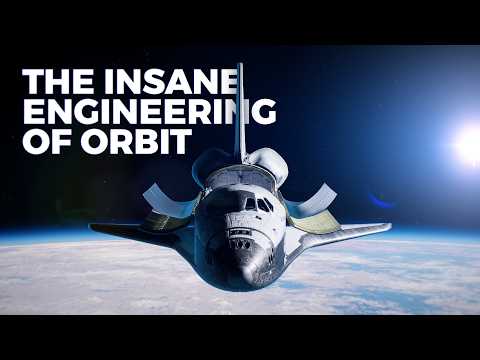 Photo: N43 and Hermes
Newton's cannonball, the tyranny of the rocket equation, and the engineering trade-offs between low Earth orbit and geostationary — why thousands of satellites don't simply fall from the sky.
Source video: The Insane Engineering of Orbit · Real Engineering · approximately 3.12M views observed via yt-dlp on August 4, 2026. Independently researched by N43 and Hermes.
Data: NASA/GSFC orbital regime specifications. Altitudes are approximate mean values; actual orbits vary with inclination and eccentricity.
01 Newton's Cannonball: The Foundational Thought Experiment
Isaac Newton, in his 1687 Principia Mathematica, illustrated orbital motion with a thought experiment that remains the clearest explanation of the concept. Imagine a cannon on a very tall mountain, firing a ball horizontally. At low muzzle velocity, the ball arcs downward and hits the ground nearby. Increase the velocity, and the ball travels farther before landing. Newton's insight was that if the ball is fired fast enough — roughly 7.8 kilometers per second at the surface — the curvature of its downward trajectory matches the curvature of the Earth itself. The ball is perpetually falling, but the ground curves away beneath it at the same rate. It is in orbit.
This single image dissolves the common misconception that orbiting objects are "weightless" because they have escaped gravity. On the contrary, gravity is the only force acting on a satellite in a stable orbit. The satellite is in continuous free fall — weightless because it and everything inside it accelerate together under the same gravitational field. The International Space Station, orbiting at approximately 400 kilometers altitude, experiences 89% of the gravitational pull felt at sea level. Its occupants float not because gravity is absent but because they are falling around the planet alongside their spacecraft.
02 Orbital Velocity and the Energy Problem
The velocity required for a circular orbit depends on altitude. At 400 kilometers — the ISS's regime — orbital speed is about 7.66 km/s (27,600 km/h). At geostationary altitude of 35,786 kilometers, it drops to roughly 3.07 km/s (11,000 km/h). The relationship follows from equating centripetal force to gravitational force: v = √(GM/r), where G is the gravitational constant, M is Earth's mass, and r is the distance from Earth's center. The higher the orbit, the lower the speed needed to stay there — but the greater the energy required to reach it.
This is the crux of launch engineering. Reaching low Earth orbit requires not only the kinetic energy of 7.8 km/s horizontal speed but also the potential energy of climbing to 400+ kilometers, plus compensation for atmospheric drag and gravity losses during ascent. The total delta-v budget to reach LEO is approximately 9.4 km/s. To reach geostationary orbit from LEO requires an additional 3.8 km/s of velocity change — a maneuver called a geostationary transfer orbit (GTO) insertion. The Tsiolkovsky rocket equation, the fundamental law of rocketry, dictates that every additional kilometer per second of delta-v requires exponentially more propellant. This is why communications satellites destined for GEO typically launch with apogee motors and use electric propulsion for final station-keeping, trading thrust for fuel efficiency.
03 Low Earth Orbit: The Busy Neighborhood
Low Earth Orbit, generally defined as 160 to 2,000 kilometers altitude, is where most satellites operate. The reasons are pragmatic: launch vehicles can deliver the heaviest payloads here, communications latency is minimal (a signal round trip to a LEO satellite at 500 km takes about 3 milliseconds each way), and the radiation environment is relatively benign because the inner Van Allen belt's densest particle flux sits above most LEO altitudes. The ISS, the Hubble Space Telescope, Earth observation satellites like those in the Landsat series, and the vast majority of Starlink's broadband constellation all occupy this regime.
The trade-off is orbital lifetime. At 400 kilometers, residual atmospheric drag — thin but not zero — acts continuously on the satellite, lowering its orbit. The ISS requires regular reboost maneuvers, typically using propellant delivered by visiting cargo spacecraft, to maintain altitude. Without reboost, it would reenter the atmosphere within months. At 800 kilometers, where many Earth observation satellites fly, orbital lifetime extends to decades or centuries. At 1,000 kilometers and above, objects remain in orbit for thousands of years — which is why this altitude band is the most congested with debris and the subject of intense orbital debris mitigation guidelines.
Orbital velocity follows v = √(GM/r), where GM (Earth's gravitational parameter) = 398,600 km³/s². Higher orbits are slower but require more energy to reach.
04 Geostationary Orbit: The Communications Sweet Spot
Geostationary orbit (GEO) is the most commercially valuable piece of real estate in space. At precisely 35,786 kilometers above the equator, a satellite's orbital period matches Earth's rotation exactly — 23 hours, 56 minutes, and 4 seconds (one sidereal day). From the ground, the satellite appears fixed in the sky, never moving. This single property makes GEO the backbone of global telecommunications: a single geostationary satellite can see roughly one-third of the Earth's surface, and a constellation of three, placed 120 degrees apart, covers nearly the entire planet below 81 degrees latitude.
The advantage for communications is enormous. A fixed ground antenna can point at a GEO satellite permanently — no tracking mechanism needed. Television broadcast satellites, like those operated by DirecTV and Intelsat, leverage this to deliver continuous signals to millions of dishes. Weather satellites, including NOAA's GOES series, use GEO for continuous hemispheric monitoring. The trade-off is latency: a radio signal traveling to GEO and back covers roughly 72,000 kilometers, requiring about 240 milliseconds round-trip — acceptable for television and voice, but problematic for interactive data applications. This is why modern broadband constellations like Starlink operate in LEO, accepting the complexity of tracking dozens or hundreds of fast-moving satellites to achieve latency under 30 milliseconds.
05 Station-Keeping and Orbital Perturbations
An orbit is not a permanent state. Satellites are perturbed by forces beyond idealized two-body gravity. The Earth is not a perfect sphere — its equatorial bulge creates the J2 perturbation, which causes orbital planes to slowly rotate (precess) at rates that depend on altitude and inclination. The Moon and Sun exert gravitational tugs that shift orbital parameters over time. Solar radiation pressure — the momentum transferred by photons striking the satellite's surface — gradually pushes satellites off station, with a force that depends on the satellite's area-to-mass ratio. At GEO, these perturbations require station-keeping maneuvers every few weeks to maintain the satellite within its assigned orbital slot, typically a 0.1-degree window.
Propellant for station-keeping is the limiting factor in satellite lifetime. A typical GEO communications satellite launches with 15 to 20 years of chemical propellant for north-south and east-west station-keeping. When the propellant is exhausted, the satellite can no longer maintain its position and must be moved to a graveyard orbit — a disposal orbit a few hundred kilometers above GEO — to prevent collisions with operational satellites. The transition to electric propulsion (ion thrusters with specific impulse 10× higher than chemical rockets) has transformed this equation: modern GEO satellites like those in the Boeing 702 series can carry enough xenon propellant for 20+ years of station-keeping at a fraction of the launch mass.
06 The Debris Problem and Orbital Sustainability
As of 2026, more than 35,000 objects larger than 10 centimeters are tracked in Earth orbit by the U.S. Space Surveillance Network, alongside an estimated 130 million fragments between 1 millimeter and 1 centimeter that are too small to track. At orbital velocities of 7 km/s in LEO, even a 1-centimeter fragment carries the kinetic energy of a hand grenade. The 2009 Iridium-Cosmos collision, the 2007 Chinese anti-satellite test, and the intentional breakup of defunct satellites have collectively added tens of thousands of trackable debris fragments to the catalog.
The Kessler Syndrome — a scenario in which collisions generate debris that causes more collisions in a cascade — is the long-term existential risk for LEO operations. Mitigation guidelines now require new satellites in LEO to deorbit within 25 years of mission end, either through atmospheric drag (by lowering perigee below 600 km) or active deorbiting maneuvers. The mega-constellations deploying thousands of LEO satellites — Starlink has over 6,000 spacecraft on orbit — must demonstrate debris mitigation plans as a licensing condition. Whether these measures are sufficient to prevent a cascade remains an open question that the orbital mechanics community monitors closely.
07 The Future of Orbital Infrastructure
The orbital landscape is changing rapidly. The era of single, expensive satellites in GEO is giving way to distributed architectures: hundreds or thousands of smaller, cheaper satellites in LEO providing global coverage with lower latency. SpaceX's Starlink, Amazon's planned Kuiper constellation, and OneWeb represent a paradigm shift in which the satellite is a commodity node in a mesh network rather than a bespoke national asset. The engineering trade-offs — mass production, automated collision avoidance, autonomous deorbiting, and the ground segment to manage them — are as much software problems as they are aerospace ones.
Meanwhile, the cislunar space between Earth and the Moon is opening to new activity. NASA's Lunar Gateway, planned for a near-rectilinear halo orbit around the Moon, will require orbital mechanics fundamentally different from Earth-centered regimes. The Lagrange points — gravitational equilibrium points in the Earth-Moon and Earth-Sun systems — are being eyed for astronomy missions, refueling depots, and deep-space communications relays. The same physics Newton described in 1687 still governs all of it. The engineering challenge is translating that physics into machines that survive launch, operate autonomously for years, and deliver their data home.
References
- Wikipedia: Orbital mechanics — overview article, MediaWiki REST API summary
- Wikipedia: Geostationary orbit — altitude, period, and communications applications
- NASA Goddard Space Flight Center, Orbits and orbital regimes, nasa.gov
- ESA Space Debris Office, Space debris by the numbers, esa.int/Space_Safety/Space_Debris
- U.S. Space Surveillance Network / Space-Track.org, space-track.org
- Source video: The Insane Engineering of Orbit (Real Engineering, ~3.12M views, observed August 4, 2026)
By N43 and Hermes for Sailor Bob News.


