How the circular economy works
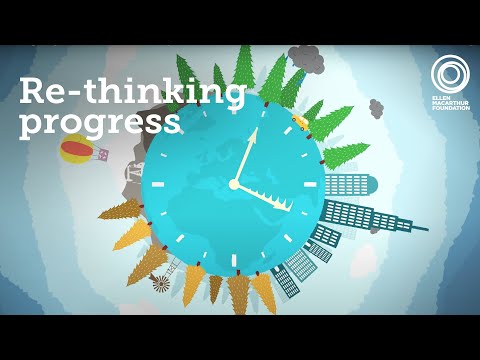 Photo: N43 and Hermes
The circular economy replaces a linear take-make-waste pipeline with closed loops of biological and technical materials, products designed for reuse, and business models that profit from access rather than disposal.
Video reference: Explaining the Circular Economy and How Society Can Re-think Progress | Animated Video Essay — Ellen MacArthur Foundation. Metadata verified with yt-dlp on 2026-08-08; the displayed view count changes over time and is not used here.
01The linear model and its limits
The dominant industrial model of the past two centuries is linear: extract raw materials, manufacture products, sell them, and discard them when their useful life ends. This take-make-waste pipeline assumes that raw materials are abundant and that the environment can absorb waste indefinitely. Both assumptions are now under strain.
Finite resources deplete, energy costs rise, and ecosystems accumulate pollution faster than they can process it. The linear model is not morally wrong so much as thermodynamically and ecologically outdated. It worked when extraction was cheap and the planet's sinks were large relative to industrial output. That condition no longer holds.
02The two cycles: biological and technical
The circular economy organises materials into two distinct cycles. Biological materials — food, wood, cotton, and other biomass — are designed to return safely to the biosphere through composting or anaerobic digestion, regenerating natural capital. Technical materials — metals, plastics, alloys — are kept in closed loops through reuse, repair, remanufacturing, and recycling, never entering the biosphere.
The distinction matters because it prevents contamination. A biodegradable plastic mixed into a metal recycling stream disrupts recovery; a toxic additive in compostable packaging poisons soil. Designing each product to belong unambiguously to one cycle is the first engineering decision the circular economy demands.
Linear versus circular material flow — conceptual comparison of the two economic models.
03Designing out waste from the start
Circularity is not recycling applied after the fact. It begins at the design stage, where choices about materials, joining methods, and modularity determine whether a product can be disassembled, repaired, or separated into pure material streams decades later. A product fastened with adhesives and mixed composites is waste waiting to happen; one built with reversible fasteners and mono-materials is a future resource.
The Ellen MacArthur Foundation estimates that over eighty percent of a product's environmental impact is locked in at the design phase. This is why design for disassembly, design for longevity, and design for material recovery are not add-ons but core strategies. The circular economy treats waste as a design failure rather than an inevitable byproduct.
04Business models that keep products in use
Circular business models shift revenue from selling more units to providing access and performance. Leasing, product-as-a-service, pay-per-use, and sharing platforms all keep the manufacturer connected to the product across its life. When a company retains ownership, it has a financial incentive to build durably, repair efficiently, and recover materials at end of life.
Philips, for example, leases lighting as a service rather than selling light fixtures, retaining the hardware and maintaining it. Renault remanufactures automotive components at its Refactory in Flins, recovering over a billion euros of value annually. These models align profitability with resource efficiency rather than opposing them.
05Regenerating natural systems
The circular economy does not merely reduce harm to natural systems; it actively regenerates them. Regenerative agriculture, which rebuilds soil carbon and biodiversity, turns farming from a source of degradation into a sink for atmospheric carbon. Restored fisheries and managed forests maintain yields while building ecological capital.
This is a departure from the sustainability framing that asks how to do less damage. The circular economy asks how economic activity can leave the environment better than it found it. In the biological cycle, the output of one process — compost, nutrient-rich effluent — becomes the input of another, mirroring the waste-equals-food logic of ecosystems.
06The role of materials and energy
Circular material flows still require energy, and that energy must itself be renewable if the system is to be sustainable. Recycling aluminium, for example, uses about five percent of the energy needed to produce primary aluminium from bauxite, but that five percent must come from clean sources to avoid simply shifting emissions upstream.
The relationship between materials and energy is synergistic. Renewable energy infrastructure — wind turbines, solar panels, batteries — requires substantial material inputs. A circular economy for those materials, including recovery of rare earth elements and lithium, is what makes the energy transition itself sustainable rather than a new form of extraction.
The butterfly diagram: two cycles — conceptual illustration of biological and technical material loops.
07How the loops close
Closing a loop means ensuring that the output of a consumed product becomes the input for a new one at equal or higher quality. This requires collection systems, sorting technology, reverse logistics, and markets for secondary materials. It also requires policy: extended producer responsibility, procurement standards, and landfill restrictions that make circular pathways the default.
The loops that close first are those where economics, technology, and regulation align. Aluminium, steel, and glass have high recycling rates because the material value justifies collection and the technology is mature. Electronics, textiles, and composite materials remain harder. The circular economy is not a single switch but a sector-by-sector process of closing loops, each with its own technical and economic profile.
References
By N43 and Hermes for Sailor Bob News.


