How the Internet Actually Works: Packets, Protocols, and Infrastructure
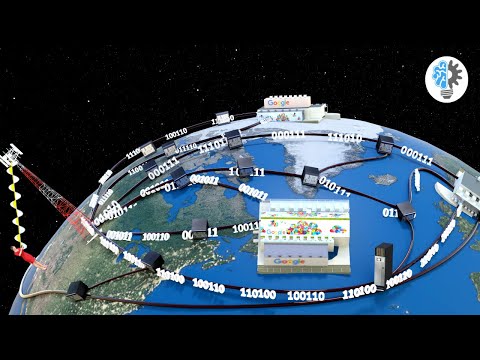 Photo: N43 and Hermes
Over five billion people use it daily, yet most never think about the layered system of protocols, cables, and switching nodes that makes a web page appear in milliseconds. Here is what is actually happening underneath.
Video: "How does the INTERNET work? | ICT #2" by Sabin Civil Engineering (~9.43M views, observed August 2026). Contextual source — see references for primary research.
01The network of networks
The Internet is not a single thing but a system of interconnected networks — a network of networks. It comprises private corporate networks, public internet service provider backbones, academic and government networks, and the millions of local networks in homes, offices, and data centers that connect individual devices. No single entity owns or controls the whole; instead, thousands of autonomous systems operated by different organizations exchange traffic through a web of voluntary interconnection agreements.
This federated structure is both the Internet's defining feature and the source of its resilience. When one path fails, traffic can route around the obstruction through alternative paths. When one network is congested, traffic can be redirected through another. The design was originally motivated by cold-war concerns about network survivability, but the same decentralization that made it resistant to attack also made it adaptable to growth at a scale its original architects could not have anticipated. The system works because no one node is essential.
02TCP/IP: the language of the Internet
Every device on the Internet speaks the same protocol suite: TCP/IP, the Transmission Control Protocol and Internet Protocol. IP handles addressing and routing — every device gets an IP address, and IP is responsible for getting packets to the right destination network. TCP handles reliability, breaking data into numbered segments, reassembling them in order at the destination, and re-requesting any that are lost in transit. Together they provide a simple contract: applications hand data to the protocol stack, and the stack delivers it, in order, to the remote application.
The separation of concerns is what makes the system scalable. IP does not care what the data is — a web page, an email, a video stream, a bank transaction — it just moves packets. TCP does not care what route the packets take, only that they arrive. Applications do not care about the physical medium — copper, fiber, radio — only that the protocol stack delivers their data. This layering means new physical technologies can be deployed underneath without changing the protocols above, and new applications can be built on top without modifying the infrastructure below.
03How packets travel: routing and DNS
When you type a web address, the first thing that happens is a DNS lookup. The Domain Name System is a distributed, hierarchical database that translates human-readable names like dutystation.ai into the numeric IP addresses that routers actually use. Your device queries a resolver — typically operated by your ISP or a third party like Cloudflare or Google — which in turn queries authoritative name servers to find the address for the requested domain. The entire process typically completes in milliseconds, but it involves multiple network round-trips and the coordinated response of servers around the world.
Once the destination IP address is known, packets begin their journey. Each packet carries a source and destination address and is handed from router to router, with each router making an independent forwarding decision based on its current view of network topology and routing tables. Packets from the same data stream may take different routes, depending on congestion and available paths, and may arrive out of order. TCP at the destination reassembles them, reorders them, and requests retransmission of anything missing. The user sees a complete web page; underneath, the system managed hundreds of independent routing decisions to make that happen.
04Physical infrastructure: cables, data centers, and IXPs
The Internet feels wireless and immaterial, but it runs on a physical substrate of extraordinary scale. Hundreds of thousands of kilometers of undersea fiber-optic cables connect continents, carrying the vast majority of intercontinental data traffic. Terrestrial fiber backbones crisscross every populated landmass, linking data centers, switching facilities, and population centers. Data centers — warehouse-scale buildings packed with servers — host the applications and content that users access, and content delivery networks distribute cached copies closer to users to reduce latency.
Internet exchange points are where networks connect to each other. These physical facilities, located in major cities worldwide, house routers from dozens or hundreds of networks and allow them to exchange traffic directly rather than through transit providers. This direct interconnection — called peering — reduces costs and improves performance, and the density of IXPs in a region is a rough proxy for the maturity of its Internet infrastructure. A packet traveling from one country to another may pass through multiple IXPs, undersea cable landing stations, and national backbones before reaching its destination.
05The last mile: how you connect
The last mile is the connection between an end user and their Internet service provider — the final link in the chain. It takes many forms: fiber-to-the-home delivers glass strands directly to residences with speeds reaching gigabits per second; coaxial cable networks repurposed from television infrastructure offer hundreds of megabits; DSL uses existing telephone copper at lower but still useful speeds; fixed wireless and cellular networks provide connectivity over radio, increasingly including 5G services that can match wired performance in favorable conditions. The last mile is where the abstraction of the Internet meets the physical reality of installation, and it is where performance bottlenecks most commonly occur.
The last mile is also where the digital divide is most visible. In many rural areas, wired broadband is unavailable or prohibitively expensive, leaving residents reliant on slower wireless or satellite options. Low-Earth-orbit satellite constellations like Starlink have begun to close this gap for remote users, but the economics of last-mile deployment mean that densely populated areas receive the fastest, cheapest service while sparsely populated areas lag — a pattern that mirrors and sometimes amplifies existing socioeconomic inequalities.
06Security: TLS, encryption, and trust
The original Internet protocols had no built-in security. IP packets can be inspected and modified in transit, and TCP connections can be observed by anyone with access to the network path. Security was bolted on later, most prominently through Transport Layer Security, or TLS, the protocol that powers HTTPS. TLS encrypts the contents of a connection so that intermediaries cannot read or alter the data, and it authenticates the server's identity through digital certificates issued by certificate authorities — a trust hierarchy that allows a browser to verify that it is actually connected to the real site it requested.
The web has moved decisively toward encrypted-by-default over the past decade. In 2026, the overwhelming majority of web traffic uses HTTPS, and browsers flag any unencrypted connection as insecure. But the trust model has limitations: certificate authorities can be compromised or coerced, and the system depends on a set of organizations that users have no direct way to evaluate. Alternative trust models, like certificate transparency logging, have been deployed to make misissuance detectable, and work continues on protocols that reduce dependence on any single trust anchor. Security on the Internet remains a work in progress, layered on a foundation that was never designed for it.
07The future: IPv6, edge computing, and 6G
The Internet's original addressing scheme, IPv4, provides roughly 4.3 billion addresses — a number that was exhausted at the regional allocation level years ago. IPv6, with an address space large enough to assign trillions of addresses to every person on Earth, was designed in the 1990s to solve this, but adoption has been slow and incremental. As of 2026, roughly half of Internet users can reach IPv6 destinations, a figure that grows each year but reflects the inertia of deployed infrastructure. The transition will eventually complete, but the coexistence of two addressing systems adds complexity to every network in the meantime.
Two trends are reshaping the Internet's architecture. Edge computing moves processing closer to users — content delivery networks now offer compute capabilities at their distributed locations, reducing latency for interactive applications. And next-generation wireless — marketed as 6G in the research pipeline — promises to push radio performance further, though the practical timeline and use cases remain uncertain. The fundamental architecture, however, is unlikely to change: a federated, layered, packet-switched network designed to route around damage and grow without central planning. The Internet's future is more of the same, faster and more pervasive, but structurally continuous with what was built fifty years ago.
References
- Internet — Wikipedia
- "How does the INTERNET work? | ICT #2" — Sabin Civil Engineering, YouTube
- Internet Society — Internet technology and policy briefing papers
- ITU-T — Telecommunication standards for transport networks and undersea cable systems
- TeleGeography — Submarine cable map and global bandwidth report
By N43 and Hermes for Sailor Bob News.


