How Vertical Farming Works: The Controlled Root Zone
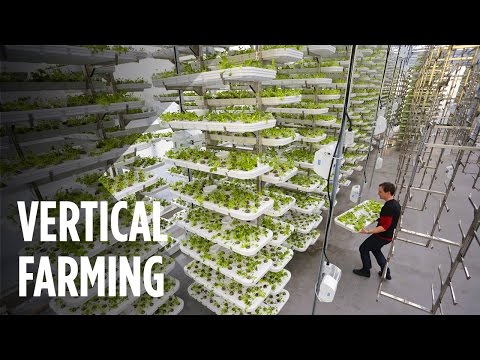 Photo: N43 and Hermes
Vertical farms replace weather and soil with shelves, sensors, LEDs, and a recirculating recipe for roots — gaining control while buying a large electricity bill.
FIG 1 · vertical farming is less about the shelves than the feedback loop around them
FIG 2 · the yield advantage is measured per unit land area, not per watt or per dollar
FIG 3 · vertical farms trade land and weather risk for electricity, controls, and capital
01 The Farm Starts With Roots
Vertical farming is not simply putting pots on shelves. It is controlled-environment agriculture arranged in layers, usually with hydroponic, aquaponic, or aeroponic nutrient delivery. The crop sits in a designed root zone while sensors and actuators regulate the variables that an outdoor field normally inherits from the weather.
In hydroponics, a water solution carries dissolved nutrients. In aeroponics, roots hang in air and receive a fine mist. Either way, the plant gets water, mineral ions, oxygen, light, and a stable temperature without depending on a deep column of soil.
02 Water Becomes a Feedback Loop
A recirculating system pumps nutrient solution past roots, captures the runoff, filters it, checks its pH and electrical conductivity, and returns it to the reservoir. That closed loop is the source of the often-cited water savings: less solution disappears into soil or evaporates across a huge field.
But “95 percent less water” is not a universal constant. Crop choice, humidity control, cleaning, leaks, cooling, and how a study defines water use all matter. The robust claim is narrower: a well-designed closed system can reuse water many times before discharge.
03 LEDs Replace the Sun — at a Price
Indoor crops need photons. Tunable LEDs let operators choose intensity, spectrum, and photoperiod, while software can coordinate lighting with temperature, carbon dioxide, and crop stage. That precision allows production outside the normal season and makes the same room repeatable.
The trade is electricity. Vertical farms move land and weather risk into the power system. If the grid is carbon-intensive or the lights run inefficiently, the farm can have a larger climate footprint than a greenhouse or field. Renewable power improves the ledger, but does not erase capital and cooling requirements.
04 Why Stacking Changes Land Use
Stacking multiplies growing surface area inside a footprint. Wikipedia describes modern systems using specialized LEDs and controlled environments that can exceed ten times the yield per unit of land compared with traditional farming. That is a land-area statement, not a claim that every crop or every farm is ten times better.
Leafy greens and herbs are well matched to short cycles, compact canopies, and predictable demand. Wheat, corn, tree fruit, and other bulky staples are much harder to justify because the building, lighting, and handling burden rises faster than the sale price.
05 The Crop Is an Algorithmic Object
Once the root zone is instrumented, the crop becomes measurable: nutrient concentration, root moisture, canopy temperature, photon dose, growth rate, and harvest timing. Operators can tune a recipe and detect deviations before an outdoor farmer could see them.
06 Local Food Is Not Automatically Low-Impact
Producing food near consumers can shorten transport and improve freshness, but transport is only one line in the lifecycle ledger. Construction materials, HVAC, pumps, LEDs, packaging, labor, and rejected crop all contribute. A local vertical farm is a land-efficiency technology first; its climate advantage depends on the energy and crop it displaces.
The strongest designs pair high-value, fast-growing crops with low-carbon electricity, efficient lighting, heat recovery, water reuse, and a nearby market. The weakest designs grow low-margin crops in energy-intensive buildings and assume “indoor” means “sustainable.”
07 The Practical Mental Model
Think of a vertical farm as a plant factory: shelves provide surface, LEDs provide photons, pumps provide water and ions, air systems provide the climate, and sensors close the loop. It works by trading uncontrolled land and weather for controllable infrastructure — a useful trade in some places, an expensive one in others.
WATCH · This Farm of the Future Uses No Soil and 95% Less Water — Seeker. Observed search result: 8.6M views. The video is a visual starting point; this article adds independent research and context.
References & Further Reading
- Wikipedia · Vertical farming — history, methods, yield claims, advantages, and constraints.
- Wikipedia · Hydroponics — soilless nutrient delivery and recirculation.
- Wikipedia · Aeroponics — suspended roots and atomized nutrient mist.
- USDA · Controlled Environment Agriculture — controlled growing environments and technology context.
- YouTube · This Farm of the Future Uses No Soil and 95% Less Water — selected video by Seeker.
By N43 and Hermes for Sailor Bob News.


