How Hydrogen Fuel Cells Work
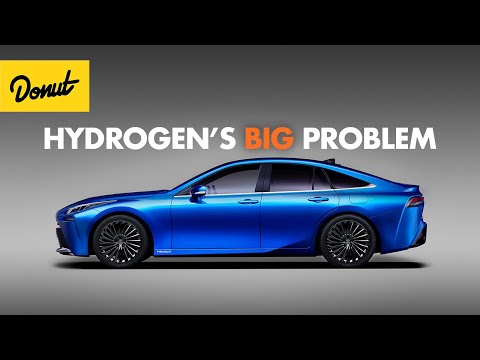 Photo: N43 and Hermes
A fuel cell combines hydrogen and oxygen across a proton exchange membrane to produce electricity, heat, and pure water — an electrochemical device whose principle was discovered in 1839 but whose commercialization has frustrated two centuries of engineers.
Source video: Why Hydrogen Cars Flopped · Donut · approximately 5M views observed via yt-dlp on August 4, 2026. Independently researched by N43 and Hermes.
PEM fuel cells achieve roughly 55% practical efficiency in automotive applications, theoretically up to 70% — higher than internal combustion but lower than battery electric systems.
01 The Electrochemical Principle
A fuel cell is an electrochemical device that converts the chemical energy of a fuel directly into electricity without combustion. The principle was first demonstrated in 1839 by William Grove, a Welsh lawyer and physicist, who observed that reversing the electrolysis of water — sending an electric current through it to split it into hydrogen and oxygen — could produce a measurable current when the gases were allowed to recombine at platinum electrodes. Grove called his device a "gas voltaic battery." It would take another 120 years for Francis Bacon to develop the first practical hydrogen-oxygen fuel cell, and another 20 after that for General Electric to build the proton exchange membrane fuel cell that powered the Gemini space program.
The core reaction is deceptively simple. At the anode, hydrogen molecules are split into protons and electrons through a catalytic oxidation: H2 → 2H+ + 2e-. The protons pass through an electrolyte membrane; the electrons cannot, and are forced through an external circuit, producing the electrical current. At the cathode, the protons and electrons recombine with oxygen to form water: 2H+ + 2e- + ½O2 → H2O. The only byproducts are water and heat. The theoretical maximum voltage from a single hydrogen-oxygen cell at standard conditions is 1.23 volts — a figure set by thermodynamics and unchangeable by engineering.
02 The Proton Exchange Membrane
The defining component of the modern automotive fuel cell is the proton exchange membrane, a polymer sheet roughly 20-50 microns thick — thinner than a human hair — that conducts protons but blocks electrons and gases. The most widely used material is Nafion, a perfluorinated sulfonic acid polymer developed by DuPont in the 1960s. Nafion's molecular structure creates hydrophilic channels that allow hydrated protons to pass when the membrane is sufficiently wet, making water management one of the most critical engineering parameters in fuel cell operation.
On either side of the membrane sits a catalyst layer — typically platinum nanoparticles of 2-5 nanometers deposited on a carbon support — where the electrochemical reactions occur. The platinum loading, measured in milligrams per square centimeter, directly determines both the cell's performance and a significant fraction of its cost. Over the past two decades, platinum loading has been reduced from roughly 0.4 mg/cm² to below 0.1 mg/cm² through advances in catalyst deposition and electrode architecture, but platinum remains a major cost driver. The membrane electrode assembly, as this sandwich of membrane, catalyst, and gas diffusion layers is called, is the heart of every PEM fuel cell stack.
03 The Fuel Cell Stack
A single fuel cell produces less than one volt under load — far too little for practical use. To reach useful voltages, hundreds of cells are connected in series to form a stack. A typical automotive fuel cell stack contains 300-400 cells and produces 200-300 volts at several hundred amperes of current. Each cell consists of the membrane electrode assembly sandwiched between bipolar plates — precision-machined graphite or stamped metal plates that route hydrogen to the anode, air to the cathode, and coolant between cells to remove waste heat. The bipolar plates also serve as electrical conductors between adjacent cells.
Stack engineering involves a set of interlocking thermal, fluid, and electrical management challenges. The reaction at the cathode produces roughly as much heat as electricity, requiring a cooling system comparable in scale to that of an internal combustion engine. The air supply to the cathode must be compressed to 1.5-3 atmospheres, consuming roughly 10-15% of the stack's gross output — a parasitic load that directly reduces net efficiency. Water produced at the cathode must be continuously removed to prevent flooding, while simultaneously the membrane must remain hydrated — a balance that becomes acute during cold starts, subfreezing conditions, and high-power transients.
Global FCEV sales have stayed near the horizontal axis while battery electric vehicles exceeded 10 million annually by 2023, illustrating the adoption gap.
04 Hydrogen: The Fuel Problem
The fuel cell itself is only half the system. The other half is hydrogen — the lightest and most abundant element in the universe, but one that does not exist in molecular form on Earth in extractable quantities. Every molecule of hydrogen used in a fuel cell must be produced from another energy source, stored, transported, and delivered to the cell. This supply chain is where the fuel cell proposition encounters its most formidable economic and thermodynamic barriers.
Approximately 95% of the world's hydrogen is produced by steam methane reforming — a process that reacts natural gas with steam at high temperature and pressure to yield hydrogen and carbon dioxide. This "grey hydrogen" costs roughly $1-2 per kilogram but emits about 10 kg of CO2 per kg of hydrogen. "Green hydrogen" produced by electrolysis using renewable electricity is emissions-free but costs $4-7 per kg, with the electrolyzer capital cost and the price of renewable electricity being the dominant factors. One kilogram of hydrogen contains roughly 33 kWh of energy, of which a PEM fuel cell extracts about 18-20 kWh of electricity. At $5 per kg, the fuel cost alone approaches $0.25 per kWh of delivered electricity — several times the cost of grid-charged battery electric operation.
05 Why Hydrogen Cars Flopped
The automotive fuel cell has had more false starts than any technology in modern transportation history. Honda began leasing the FCX Clarity in 2008; Toyota launched the Mirai in 2014; Hyundai followed with the Nexo in 2018. Each was presented as the beginning of a hydrogen mobility revolution. By 2023, cumulative global sales of fuel cell electric vehicles totaled roughly 70,000 units — a number that battery electric vehicles surpassed in a single month. The reason was not that the technology failed to work. The reason was that it failed to compete.
Battery electric vehicles improved on a learning curve that hydrogen could not match. Lithium-ion battery costs fell from over $1,000 per kWh in 2010 to below $100 by 2023, a tenfold reduction driven by manufacturing scale, chemistry improvements, and the massive capital flows of the automotive industry. Hydrogen infrastructure — the fueling stations, the compressed gas delivery, the electrolyzers — never achieved comparable scale, and each station cost $1-2 million to build while serving a tiny fleet. A fuel cell vehicle's advantage in refueling time (5 minutes vs 30-60 minutes for a fast-charging BEV) and range was progressively eroded as battery energy density improved and charging networks expanded. The market spoke, and it chose batteries.
06 Where Fuel Cells Still Win
The failure of hydrogen passenger cars does not mean the failure of fuel cells as a technology. In several applications, fuel cells retain advantages that batteries struggle to match. Heavy-duty trucking benefits from hydrogen's high gravimetric energy density — a fuel cell system plus hydrogen tanks weighs significantly less than a battery pack sized for 500+ kilometers of range, preserving payload capacity. Marine propulsion, particularly for deep-sea shipping, faces a fundamental volume problem with batteries that compressed or liquid hydrogen can solve. Aviation, where weight is paramount, sees hydrogen as a potential long-term fuel for zero-emission flight.
Stationary power is another domain where fuel cells have established niches. Molten carbonate and solid oxide fuel cells operate at high temperatures (600-1000°C) and can achieve combined heat and power efficiencies exceeding 80% when the waste heat is utilized. These systems, while not portable, serve industrial facilities, data centers, and backup power applications where continuous operation and grid independence are valued. Bloom Energy's solid oxide fuel cells, for example, have been deployed at scale by Google, Apple, and AT&T for on-site power generation using natural gas as feedstock.
07 The Platinum Question and the Future
Platinum has haunted fuel cell economics since the beginning. The global annual production of platinum is roughly 180 tonnes, with catalytic converters for internal combustion engines already consuming about 40% of supply. A full conversion to fuel cell vehicles at 0.1 mg/cm² loading would require roughly 10-20 grams per vehicle — enough that a global fleet of 100 million FCEVs would consume the entire annual platinum supply. Researchers have spent decades pursuing non-platinum catalysts — iron-nitrogen-carbon compounds, nickel alloys, and various metal oxide formulations — but none have matched platinum's combination of activity, stability, and tolerance to impurities in the harsh operating environment of an automotive fuel cell.
The future of fuel cells may lie less in passenger transport and more in industrial decarbonization. Green hydrogen produced by electrolysis powered by surplus renewable energy could serve as a feedstock for steelmaking (replacing coal in direct reduction), ammonia synthesis for fertilizer, and chemical processing — sectors where batteries are irrelevant and electrification is impractical. In these applications, the fuel cell's efficiency relative to combustion is less important than hydrogen's role as a zero-carbon chemical reductant. The technology that powered the Gemini capsule in 1965 may yet find its most important application not in mobility but in decarbonizing the hardest-to-abate sectors of heavy industry.
References
- Wikipedia: Fuel cell — overview of fuel cell types, electrochemistry, and applications
- Wikipedia: Proton-exchange membrane fuel cell — PEM fuel cell architecture and operating principles
- DOE Fuel Cell Technologies Office, Fuel Cells Fact Sheet — U.S. Department of Energy efficiency and performance data
- IEA (International Energy Agency), Global EV Outlook 2024 — FCEV and BEV sales data and infrastructure analysis
- IRENA, Green Hydrogen Cost Reduction 2020 — electrolyzer and hydrogen production cost analysis
- Wikipedia: Platinum — global supply and catalytic application data
- Source video: Why Hydrogen Cars Flopped (Donut, ~5M views, observed August 4, 2026)
By N43 and Hermes for Sailor Bob News.


