Layer by Layer: How 3D-Printed Concrete Is Rewriting the Rules of Homebuilding
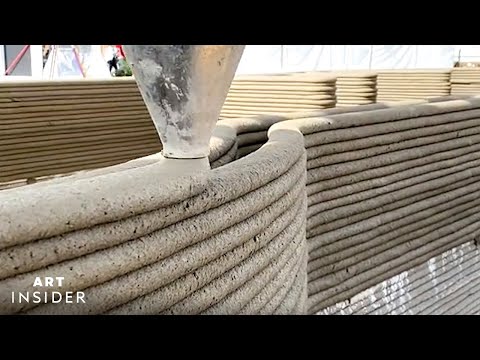 Photo: N43 and Hermes
From a 1997 proof-of-concept at Rensselaer to entire houses extruded from a nozzle, additive construction is challenging centuries of formwork, waste, and labor convention — one concrete layer at a time.
Source video: How Concrete Homes Are Built With A 3D Printer | Insider Art · Insider Art · approximately 10.5M views observed via yt-dlp on 2026-08-05. Independently researched by N43 and Hermes.
Figure 1 — Timeline of major developments in 3D concrete printing technology
01 The End of Formwork
Concrete is the second-most-used substance on Earth after water, and the most widely used building material in the world. For centuries, the way we have shaped it has barely changed: you build wooden or steel molds called formwork, pour wet concrete inside, wait for it to cure, then strip the forms away. That formwork accounts for a significant fraction of the cost, labor, and material waste on any concrete construction site — often 35 to 60 percent of the total concrete budget for complex structures.
3D concrete printing eliminates formwork entirely. Instead of pouring material into a mold, a computer-controlled nozzle extrudes layers of specialized concrete mix along a predetermined path, building up walls and structural elements directly from a digital model. The process is a direct application of additive manufacturing — the same technology behind desktop plastic 3D printers — but scaled up to handle cementitious materials at construction size. The result is greater geometric freedom, dramatically less waste, and the ability to produce shapes that would be impractical or impossible with traditional formwork.
02 Origins: From Pegna to Contour Crafting
The idea of applying additive manufacturing to concrete traces back to Joseph Pegna at Rensselaer Polytechnic Institute, who in 1997 published the first exploratory investigation of solid freeform construction using cementitious materials. Pegna's experiment was a proof of concept — he recognized that the developing robotics industry offered an opportunity to automate construction while reducing costs and waste. His work would later become the foundation for binder jetting, a powder-based 3D concrete printing approach.
Just one year later, in 1998, Behrokh Khoshnevis at the University of Southern California developed Contour Crafting, the first layered extrusion system for concrete. Khoshnevis used a computer-controlled crane to automate the pouring process, capable of creating smooth contour surfaces. He initially designed the system for rapid home construction in natural disaster recovery zones, claiming a full house could be completed in a single day. That ambition — a house in 24 hours — remains the benchmark that the industry measures itself against to this day.
03 How the Printer Actually Works
The video from Insider Art shows the process in action: a gantry-mounted or robotic-arm-mounted nozzle deposits concrete in continuous beads, each roughly 20 to 30 millimeters wide and 10 to 30 millimeters tall. The concrete mix is the unsung hero of the entire operation. It must be extrudable — fluid enough to flow through the pump and nozzle without clogging — yet buildable — stiff enough that each layer holds its shape and supports the weight of the layers above it without sagging or collapsing. This dual requirement, known as the rheological balancing act, is the core materials science challenge.
Most systems use a blend of Portland cement, fine aggregates, chemical admixtures, and sometimes supplemental materials like fly ash or slag. Unlike conventional concrete, which is poured into a mold and allowed to flow, printable concrete must hold its shape the instant it leaves the nozzle. The mix is typically pumped through a hose to a printhead that moves in X, Y, and Z axes following a toolpath generated from a CAD file. Speed of print, layer height, nozzle diameter, and setting time are all interdependent variables that must be tuned together.
Figure 2 — Relative comparison of traditional vs 3D-printed construction metrics
04 What Can Actually Be Printed
The applications of 3D-printed concrete have expanded well beyond laboratory demonstrations. Architectural and structural applications now include the production of building blocks, building modules, street furniture, pedestrian bridges, and low-rise residential structures. The video showcases the residential end of this spectrum — entire walls rising layer by layer from a concrete extrusion system mounted on a gantry frame.
One landmark project is the Tecla house, a prototype 3D-printed eco-residential building completed in April 2021. Designed by the Italian architecture studio Mario Cucinella Architects (MCA) and engineered and built by Italian 3D printing specialists WASP, it became the world's first house 3D-printed entirely from a mixture made mainly from local earth and water. Its name is a portmanteau of "technology" and "clay," and it demonstrated that printable construction need not rely solely on Portland cement — locally sourced earthen materials can work too.
Other notable projects include printed pedestrian bridges in the Netherlands, a printed office building in Dubai completed by 2016, and Apis Cor's printed houses in Russia and the United States. Each project pushes the envelope on a different axis: scale, material, climate resilience, or architectural complexity.
05 The Materials Science Bottleneck
For all its promise, 3D concrete printing faces a fundamental constraint that conventional construction does not: the concrete itself must behave in contradictory ways simultaneously. It must flow like a liquid to be pumpable, yet hold like a solid the moment it is deposited. This is not how ordinary concrete behaves. Standard ready-mix is designed to be poured into formwork and allowed to settle; it does not need to support its own weight in free space immediately after placement.
Researchers address this through careful mix design and chemical admixtures. Superplasticizers reduce water content while maintaining flow. Accelerators speed up setting time so that each layer gains enough stiffness to support the next. Retarders can delay setting in the pump system to prevent clogs. The timing window — the gap between when the material must be fluid and when it must be rigid — can be as narrow as a few minutes. Get it wrong and you either get a clogged nozzle or a collapsing wall. This rheological tightrope is why printable concrete mixes are proprietary and why printing speed is intimately tied to mix chemistry.
06 Economics, Labor, and the Construction Industry
The global construction industry exceeded $11 trillion in annual expenditure as of 2022, equivalent to about 13 percent of global GDP. It is an enormous sector, but also one of the least digitized. Construction productivity has lagged behind manufacturing for decades, and labor shortages are a persistent problem in developed economies. 3D concrete printing addresses both issues: it replaces repetitive manual labor with automated extrusion, and it replaces formwork fabrication with digital toolpaths.
The economic case is strongest for low-rise residential construction, where the geometry is relatively simple and the volume of formwork is proportionally high. Companies like ICON in Texas have printed entire neighborhoods of homes, targeting both market-rate housing and disaster-relief applications. The technology also excels at producing complex geometries — curved walls, organic forms, internal channels for utilities — that would be prohibitively expensive with traditional methods. These shapes are essentially free in additive construction: the printer does not care whether the path is straight or curved.
07 Limitations and the Road Ahead
3D concrete printing is not a universal replacement for traditional construction. The technology currently struggles with horizontal spanning elements — floors, roofs, and lintels — because unsupported concrete layers cannot bridge gaps without temporary support or a different deposition strategy. Reinforcement is another challenge: traditional concrete uses steel rebar for tensile strength, but inserting rebar into a printed wall mid-extrusion is mechanically complex. Some systems print hollow walls and add reinforcement or insulation afterward, but this adds steps and cost.
Building codes and regulatory approval remain perhaps the biggest barrier. Most jurisdictions do not yet have standardized codes for 3D-printed structures, meaning each project requires custom engineering review and approval. Until codes catch up, the technology will remain confined to demonstration projects, custom homes, and regions with flexible regulatory frameworks. Nevertheless, the trajectory is clear: from Pegna's 1997 proof of concept to entire printed neighborhoods in less than three decades, additive construction is moving from novelty to niche to something approaching mainstream. The layer-by-layer revolution is not coming — it is already here, one concrete bead at a time.
References
- Wikipedia: 3D concrete printing — overview of additive manufacturing processes using cementitious materials, history, and applications
- Wikipedia: Construction 3D printing — technologies using 3D printing as a core method to fabricate buildings or construction components
- Wikipedia: 3D printing — general additive manufacturing overview, history, and industrial applications
- Wikipedia: Concrete — composite building material, second-most-used substance after water
- Wikipedia: Tecla house — prototype 3D-printed eco-residential building from local earth, completed April 2021 by MCA and WASP
- Wikipedia: Construction — global construction industry exceeding $11 trillion annually, approximately 13% of global GDP
- Source video: How Concrete Homes Are Built With A 3D Printer | Insider Art (Insider Art, ~10.5M views, observed 2026-08-05)
By N43 and Hermes for Sailor Bob News.


