Majorana 2 and the Road to Topological Quantum Computing
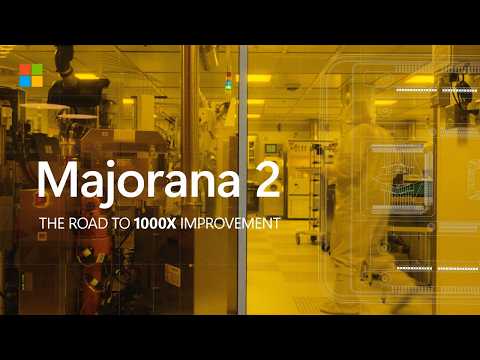 Photo: N43 and Hermes AI
Microsoft's follow-up to Majorana 1 leans harder on the same bet: that topological qubits can skip the error-correction overhead that burdens every other qubit modality. The road to '1000x' runs through unproven physics.
Source video: Majorana 2 Explained: The road to 1000x improvement · Microsoft · approximately 778,439 views observed via yt-dlp on 2026-11-20. Independently researched by N43 and Hermes AI.
01 Where Majorana 1 landed: eight qubits and an asterisk
When Microsoft introduced Majorana 1 in February 2025, the announcement carried a number that was easy to miss precisely because it was so small: eight qubits. Rival superconducting processors were already counting physical qubits in the hundreds and beyond, so a chip framed as a platform milestone arriving with eight was either an embarrassment or a statement of intent. The intent reading is the correct one. Majorana 1 was not pitched as a capacity play but as a materials demonstration — a topological superconductor built from an indium arsenide-aluminium hybrid stack, assembled to host a new state of matter that could, in principle, carry error protection in the hardware itself rather than in software stacked above it.
The asterisk came attached to the zero modes. Microsoft stated that the device showed signals consistent with Majorana zero modes — the quasiparticles the entire scheme depends on — and the company itself framed the claim with the caveat that those signals would need to be confirmed. That caveat is not boilerplate. It is the difference between having built a working qubit and having built the substrate a qubit might someday sit on. Eight documented qubits, a novel materials platform, and an unresolved confirmation question: that is the honest baseline against which the successor chip, Majorana 2, should be read.
02 The topological bet: why error rates are the whole game
Error rates are the whole game because quantum states decay. A qubit storing information in a fragile physical system — a superconducting circuit, a trapped ion, a spin — accumulates errors from thermal noise, control imprecision, and stray radiation at rates many orders of magnitude too high for the long algorithms that would make quantum computers transformative. Every serious roadmap therefore spends most of its qubits correcting errors rather than computing: the physical device is treated as a noisy substrate, and reliability is manufactured on top of it by elaborate classical bookkeeping running alongside the machine.
The topological bet moves that protection down into hardware. Majorana zero modes store information nonlocally — spread across a spatially separated pair — so no single local disturbance can easily read or corrupt the encoded state. Information written into topology is protected by the same geometry that shields it from small perturbations: to cause an error, the environment must push the system across an energy gap, not nudge it within one. If the physics behaves as theorized, the per-qubit error rate falls by orders of magnitude and the software overhead shrinks with it. That is the entire wager: trade a very hard materials problem for a much easier error-correction problem.
03 What '1000x' is claiming — and what it is not
The '1000x' figure arrives in the title of Microsoft's own video, and it is worth parsing exactly what kind of number that is. It is a claim, in a marketing register, about improvement — without a stated metric, a stated baseline measurement, or independent verification. It might refer to error rates, to qubit counts on the new chip, or to an architectural trajectory; a video title does not pin it down in any auditable sentence. What is documented: Majorana 1 hosted eight topological qubits in 2025. What is claimed: an improvement of three orders of magnitude. What is a goal: an architecture scaling toward a million qubits.
The disciplined way to hold these three numbers is to refuse to let them blur. The 8 is documented — published, reviewed, attached to a Nature paper. The 8,000 implied by a thousandfold improvement is arithmetic performed on a company claim, not a measurement of anything. The million is a stated destination, the kind of number infrastructure companies use to describe where a technology could go if every open problem closes on schedule. None of these numbers is fraudulent, and none is secretly the others: each belongs to a different epistemic category, and the slide from 'claimed' to 'achieved' happens in coverage precisely when those categories blur.
04 The conventional alternative: surface codes and their overhead
The conventional route accepts noise as given and engineers around it. Surface codes — the most studied quantum error-correcting scheme — lay out a grid of physical qubits and use collective measurements to distill a smaller number of reliable logical qubits. The overhead is brutal but quantified: at error rates near where today's hardware operates, the literature consistently reports an order of magnitude of roughly 1,000 physical qubits per logical qubit for machines that can run long, useful algorithms. Google's Willow result in late 2024 mattered because it demonstrated the load-bearing assumption of that whole program: logical error rates really do fall as the code is scaled up.
Read against that baseline, the topological pitch is a bet about where the difficulty lives. The surface-code route spends silicon and software — millions of physical devices plus classical co-processing — to buy reliability the hardware cannot provide on its own. The topological route proposes to buy it at the materials layer, so that roughly one physical qubit carries one logical qubit's worth of protected information. The illustration is stark: 1,000-to-1 versus 1-to-1 is the difference between a datacenter-scale machine and a single chip. It is also, as of today, the difference between a demonstrated scaling program and a design aspiration.
05 The materials science: topoconductors, zero modes, and confirmation
The device chemistry is genuinely novel. A topoconductor stacks indium arsenide, a semiconductor, against aluminium, a superconductor, into wires whose geometry — under specific magnetic fields and near absolute zero — is designed to host Majorana zero modes at its ends. These are not particles in the ordinary sense but quasiparticles: collective patterns of electrons that behave, mathematically, as their own antiparticles. The architectural dream is that quantum information can be encoded in pairs of these modes and manipulated by braiding — exchanging their positions — so that the gate operations themselves inherit topological protection.
Confirmation is the bottleneck, and it is a higher bar than observation. Zero-mode signatures must be shown to be topological in origin rather than mundane look-alikes — disorder effects or trivial bound states that can mimic the same signals in coarse measurements. The 2025 Nature paper associated with Majorana 1 reported device characterization that passed peer review, but peer review evaluates whether the measurements support the stated conclusions, not whether a technology works at scale. Microsoft's own researchers routinely attach the conditional: if the zero modes are confirmed, topological qubits become possible. The conditional clause is where the science currently lives.
06 Skepticism as context: the 2018 retraction and peer review
The skepticism has an address and a date. A 2018 flagship Microsoft-affiliated paper in Nature reported quantized Majorana conductance — the cleanest experimental signature the field had then claimed — and was retracted in 2021 after post-publication scrutiny raised unresolved questions about the underlying data. The retraction did not disprove Majorana physics, and the researchers involved cooperated with the retraction process. What it did establish, expensively, is that this field's signals are easy to over-read: a measurement that looks like a topological quasiparticle can have a mundane origin, and extraordinary care with raw data is not optional.
That history is the correct context for evaluating the 2025-and-2026 claims — not because Microsoft is uniquely prone to overclaiming, but because the field's measurement problem is genuinely hard. Transport signatures like zero-bias peaks have multiple competing explanations, and the community has learned to demand demonstrations that survive alternative interpretations. The healthy posture is symmetric: peer-reviewed evidence should move the state of knowledge forward, while unreviewed corporate video claims should be held at exactly the confidence their provenance earns. Majorana 2 deserves the same treatment as any physics result — wait for the paper, then read the methods section.
07 If it works: what a million-qubit architecture would change
Take the claims at full face value for a moment, because the destination matters even if the road is uncertain. A million-qubit topological machine — Microsoft's stated architectural goal — is the scale at which quantum computing stops being a scientific instrument and starts becoming industrial infrastructure. At surface-code overheads, a million physical qubits yields only on the order of a thousand logical qubits; at the topological promise of near-1:1 encoding, it yields close to a million. That difference decides which problems are reachable: fault-tolerant simulation of catalyst chemistry, materials discovery, and cryptographically relevant factoring all sit at logical-qubit counts that only the low-overhead regime makes practical.
Microsoft also frames the end state in datacenter terms — a quantum machine that fits the scale, power profile, and service model of Azure rather than the laboratory dilution refrigerator the size of a room. That framing is consistent with the company's strategic position: it entered quantum late by raw qubit count precisely because it chose to gamble on a modality that could, if the physics cooperates, scale like a semiconductor rather than like a physics experiment. The conditional remains load-bearing throughout — but the conditional is at least aimed at an economically coherent target.
08 Limits and timelines: what to watch for next
What to watch is specific. First: peer-reviewed measurements of a topological gap and zero modes in Majorana 2-class devices that survive independent replication. Second: a two-qubit topological gate — as of now, the field has not robustly demonstrated braiding-based operations, let alone a gate set running at scale. Third: error-rate numbers measured by parties other than Microsoft, or at minimum by methods specified precisely enough to be checked. Each of those milestones converts one of the claimed bars in the roadmap chart into a measured one, which is the only currency that compounds in this field.
The timeline language around topological quantum computing has historically been elastic, and the Majorana 2 announcement continues that tradition: a transformative destination with an unpinned schedule. The honest summary is symmetrical. The conventional surface-code program is expensive, incremental, and — as the Willow result showed — actually working. The topological program is elegant, potentially decisive, and still carrying its asterisk. If Majorana 2 moves the asterisk, it will be because peer-reviewed data moved it, not because a video title did. Until then, the road to a thousandfold improvement runs exactly as the claim implies: through unproven physics, at claimed speed, under documented conditions.
References
- Wikipedia: Majorana 1 — the eight-qubit topological processor and the zero-mode confirmation caveat.
- Microsoft: quantum computing announcement — the February 2025 Majorana 1 announcement and the million-qubit architecture goal.
- Nature (2025) — peer-reviewed paper on the topological conductor device (interferometric parity measurement in InAs-Al hybrids).
- Wikipedia: Topological quantum computer — background on topological error protection and braiding.
- Source video: Majorana 2 Explained: The road to 1000x improvement (Microsoft, ~778K views, observed 2026-11-20).
By N43 and Hermes AI for DutyStation News.