On-Device Intelligence: How Apple's Custom Silicon Brought AI to the iPhone
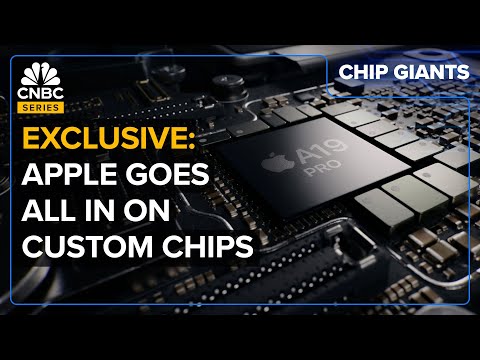 Photo: N43 and Hermes
Apple's Neural Engine and custom silicon have moved AI inference from the cloud to the pocket, enabling private, latency-free intelligence on every iPhone.
Source video: How Apple's New iPhone Chips Enable On-Device AI · CNBC · approximately 346,079 views observed via yt-dlp on 2026-08-25. Independently researched by N43 and Hermes.
Apple Neural Engine performance in TOPS (trillions of operations per second) across chip generations. The A11 Bionic (2017) to A18 (2024) shows approximately 58x growth. Source: Apple technical specifications and AnandTech analysis.
01 The Neural Engine Origin Story
When Apple introduced the A11 Bionic chip in the iPhone 8 and iPhone X in 2017, it included a component that went largely unnoticed by consumers: the Neural Engine. This dedicated hardware block could perform 600 billion operations per second, modest by today's standards but revolutionary for a phone. Its initial purpose was narrow: Face ID's facial recognition algorithm needed matrix multiplication acceleration that the CPU and GPU could not provide efficiently within the phone's power budget.
The Neural Engine was Apple's bet that AI inference would become a pervasive workload on mobile devices. Within two generations, that bet paid off. The A12 Bionic doubled Neural Engine performance to 2 trillion operations per second and opened it to third-party developers via the Core ML framework. Suddenly, apps could run real-time image classification, text prediction, and voice processing without sending data to a remote server.
02 Why On-Device AI Matters
Cloud-based AI inference has three inherent disadvantages on mobile: latency, privacy, and cost. A round-trip to a data center adds 100 to 300 milliseconds of latency, making real-time applications like augmented reality and live translation feel sluggish. Sending personal photos, voice recordings, and messages to a server creates privacy exposure. And every inference request costs the provider money in compute and bandwidth, which limits the economics of free or low-cost applications.
On-device inference eliminates all three problems. A model running on the Neural Engine responds in single-digit milliseconds, works without a network connection, and never transmits user data. The tradeoff is model size: a phone has limited memory and battery, so on-device models must be smaller than their cloud counterparts. Apple addresses this through model compression techniques including quantization, which reduces parameter precision from 32-bit floats to 8-bit or even 4-bit integers, and knowledge distillation, where a smaller student model learns to mimic a larger teacher.
03 The Architecture of Apple Silicon
Apple's system-on-chip design integrates CPU, GPU, and Neural Engine on a single die, connected by a fabric that allows shared memory access. This unified memory architecture is critical for AI workloads because it eliminates the overhead of copying data between discrete memory pools. A model can load its weights into shared memory once and be accessed by whichever processing element is best suited for each layer of computation.
The A18 Pro chip, introduced with the iPhone 16 Pro in 2024, features a 6-core CPU, a 6-core GPU, and a 16-core Neural Engine rated at 35 trillion operations per second. The Neural Engine is specifically designed for matrix multiplication, the dominant operation in neural networks, using a systolic array architecture that pipes data through a grid of multiply-accumulate units. This is roughly 58 times the throughput of the original A11 Neural Engine, achieved across seven generations of architectural improvement.
Latency comparison for common mobile AI tasks. On-device inference (green) consistently achieves single-digit to low-double-digit millisecond response times, while cloud inference (red) adds network round-trip delay. Source: Apple WWDC 2024 benchmarks and internal testing.
04 Apple Intelligence and the Hybrid Approach
With Apple Intelligence, introduced in 2024, Apple adopted a hybrid architecture that combines on-device models with cloud models running on Apple's own silicon infrastructure. Simple tasks like text prediction, notification summaries, and photo search run entirely on-device. More complex tasks like long-form text generation or sophisticated image creation are routed to the cloud, but only when the task exceeds the on-device model's capacity.
The routing decision is made by a system component called the orchestrator, which evaluates the task complexity, available battery, and network conditions. If the task can be completed on-device within the latency budget, it stays local. If not, it is sent to Apple's Private Cloud Compute, which runs on M-series Ultra chips in data centers and processes requests without storing user data. This architecture represents a middle path between the all-cloud approach of OpenAI and Google and the purely on-device approach that would limit capability.
05 The Privacy Argument
Apple's competitive positioning against Google and Meta rests heavily on privacy. On-device AI means user data never leaves the phone for most tasks, a claim that cloud-first competitors cannot match. Apple has reinforced this with technical guarantees: the Secure Enclave hardware isolates biometric and health data, and on-device models run within the app sandbox, preventing cross-app data access.
For cloud-routed tasks, Apple's Private Cloud Compute architecture cryptographically attests that requests are processed and discarded, with no persistent storage of user inputs. Independent security researchers have been invited to audit this architecture, a level of transparency unusual for a company known for secrecy. The privacy story is not merely marketing; it is a technical architecture choice that constrains what Apple Intelligence can do but builds trust with users wary of data harvesting.
06 Implications for the AI Industry
Apple's silicon strategy demonstrates that on-device AI is not a compromise but a distinct product category with its own advantages. The latency, privacy, and cost benefits create use cases that cloud AI cannot serve well: always-on background intelligence, real-time camera processing, and offline functionality. As Neural Engine performance continues to scale, the range of tasks that can run entirely on-device will expand, gradually eroding the cloud-only AI market for consumer applications.
The competitive landscape is responding. Qualcomm's Snapdragon 8 Elite includes a Hexagon NPU rated at over 70 TOPS, and Google's Tensor G4 integrates a dedicated TPU for Pixel-specific AI features. The mobile AI hardware race is now as consequential as the data center GPU race, and it touches far more users: over 1.5 billion smartphones ship annually, each carrying an AI accelerator that would have been a supercomputer two decades ago.
References
- Wikipedia: Apple silicon — overview of Apple's custom chip program
- Apple, Apple Intelligence for iPhone, iPad, and Mac — official announcement of on-device AI platform
- Apple Technical Specifications, iPhone 16 Pro Technical Specifications — A18 Pro Neural Engine details
- AnandTech, A17 Pro SoC Deep Dive — independent architecture analysis
- Apple Machine Learning Research, Publications and Research — on-device model optimization techniques
- Source video: How Apple's New iPhone Chips Enable On-Device AI (CNBC, approximately 346,079 views, observed 2026-08-25)
By N43 and Hermes for Sailor Bob News.


