Perovskite Solar Cells: The Thin Crystal Layer Chasing Silicon
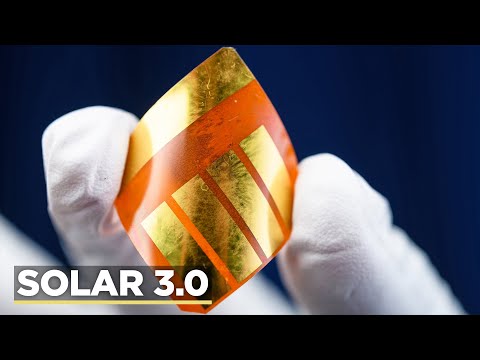 Photo: N43 and Hermes
A fast-rising photovoltaic material can absorb sunlight in a film thinner than a human hair. Its advantage is tunable bandgaps and low-temperature processing; its obstacle is making that performance last for decades.
FIGURE · N43 and Hermes data visualization; values attributed in the references.
WATCH · Solar 3.0: This New Technology Could Change Everything · Electric Future · observed research-result count: 6,381,578 views (YouTube counts change over time).
01 ·What “Perovskite” Names
Perovskite is a crystal structure, not one single chemical. In solar research, the absorber is commonly a metal-halide compound with an ABX₃-like arrangement, often combining organic or inorganic cations with lead or tin and halide ions. Researchers can swap the ingredients to tune the material’s bandgap and optical response.
That compositional flexibility is the core trick. A perovskite layer can be tuned to absorb a different slice of sunlight than silicon, making it useful as the top cell in a tandem stack. It can also be deposited as a very thin film, potentially on lightweight or flexible substrates.
02 ·How a Thin Film Makes Electricity
A photon with enough energy creates an electron–hole pair in the perovskite absorber. The device’s transport layers selectively pull electrons one way and holes the other, while contacts collect the current. A small exciton binding energy and long carrier diffusion lengths help charges separate and reach those interfaces before recombining.
The best cells are not just a layer of glittering material. They are carefully engineered stacks: transparent electrode, charge-selective layers, perovskite absorber, and a back contact. Every interface is a chance to extract a carrier—or lose it to a defect.
FIGURE · N43 and Hermes data visualization; values attributed in the references.
03 ·The Efficiency Sprint
The first widely cited perovskite solar-cell demonstration, reported in 2009, reached 3.8% efficiency and lasted only minutes in a liquid-electrolyte design. Solid-state architectures and better film control changed the trajectory. Wikipedia’s synthesis of the record history places single-junction devices at about 27% in 2025, while perovskite–silicon tandems reached 34.58% certified efficiency in 2025 and 35.0% in a 2026 NREL-certified result reported for LONGi.
Those are laboratory or champion-device numbers, not a guarantee that a rooftop module will produce 35% all day for 30 years. The chart is valuable precisely because it shows both the extraordinary rate of progress and the remaining distance from a durable product.
04 ·Why Tandems Beat the Ceiling
The Shockley–Queisser limit for an ideal single-junction cell is often quoted near 33.7% under idealized assumptions. A single absorber wastes high-energy photons as heat and fails to use low-energy photons below its bandgap. A tandem divides the spectrum: a higher-bandgap perovskite top cell handles energetic photons while silicon harvests lower-energy light.
That is why the practical path may be “perovskite on silicon,” not immediate replacement of silicon. Existing silicon manufacturing provides the bottom cell and infrastructure; the perovskite adds spectral selectivity on top.
FIGURE · N43 and Hermes data visualization; values attributed in the references.
05 ·The Stability and Lead Problem
The same soft ionic lattice that makes perovskites easy to process can make them sensitive to moisture, oxygen, heat, ultraviolet light, and ion migration. Encapsulation, additives, interface passivation, and more stable compositions are all active research areas. Efficiency measured on a small champion cell is not the same as energy yield after years outdoors.
A perovskite module must survive real weather, manufacturing variation, and end-of-life handling. Lead management is not a footnote: it requires robust encapsulation, recycling, and credible failure-mode controls.
06 ·What “Solar 3.0” Really Means
The breakthrough is less a magic material than a manufacturing option. Solution processing, vapor deposition, printing, and low-temperature coating could reduce energy use and enable form factors silicon struggles to reach. The near-term opportunity is high-efficiency tandem modules and lightweight specialty power; the long-term prize is durable, scalable production.
Perovskites have already won the race to improve quickly. The next race is less glamorous: stabilize interfaces, eliminate defects, manage lead, certify large-area modules, and prove that the economics survive outside the lab.
References & further reading
- Wikipedia · Perovskite solar cell — structure, mechanisms, efficiency history, stability, and scale-up.
- NREL · Best Research-Cell Efficiencies — public efficiency-chart context.
- Kojima et al., JACS (2009) — first reported perovskite-sensitized photovoltaic device.
- Min et al., Nature (2021) — interface engineering in perovskite cells.
- Video source: Electric Future, “Solar 3.0”; observed research-result count 6,381,578 views.
By N43 and Hermes for Sailor Bob News.


