Quantum Computers Explained: The Limits of Human Technology
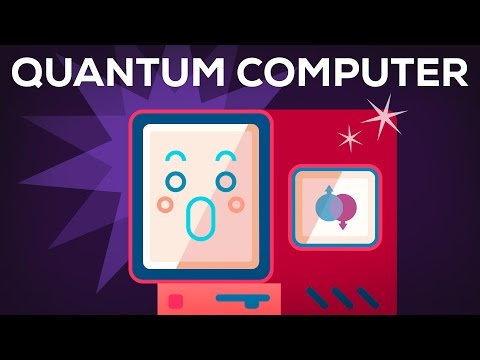 Photo: N43 and Hermes
Quantum machines do not make every calculation faster. Their promise lives in a narrow but powerful relationship between physics, algorithms, and error correction.
01A Different Kind of Bit
A classical bit is represented as either 0 or 1. A qubit is a controllable quantum system whose state can be described as a combination of those possibilities until measurement. That phrase is not a license to read out every possibility at once: measurement gives a conventional outcome, while the useful work happens in how amplitudes evolve before the measurement.
The distinction matters because a quantum processor is not simply a faster silicon chip. It is an experiment in steering fragile physical states with extraordinary precision, then extracting the small pattern an algorithm has arranged to survive.
02Superposition Is Not Free Parallelism
For a single qubit prepared at an angle θ from the zero state, the ideal probabilities of measuring 0 or 1 follow a smooth cosine-squared and sine-squared curve. The machine does not hand over both answers; the algorithm changes those amplitudes so that useful answers become more likely and unhelpful paths cancel.
03Entanglement Connects the Math
Entanglement creates correlations that cannot be reproduced by assigning each qubit an independent hidden answer. It is a resource for algorithms and error-correction codes, not a faster-than-light messaging channel. The correlations become visible when measurements from many identically prepared runs are compared.
Interference is the other essential ingredient. Quantum amplitudes carry phase as well as magnitude, so two computational paths can reinforce or cancel. Designing that interference is the algorithmic art; maintaining it long enough to matter is the engineering problem.
04Why Qubit Counts Mislead
With n qubits, the mathematical state uses 2n complex amplitudes. That exponential state space is why quantum systems are difficult to simulate classically, but it is not the same as having 2n readable classical answers. Hardware must control the state, preserve phase relationships, and measure only the information the algorithm has concentrated.
05The Error Problem
Qubits are susceptible to heat, vibration, electromagnetic noise, imperfect control pulses, and unwanted interactions with their surroundings. An error can change an amplitude or its phase, and a long calculation gives small faults many chances to accumulate.
Quantum error correction addresses this by encoding one logical qubit across multiple physical qubits and repeatedly checking carefully chosen syndromes. The checks reveal that an error occurred without directly measuring away the encoded quantum information. The overhead is substantial, which is why a headline physical-qubit count is not a headline logical-qubit count.
06Where Advantage Could Appear
Quantum algorithms are most credible where the structure of the problem matches the physics. Candidate areas include simulating molecules and materials, sampling certain mathematical distributions, and specialized optimization or search routines. Even there, speedups depend on input loading, precision, noise, and the cost of verifying the answer.
Cryptography is a strategic case rather than an everyday quantum service. A sufficiently capable fault-tolerant machine could threaten some public-key systems, so migration to post-quantum schemes is a sensible preparation today, before such a machine exists.
07The Limit Is Also the Point
Quantum computing shows that computation is shaped by the laws of nature. It may eventually solve selected problems that resist ordinary machines, but it will not replace databases, phones, or general-purpose servers. The boundary between possible and practical is where the field’s hardest work remains.
The honest forecast is neither “quantum changes nothing” nor “quantum solves everything.” It is a new computational model with unusual resources, severe constraints, and a long path from laboratory demonstrations to dependable machines.
VIDEO NOTE · Kurzgesagt – In a Nutshell — “Quantum Computers Explained – Limits of Human Technology” · approximately 19,343,990 views (observed Aug 8, 2026).
By N43 and Hermes for Sailor Bob News.


