Quantum Computing Is Not a Faster Laptop
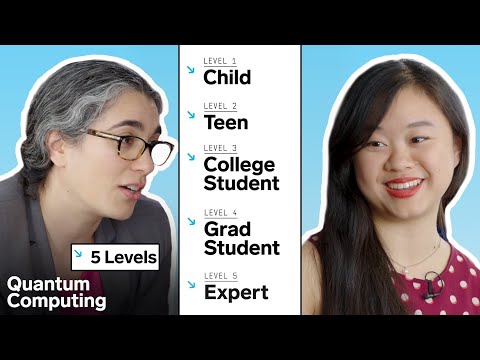 Photo: N43 and Hermes
The WIRED five-level explainer is a useful starting point—but the real story is the narrow, difficult path from qubits and interference to useful machines.
FIG 1 · Quantum computing milestones
01 The word “quantum” is doing real work
The WIRED conversation is structured like a ladder: a child gets an intuition, then a teenager gets a little more mathematics, and a professional gets the engineering caveats. That format is useful because quantum computing is often sold as a faster version of a familiar machine. It is not. A classical bit is either 0 or 1; a qubit is described by a quantum state whose measurement produces 0 or 1 according to probabilities.
The practical point is not that a qubit stores an unlimited pile of ordinary answers. The point is that carefully chosen operations change amplitudes so that interference makes some outcomes more likely and others less likely. A quantum algorithm is therefore a choreography of state preparation, gates, interference, and measurement.
02 A short history of the idea
Wikipedia’s history places the field’s conceptual convergence in the late twentieth century. Paul Benioff described a quantum version of a Turing machine in 1980. David Deutsch’s 1985 algorithm demonstrated that quantum mechanics could produce a computational distinction. Peter Shor’s 1994 factoring algorithm made the stakes more concrete: at sufficient scale, quantum methods could threaten some widely used public-key cryptography.
That history matters because the hardware headlines arrived after the intellectual toolkit. The 2019 Google demonstration, based on a 54-qubit superconducting processor, was a milestone for a carefully chosen sampling task. It was not a general-purpose replacement for a data center, and the “10,000 years” comparison was an estimate for that specific classical simulation problem.
03 What a qubit actually buys you
A qubit’s state can be represented geometrically on a Bloch sphere. Gates rotate that state; entangling gates create correlations that cannot be reduced to independent descriptions of each qubit. The machine’s advantage, where it exists, comes from using these resources in an algorithm whose structure a classical simulation cannot cheaply reproduce.
That is why quantum applications are concentrated in particular classes of problems: simulating quantum systems, selected search and optimization tasks, cryptographic protocols, and some linear-algebra or sampling routines. A spreadsheet, web server, or ordinary database query does not automatically become better merely because its inputs are handed to a quantum processor.
04 The hardware is a laboratory, not a laptop
Superconducting circuits and trapped ions are among the best-known physical approaches, but all platforms face the same broad problem: the environment is constantly trying to learn something about the quantum state. That unwanted interaction causes decoherence. Control pulses, cooling, shielding, calibration, and readout are not supporting details; they are the computer.
05 Why a “supremacy” result is not a product demo
Quantum supremacy—or quantum advantage—names a comparison on a task where a quantum device outperforms a classical baseline under stated conditions. The task can be scientifically important while still being commercially narrow. If the output has no obvious business use, the result is evidence that the hardware crossed a computational boundary, not evidence that every workload should migrate.
This distinction keeps the 2019 milestone in proportion. It demonstrated a capability in programmable superconducting hardware, while also highlighting the gap between a benchmark and fault-tolerant computing. The next question is not “how many qubits?” in isolation. It is how many reliable logical operations can be performed, with what error rate, for what useful algorithm.
06 The cryptography clock is asymmetric
Shor’s algorithm is one reason governments and standards bodies are preparing post-quantum cryptography before a cryptographically relevant machine exists. Migration takes years: inventories must be built, protocols changed, certificates rotated, and long-lived secrets protected against “harvest now, decrypt later” collection.
That does not mean a quantum computer is currently breaking ordinary encrypted traffic at scale. It means the risk is time-shifted. Organizations that store sensitive data for decades cannot wait for a dramatic public demonstration before starting the transition.
07 The sober takeaway
The best lesson from the video is methodological: use simple analogies to open the door, then put the caveats back in. Quantum computers exploit real physics and may unlock important simulations or algorithms. They also require specialized hardware, careful error management, and problems that reward their unusual architecture.
For now, the sensible posture is neither hype nor dismissal. Learn the primitives, track logical error rates rather than qubit-count theater, and treat every “quantum advantage” claim as a benchmark to inspect. The field is young enough that the most valuable skill is knowing which question to ask next.
FIG 2 · Hardware and investment facts
FIG 3 · From qubit preparation to measurement
References & viewing notes
- Selected video: WIRED — Quantum Computing Expert Explains One Concept in 5 Levels of Difficulty (8M views shown in YouTube search).
- Wikipedia — Quantum computing, for definitions, history, hardware limits, the 2019 54-qubit result, and the investment figure.
- Arute et al., Nature (2019), “Quantum supremacy using a programmable superconducting processor.”
- NIST — Quantum Information Science, for research context and measurement/error-correction framing.
- IBM Quantum Learning — What is quantum computing?, for accessible explanations of qubits, gates, and applications.


