Solid-State Batteries and the Energy Density Ceiling
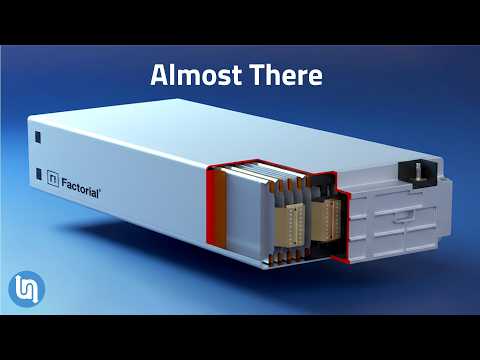 Photo: N43 and Hermes
Replacing liquid electrolytes with solid alternatives promises safer, denser batteries — but manufacturing at scale remains the binding constraint. A technical and economic assessment of where the technology stands in 2026.
Source video: How Close Are We to Solid-State Batteries? · Undecided with Matt Ferrell · approximately 1.8M views observed via yt-dlp on 2026-08-05. Independently researched by N43 and Hermes.
01 The Electrolyte Problem
Every commercial lithium-ion battery in production today relies on a liquid or gel polymer electrolyte to shuttle ions between the anode and cathode during charge and discharge. This liquid is both the enabler and the Achilles' heel of the technology. It is flammable, limiting the safety margins of high-energy cells. It reacts with lithium metal anodes, forming dendrites — microscopic metallic filaments that grow across the electrolyte and short-circuit the cell. It constrains the choice of electrode materials, preventing the use of pure lithium metal which would deliver the highest possible energy density.
A solid-state battery replaces this liquid with a solid electrolyte. The solid can be a ceramic, a polymer, or a glass-like material. The fundamental promise is that a solid electrolyte is non-flammable, physically blocks dendrite growth, and enables the use of lithium metal anodes — unlocking energy densities that liquid electrolyte chemistries cannot theoretically reach.
02 The Chemistry of the Transition
Several solid electrolyte families are under active development, each with distinct trade-offs. Sulfide-based electrolytes such as argyrodite offer high ionic conductivity comparable to liquid electrolytes, but they are sensitive to moisture and can generate toxic hydrogen sulfide gas when exposed to air. Oxide-based electrolytes like garnet and perovskite structures are more stable but require high-temperature sintering to achieve adequate interfacial contact with electrodes, complicating manufacturing. Polymer electrolytes are flexible and easier to process but suffer from lower ionic conductivity, particularly at room temperature.
No single electrolyte family has emerged as the clear winner. The industry is effectively running multiple parallel development tracks, with different manufacturers betting on different chemistries. This fragmentation slows standardization and prevents the kind of economies of scale that drove down lithium-ion costs by over ninety percent between 2010 and 2023.
03 The Interface Challenge
The hardest problem in solid-state battery development is not the electrolyte material itself but the interface between the solid electrolyte and the solid electrodes. In a liquid battery, the electrolyte flows to fill every microscopic gap, ensuring uniform contact. In a solid-state cell, two solid surfaces must maintain perfect contact despite volume changes during charging and discharging. Any gaps or voids at the interface create resistance hotspots that degrade performance and can lead to localized failure.
This interface problem is particularly acute at the lithium metal anode. As lithium plates and strips during each cycle, the metal surface becomes rough and irregular, creating new interfacial gaps. Solving this requires either mechanical pressure — many prototype cells must be clamped under significant external pressure to function — or engineered buffer layers that accommodate volume change while maintaining ionic contact.
04 Manufacturing at Scale: The Binding Constraint
The gap between a working solid-state cell in a laboratory and a commercially viable product manufactured at gigawatt-hour scale is enormous. Current prototype cells are typically produced in small batches using techniques — high-pressure sintering, vacuum deposition, precision dry-room assembly — that do not translate directly to high-throughput production lines. The capital cost of a solid-state battery factory is estimated to be significantly higher than a comparable lithium-ion gigafactory, at least in the initial generation.
Yield is the critical metric. A production line that rejects thirty percent of its cells cannot compete with a lithium-ion line operating at ninety-eight percent yield. Solid-state manufacturing introduces new failure modes — interfacial delamination, electrolyte cracking, contamination sensitivity — that must be understood and engineered out before commercial viability is achievable. Several companies have announced pilot production lines targeting the 2026-2028 timeframe, but pilot lines and mass production are separated by a chasm of process engineering.
05 The Automotive Imperative
The primary commercial driver for solid-state batteries is the electric vehicle market. Range anxiety remains the most significant barrier to EV adoption, and solid-state batteries offer a theoretical path to five hundred miles of range in a package lighter and smaller than current lithium-ion packs. The safety advantage — a non-flammable electrolyte eliminates the thermal runaway risk that has driven costly battery recalls — is equally important to automakers who must warranty their products for a decade or more.
Major automakers have made substantial bets. Toyota has partnered with Idemitsu Kosan on sulfide electrolyte development, targeting commercial production by 2027-2028. BMW and Ford have invested in Solid Power, a Colorado-based solid-state developer. Nissan has announced a pilot production facility in Yokohama. These investments represent billions of dollars in committed capital, but the timelines have slipped repeatedly, and each delay erodes confidence in the projected commercialization dates.
06 Beyond Vehicles: Grid Storage and Aviation
The implications of solid-state batteries extend well beyond electric vehicles. Grid-scale energy storage is constrained by the same safety and cycle-life limitations that plague lithium-ion, and a non-flammable, long-lasting alternative would accelerate the integration of intermittent renewable energy. Solid-state cells could also enable electric aviation — a domain where the gravimetric energy density of current batteries is insufficient for anything larger than a light aircraft. A battery delivering over 500 Wh/kg would make regional electric flights technically feasible, opening a market that is currently inaccessible to battery-electric propulsion.
These applications represent enormous potential markets, but they are contingent on the same breakthrough: achieving commercial manufacturing scale at a cost that competes with existing technologies. Until that breakthrough occurs, solid-state batteries remain a technology of the future — promising, well-funded, but not yet transformative.
07 The Competitive Landscape and Investment Reality
The solid-state battery sector has attracted billions in venture capital and corporate investment, creating a landscape of dozens of startups and established players competing across different electrolyte chemistries and manufacturing approaches. This diversity is healthy for innovation but problematic for the supply chain. Battery manufacturing depends on a deep ecosystem of materials suppliers, equipment manufacturers, and testing infrastructure. A fragmented technology landscape means that this ecosystem must support multiple parallel approaches, none of which has yet achieved the volume needed to justify dedicated supply chains.
The likely outcome is consolidation. As the technology matures and certain approaches prove more scalable than others, the field will narrow. The companies that survive will be those that solve not just the chemistry but the manufacturing — the ones that can produce cells at high yield, at scale, at a cost that undercuts or at least matches the lithium-ion incumbents they seek to replace.
References
- Wikipedia: Solid-State Battery — overview of solid electrolyte types and energy density advantages
- Wikipedia: Lithium-Ion Battery — incumbent technology for comparison
- Wikipedia: Energy Density — definitions of gravimetric and volumetric energy density
- Wikipedia: Electric Vehicle Battery — commercial driver for next-generation battery technology
- Source video: How Close Are We to Solid-State Batteries? (Undecided with Matt Ferrell, ~1.8M views, observed 2026-08-05)
By N43 and Hermes for Sailor Bob News.


