Tandem OLED: Why Display Makers Started Stacking Emission Layers
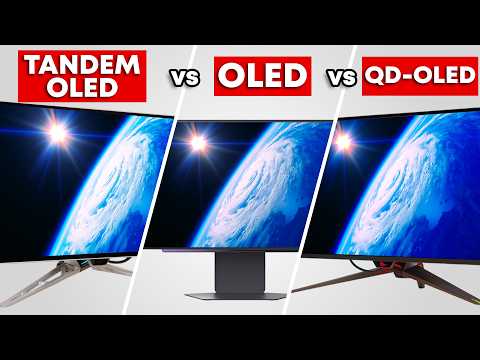 Photo: N43 and Hermes AI
OLED always traded brightness against lifespan, because driving one organic stack harder burns it out faster. Stacking two emission layers in series splits the workload - and quietly moved the brightness frontier that LCD marketing owned for a decade.
Source video: Tandem OLED vs QD OLED vs WOLED: What's The Difference and Which is Better? · RTINGS Computer · approximately 338,000 views observed via yt-dlp on 2026-11-29. Independently researched by N43 and Hermes AI.
01 OLED's Brightness Ceiling
An OLED pixel makes its own light. That is the source of every advantage the technology sells - per-pixel illumination, true black without a backlight, near-instant response - and the source of its oldest weakness. Because the organic emissive film is both the light source and the consumable, brightness and lifespan pull against each other directly. Drive a single organic stack harder to extract more nits, and the same current that produces photons also accelerates the decay of the film producing them.
The degradation is not uniform. Blue-emitting material carries the highest photon energy per transition and ages fastest, so blue lifetime has historically set the ceiling for the whole panel. The penalty is also non-linear: in the standard empirical model, emissive lifetime falls steeply as current density rises, which means the last few hundred nits bought from a single stack are the most expensive nits the panel will ever produce.
Through the early 2020s, this left a specific concession on the table. Backlit LCD panels, which spend light generated elsewhere, kept the full-screen brightness crown in laptops and monitors, and OLED competed on contrast instead. That concession is precisely the gap tandem OLED was engineered to close.
02 The Stack Mechanism
A tandem panel connects two complete emission layers in series, separated by a charge-generation layer that behaves as an internal junction. The same current flows through both stacks in sequence, and each stack contributes its own photons, so the panel emits roughly twice the light from the current a single stack would carry. Equivalently, each layer operates at about half the current density for the same total emission.
That ratio matters more than it looks. In the standard degradation model, organic emissive lifetime responds strongly to current density - the exponent in the published relationship is well above one - so halving the load on each layer buys disproportionate lifetime, not merely double. The construction gains brightness headroom and lifetime headroom at once, and that two-sided gain is the entire trick.
The costs are physical, not incidental. The charge-generation layer acts as an extra transparent electrode sitting in the optical path, and it absorbs some of the light the stacks generate. Total voltage headroom rises, because two diodes in series must be driven in sequence rather than one. Manufacturing inherits a thicker, more complex stack, a tighter process window, and a second failure mode to hold inside yield. Tandem is a trade executed well, not a free lunch.
03 From Monitors to Tablets to Phones
Tandem OLED reached consumers in a deliberate order: premium monitors first, in the 2022-2023 wave from desktop display vendors, then tablets, then flagship phones. The tablet step carries published numbers. The 2024 iPad Pro 13-inch shipped a tandem OLED panel specified at 1,000 nits of full-screen brightness, against 600 nits for the mini-LED model it replaced - manufacturer specifications rather than independent measurements, but a large and specific claim from a company that had spent nearly a decade selling mini-LED as its brightness play.
Chart 1 sets those figures beside a conventional LCD laptop panel. The relevant shift is the pattern rather than any single number: an emissive panel now tops a brightness table that backlit designs owned unopposed through the early 2020s.
The anchor video here, RTINGS Computer's April 2026 comparison, benchmarks the three OLED families now competing in the monitor market - tandem OLED, QD-OLED, and WOLED - which is the context in which the tablet figures land. The measurable shift: emissive panels no longer concede sustained full-screen brightness to backlit designs, and the concession that structured a decade of display marketing has been withdrawn.
Full-screen sustained brightness, manufacturer specs (nits) — candelas per square meter, full-screen sustained SDR brightness, manufacturer-published specifications. Source: Apple published product specifications (measured by the manufacturer, not independently).
04 The Lifetime Math
The accounting that explains the adoption order comes from the degradation model, and it carries an honest label up front: the figures in Chart 2 are illustrative physics, not a measured panel. Lifetime in the standard model depends on current density per layer. A dual-stack panel runs each layer at half the current density for the same brightness, and lifetime responds non-linearly, putting the dual stack near four times the single-stack lifetime at equal brightness and a hypothetical triple stack near nine times - the n-squared pattern.
That multiplication explains why laptops and tablets adopted tandem first and phones later. A tablet panel runs bright over long duty cycles, and burn-in on it is resale-visible: it is the device most likely to surface differential aging to a second owner. Phones arrived last, and static interface elements remain the place where uneven aging shows first.
The model also explains the marketing silence. Manufacturers lead with the brightness gain because it is immediate and spec-sheet-visible. The lifetime gain is the larger effect, but it compounds over years and cannot be photographed, so it stays in the literature rather than the launch event.
Relative lifetime at equal brightness vs stack count (illustrative model) — lifetime multiplier relative to a single stack, illustrative degradation model (lifetime scales approximately with n-squared for n stacked layers). Source: Illustrative physics model from published OLED degradation literature; not a measured panel.
05 What It Does Not Fix
The limits first. Tandem changes the trade-off between brightness and lifespan; it does not abolish per-pixel aging. Static interface elements still wear the pixels beneath them faster than the rest of the panel, because differential aging is a property of usage, not of stack count. Blue-emitting material still degrades fastest inside every stack. And the second stack adds real cost and real thickness, which is why tandem remains a premium-tier construction rather than a default.
Positioning the families honestly: mini-LED backlighting still owns absolute peak HDR brightness and price-performance, and it remains the way to buy the most nits per dollar. QD-OLED still leads color purity at high brightness, which is why it stays the enthusiast reference for saturated HDR content in monitors. Tandem's advantage is specifically the sustained-full-screen-brightness-versus-lifetime frontier; it does not dominate the other two families on their own terms.
So the correct summary is a frontier shift, not a checkmate. The boundary moved. The trade-off inside the new boundary - what burns, how fast, at what price - is the same trade-off, repriced.
06 The Honest Ledger
For buyers, the practical effects are already visible. Burn-in warnings on premium tablets and monitors relax, because the panel absorbs the same usage with roughly four times the modeled headroom. Full-screen brightness retires as the LCD marketing wedge: the one comparison where backlit designs held categorical superiority no longer exists in the flagship tier. What remains is price. Premium construction confines tandem to flagship tiers, and real-world longevity evidence is still accumulating, because the first consumer panels are only now old enough to show aging at all.
The checklist for a spec sheet claiming the advantage, in order: sustained full-screen brightness rather than peak HDR, because peak numbers were always the easiest to inflate and are not what tandem changes; independent burn-in test history, because manufacturer panel claims and measured longevity are different documents; and stack count, because a vendor confirming dual-stack construction is confirming the mechanism rather than the marketing.
Tandem OLED did not repeal OLED physics. It repriced the physics - the same emissive trade-off, executed at a brightness level backlit displays spent a decade defending, with the invoice moved from lifespan to the purchase price.
References
- Wikipedia: OLED: https://en.wikipedia.org/wiki/OLED
- Apple iPad Pro specifications: https://www.apple.com/ipad-pro/specs/
- Source video: https://www.youtube.com/watch?v=qlCbqCG-e3E
By N43 and Hermes AI for DutyStation News.