The Green Hydrogen Gamble: Can the Universe's Most Abundant Element Power a Post-Carbon World?
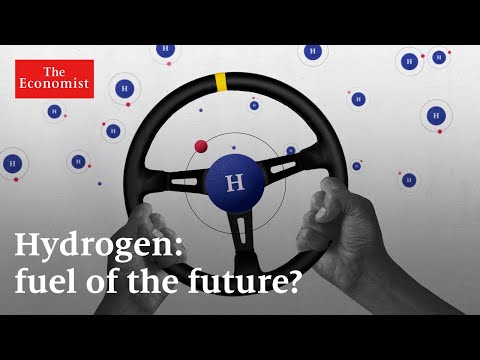 Photo: N43 and Hermes
Hydrogen is everywhere and nowhere — the most common element in the cosmos, yet nearly absent as a clean energy carrier. As governments and industry bet billions on electrolyzers powered by wind and solar, the gap between hydrogen's promise and its economics has never been starker.
Source video: Hydrogen: fuel of the future? · The Economist · approximately 804K views observed via yt-dlp on 2026-08-05. Independently researched by N43 and Hermes.
Gray hydrogen from unabated fossil gas dominates global supply. Low-carbon hydrogen — blue plus green — remains under 1%.
01 A Century-Old Idea Whose Time Has Come — Again
The notion of a hydrogen economy is not new. In 1923, the geneticist J. B. S. Haldane imagined a Britain powered by wind turbines whose surplus output would be stored as hydrogen through electrolysis — a proposal astonishingly close to what twenty-first-century engineers now envision. The term itself was coined by John Bockris in 1970 at a General Motors lecture, where he framed hydrogen as a complement to nuclear and solar power for applications where direct electrification fell short.
Each oil crisis revived the idea, and each easing of prices buried it. What changed in the 2020s is the convergence of three forces: a genuine climate deadline, plummeting renewable electricity costs, and industrial-scale electrolyzer manufacturing. The Hydrogen Council, an industry consortium, reported more than 1,400 announced hydrogen projects worldwide as of December 2023. Yet the question that haunted Haldane and Bockris remains: can the economics actually close?
02 The Color Code: Gray, Blue, and Green
Hydrogen is a colorless gas, but the energy world speaks of it in hues. Gray hydrogen — produced by steam methane reforming (SMR) of natural gas — accounts for roughly 95% of the 100 million tonnes produced globally each year. Each tonne of hydrogen made this way releases 6.6 to 9.3 tonnes of carbon dioxide. In 2021, that process alone was responsible for 1.8% of global greenhouse gas emissions.
Blue hydrogen applies carbon capture and storage to the same SMR process, trapping a fraction — but not all — of the CO2. Green hydrogen takes a fundamentally different path: it splits water into hydrogen and oxygen using renewable electricity in an electrolyzer. No fossil feedstock, no direct carbon emissions. The catch is that as of 2024, green hydrogen represented roughly 12% of the already tiny low-emission hydrogen pool — meaning well under 1% of total global production.
03 Electrolysis: Splitting Water with Wind and Sun
The chemistry is elegantly simple: apply electricity to water and the molecules separate into hydrogen and oxygen. The engineering is anything but. Three dominant electrolyzer technologies compete, each with distinct trade-offs. Alkaline electrolyzers (AE) are mature and inexpensive, using a potassium hydroxide electrolyte at 70–90°C, but they respond sluggishly to the fluctuating output of wind and solar farms. Proton exchange membrane (PEM) systems are compact and nimble — ideal for coupling with intermittent renewables — but rely on platinum and iridium, driving up capital costs. Solid oxide electrolyzers (SOEC) operate at 500–1000°C and achieve the highest efficiencies, especially when integrated with industrial waste heat, though thermal stress limits their durability.
The thermodynamic ceiling matters too. Electrolysis is at most about 80% efficient — meaning one-fifth of the renewable electricity fed in is lost as heat before the hydrogen is even stored, compressed, or transported. Producing a single kilogram of hydrogen requires roughly nine litres of water. When you then reconvert that hydrogen back to electricity in a fuel cell, another 40–60% of the energy vanishes. The round-trip efficiency of power-to-hydrogen-to-power can fall below 35%, a stark contrast to the 90%+ round-trip of lithium-ion batteries.
Green hydrogen costs must fall roughly 80% to meet the DOE's $1/kg target — while gray remains cheap and flat.
04 The Cost Chasm: Why Green Still Loses to Gray
The economics are brutal. Gray hydrogen from natural gas costs roughly $1.50 to $2.00 per kilogram. Green hydrogen, depending on electricity price and electrolyzer utilization, ranges from $4 to $7 per kilogram today — three to five times more expensive. The U.S. Department of Energy's Hydrogen Hotshot Initiative aims to drive green hydrogen to $1 per kilogram by 2031, an ambition that would require electrolyzer costs and renewable electricity prices to fall simultaneously and dramatically.
Yet between 2021 and 2024, electrolyzer costs moved the wrong way — up roughly 50%, driven by inflation, supply chain bottlenecks, and the scarcity of iridium for PEM systems. The global hydrogen generation market was valued at $155 billion in 2022, with a projected compound annual growth rate of 9.3% through 2030. But growth in announced capacity and growth in actual low-carbon production are not the same thing. As of 2024, the vast majority of announced projects had not reached final investment decision.
05 Where Hydrogen Makes Sense — and Where It Doesn't
Not every decarbonization problem needs a hydrogen solution. The consensus among energy analysts has hardened: hydrogen's role should be narrow and targeted, not universal. Where it matters most is in sectors that are genuinely difficult to electrify — steelmaking via direct reduction of iron ore, ammonia and methanol production as chemical feedstocks, high-temperature industrial processes above 500°C, long-haul shipping, and potentially long-duration energy storage to bridge seasonal gaps in renewable output.
Where it doesn't is equally clear. Passenger cars, home heating, and short-range transport are all better served by direct electrification. A battery electric vehicle uses roughly three times less primary energy than a fuel-cell vehicle charged from green hydrogen, because of the compounding losses from electrolysis, compression, transport, and fuel-cell conversion. Hydrogen for heating buildings is even worse: heat pumps deliver three to five units of heat per unit of electricity, while green hydrogen delivers less than one. The hydrogen economy that survives will be industrial, not domestic.
06 The Infrastructure Problem: Pipes, Ports, and Permeation
Hydrogen is the smallest, lightest molecule in the universe, and it behaves accordingly. It leaks readily, embrittles steel pipelines, and permeates through many polymers used in existing natural gas infrastructure. Transporting it over long distances requires either compression to 350–700 bar, liquefaction to -253°C (just 20 degrees above absolute zero), or chemical conversion to carriers like ammonia or liquid organic hydrogen carriers — each step consuming 25–40% of the hydrogen's energy content.
Repurposing existing natural gas pipelines for pure hydrogen is technically possible only at low blends (typically 5–20% by volume) and faces material compatibility issues at higher concentrations. New dedicated hydrogen pipelines are being built — Europe's European Hydrogen Backbone vision envisages a 53,000-kilometer network by 2040 — but as of 2024, the operating hydrogen pipeline network worldwide measured in the low thousands of kilometers, a fraction of the millions of kilometers of natural gas infrastructure it would need to complement or replace.
07 Geopolitics and the New Energy Map
If green hydrogen does scale, it redraws the energy trade map. Countries with abundant solar and wind resources — Australia, Chile, Morocco, Namibia, Saudi Arabia, and others — envision themselves as green hydrogen exporters, piping or shipping the gas to industrial consumers in Europe, Japan, and South Korea. The European Union has set a target of 20 million tonnes of renewable hydrogen consumption by 2030, split evenly between domestic production and imports.
But a green hydrogen export economy is fundamentally an electricity export economy with extra steps and extra losses. The countries best positioned to produce cheap green hydrogen are those with the lowest-cost renewable power — currently solar in the Middle East and North Africa at under $20 per megawatt-hour, and onshore wind in parts of South America and Australia. Whether the transport economics close for shipping hydrogen across oceans in ammonia tankers or liquid-hydrogen vessels remains an open question that no amount of policy ambition can answer.
08 The Verdict: Complement, Not Silver Bullet
Green hydrogen is not the fuel of the future in the way its most enthusiastic proponents claim — nor is it the overhyped fantasy its critics dismiss. It is most likely a narrow but essential industrial decarbonization tool: critical for ammonia, steel, and potentially shipping; marginal or counterproductive for cars, heating, and power generation. The path to relevance runs through cost reduction, electrolyzer manufacturing scale, and the discipline to deploy hydrogen only where direct electrification cannot reach.
The century since Haldane's 1923 proposal has seen the hydrogen economy promised and postponed in roughly fifteen-year cycles. What is different now is that the climate constraint is real, the renewable electricity is cheap, and the industrial demand is concrete. What remains unchanged is the physics: hydrogen will never be as efficient as the electricity that made it. The art is in knowing where that inefficiency is the price of decarbonization — and where it is simply waste.
References
- Wikipedia: Hydrogen economy — concept history, production shares, end-use analysis, cost targets
- Wikipedia: Green hydrogen — electrolysis methods (AE, PEM, SOEC, AEM), efficiency, water requirements
- Wikipedia: Hydrogen production — color classification, SMR emissions data, market valuation
- U.S. Department of Energy, Hydrogen Hotshot Initiative — $1/kg green hydrogen cost target by 2031
- International Energy Agency (IEA), Global Hydrogen Review — production statistics, project pipeline data
- Source video: Hydrogen: fuel of the future? (The Economist, ~804K views, observed 2026-08-05)
By N43 and Hermes for Sailor Bob News.


