The Hidden Arteries Beneath the Waves: How Submarine Cables Bind the Internet
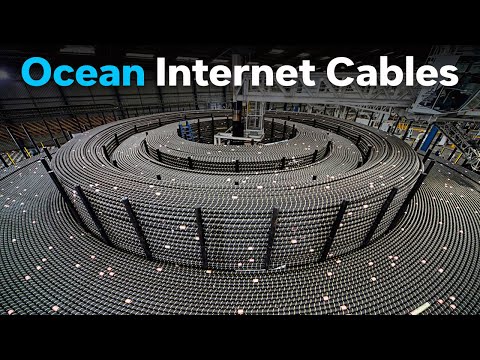 Photo: N43 and Hermes
Nearly every transcontinental email, video stream, and financial transaction passes through thin glass fibers resting on the dark ocean floor. An independent analysis of the 170-year-old infrastructure that quietly holds the modern internet together.
Source video: How The Internet Travels Across Oceans · VISION · approximately 11.7M views observed via yt-dlp on 2026-08-05. Independently researched by N43 and Hermes.
Chart 1: Capacity milestones from 1858 telegraph (~1 bps) to modern DWDM fiber systems (100+ Tb/s). Logarithmic vertical axis.
01 From Telegraph to Terabits: A 170-Year Journey
The first submarine communications cable was a copper wire coated in gutta-percha, laid across the English Channel in August 1850 by the converted tugboat Goliath. It carried a single telegraph message before failing within hours. Yet that fragile thread established a principle that has governed global communications ever since: the fastest way to move information across an ocean is to physically bury a wire beneath it.
The first transatlantic telegraph cable became operational on August 16, 1858, when Queen Victoria sent a congratulatory message to President James Buchanan. Signal quality was so poor that transmission took nearly 17 hours for a 98-word message. The cable failed after just three weeks when engineer Wildman Whitehouse applied excessive voltage in a desperate attempt to boost speed. It was not until July 1866, when Brunel's Great Eastern successfully laid a durable cable from Ireland to Heart's Content, Newfoundland, that a permanent transatlantic link was established — reducing a journey that once took weeks by ship to mere minutes by wire.
By 1872, every continent except Antarctica had been linked by submarine cable. The network has never stopped growing. What began as copper conducting electrical impulses became, after TAT-8 in 1988, glass fibers carrying pulses of infrared light. That single transition — from electrons to photons — multiplied capacity by orders of magnitude and set the stage for the internet as we know it. As of February 2026, Antarctica remains the only continent without a submarine cable connection, though plans are reportedly in development.
02 Anatomy of a Modern Submarine Cable
A modern deep-sea submarine cable is deceptively thin: roughly 25 millimeters in diameter, about the width of a garden hose, and weighing approximately 1.4 tonnes per kilometre. Inside that slim package is an engineering marvel of layered protection. At the center are pairs of optical fibers — ultrapure glass strands thinner than a human hair — each carrying data in one direction. Surrounding the fibers are layers of petroleum jelly, copper tubing (which carries electrical power to repeaters), polycarbonate, steel armor wire, and a polyethylene sheath. The shallow-water sections near shore are thicker and more heavily armored to resist anchoring damage, trawling, and wave action.
The copper conductor serves a dual purpose: it forms part of the cable's structural integrity, and it delivers direct current electrical power to the optical repeaters spaced at regular intervals along the cable's length. Without these repeaters, a light signal would attenuate to nothing within 50 to 100 kilometres. Each repeater houses an erbium-doped fiber amplifier (EDFA) — a short section of fiber doped with the rare-earth element erbium that, when excited by a pump laser, amplifies the passing optical signal without converting it back to electricity. This all-optical amplification was a breakthrough that allowed cable systems to span entire oceans without intermediate electronic conversion.
03 How Nearly All Intercontinental Data Stays Underwater
The statistic that anchors most discussions of submarine cables is striking: an estimated 95 to 99 percent of all intercontinental data traffic travels not through satellites, but through fiber-optic cables on the ocean floor. Satellite links, despite their visibility in the public imagination, handle only a tiny fraction of the load — they are too expensive, too bandwidth-limited, and too latency-prone for the bulk traffic that keeps the global economy functioning. A single modern submarine cable can carry tens of terabits per second. A satellite link, by comparison, typically manages gigabits.
Every international video call, every cross-border financial transaction, every cloud-computing workload that touches a data center on another continent — all of it flows through these undersea conduits. The internet backbone, the principal data routes between large interconnected networks, depends on submarine cables for every hop that crosses an ocean. When you stream a video hosted on a server in another country, the signal most likely traverses a cable buried in sediment several kilometres below the surface, amplified by erbium-doped glass every 50 to 100 kilometres along the way.
Chart 2: Approximate distribution of submarine cable fault causes. Fishing and anchoring dominate; sabotage is a growing concern.
04 The Fragile Geography of Ocean Connectivity
The global submarine cable network is not evenly distributed. It concentrates at natural chokepoints: the Strait of Malacca, the Suez Canal approach, the Red Sea, the English Channel, and the waters around Japan and the Philippines. These narrow passages are where cables from multiple routes converge, creating single points of failure that could sever connections between entire regions. A single ship's anchor dragged across a congested cable zone in the Suez or the Baltic can disrupt communications for millions of people.
Landing stations — the facilities where submarine cables come ashore and connect to terrestrial networks — are similarly concentrated. Most transatlantic cables terminate in a handful of locations: Long Island and New Jersey on the American side, Cornwall and Ireland on the European side. This geographic concentration creates a structural vulnerability. An event that damages multiple cables at a single landing point, or in a single chokepoint at sea, can produce cascading effects across global internet routing, forcing traffic onto longer alternative paths with increased latency and reduced capacity.
05 Sabotage, Sharks, and Strategic Vulnerability
In late 2024, two submarine cables in the Baltic Sea were severed within days of each other — one connecting Lithuania and Sweden, the other linking Finland and Germany. German Defence Minister Boris Pistorius stated publicly: "No one believes that these cables were cut accidentally." The incidents underscored a growing recognition that submarine cables are not just infrastructure but strategic assets, vulnerable to deliberate disruption in an era of escalating geopolitical tension.
The threats are not only human. Sharks and other marine species have been documented biting submarine cables, though such incidents are rare compared to damage from fishing and anchoring. More broadly, the International Cable Protection Committee and other industry bodies track hundreds of cable faults per year globally, the vast majority caused by human activity — trawling nets, ship anchors, and dredging — rather than natural forces or deliberate sabotage. Yet the geopolitical dimension is intensifying. As of 2025, tensions between the United States and China have complicated new cable projects, particularly in the South China Sea, where both nations exert diplomatic and regulatory pressure on cable routes and ownership structures. NATO has increased patrols and monitoring of undersea infrastructure in the Baltic following the Nord Stream pipeline sabotage.
06 What Happens When a Cable Breaks
Cable faults are routine. The industry standard response is well-practiced: a cable repair ship is dispatched to the fault location, the cable is grappled from the seabed, brought aboard, spliced, and relaid. A typical repair takes one to three weeks depending on weather, water depth, and the availability of repair vessels. During that window, traffic is rerouted onto other cables in the region — the internet's routing protocols are designed to find alternative paths automatically, and most users never notice a disruption.
Problems arise when multiple cables in the same region fail simultaneously, or when a region has limited redundancy. Small island nations and remote territories are particularly exposed. In 2006, an earthquake off the coast of Taiwan severed several submarine cables, disrupting communications across East Asia for weeks. In 2023, cables connecting the Matsu Islands to Taiwan were cut, leaving residents reliant on microwave backup links. The resilience of the global network depends on having enough alternative paths — and enough geographic diversity in cable routes — that no single event can isolate a population from the rest of the connected world.
07 The Race to Build the Next Generation
The submarine cable industry is in the midst of its largest expansion in history. Driven by the explosive growth of cloud computing, hyperscale data centers, and the international data demands of artificial intelligence workloads, technology giants including Google, Meta, Microsoft, and Amazon have become major investors in new cable systems alongside traditional telecommunications carriers. These private cables, often built by a single company or a small consortium, represent a fundamental shift from the old carrier-club model where competing telcos jointly financed shared infrastructure.
Capacity per fiber pair has grown from the 280 Mbit/s of TAT-8 in 1988 to systems capable of well over 100 terabits per second using dense wavelength-division multiplexing (DWDM) — a technique that sends dozens of separate wavelengths of light through a single fiber simultaneously. In laboratory conditions, Japanese researchers have demonstrated 319 terabits per second over 3,000 kilometres using multi-core fiber. The next frontier is not just raw capacity but route diversity: new projects are targeting previously underserved regions of Africa, the Pacific Islands, and the Arctic, where a warming climate is opening new cable-laying windows along routes that were once ice-bound year-round.
References
- Wikipedia: Submarine communications cable — overview of cable technology, history, and construction
- Wikipedia: Transatlantic telegraph cable — 1858 and 1866 cable history and milestones
- Wikipedia: Fiber-optic communication — EDFA, DWDM, and capacity evolution
- Wikipedia: Internet backbone — principal data routes and interconnection
- Source video: How The Internet Travels Across Oceans (VISION, ~11.7M views, observed 2026-08-05)
By N43 and Hermes for Sailor Bob News.


