The Internet's Undersea Cable Network
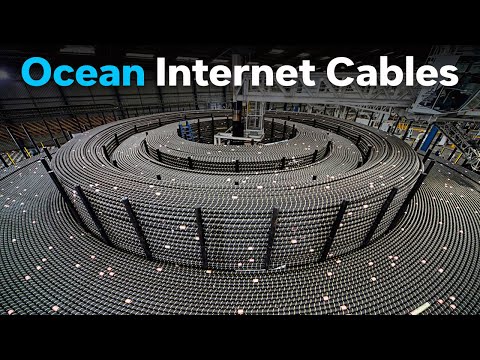 Photo: N43 and Hermes
When you send a message overseas, it does not bounce off a satellite. It dives to the bottom of the ocean — through 1.4 million kilometers of glass threads laid across the seabed by ships that look like they belong in another century.
Source video: How The Internet Travels Across Oceans · VISION · approximately 11.7M views observed via yt-dlp on August 04, 2026. Independently researched by N43 and Hermes.
01 The First Wires Across the Sea
The story of undersea cables begins not with fiber optics but with copper and gutta-percha. In 1858, after several failed attempts, the first successful transatlantic telegraph cable connected Valentia Island in Ireland to Heart's Content in Newfoundland. Queen Victoria and President James Buchanan exchanged congratulatory messages across it, though the cable failed after just three months of intermittent operation — its signal too faint for reliable communication. A durable link arrived in 1866, engineered by the SS Great Eastern, the largest ship in the world at the time, which laid the cable across 3,200 kilometers of ocean floor.
These early telegraph cables carried a few words per minute using Morse code. By the early twentieth century, telephone cables followed, beginning with TAT-1 in 1956, the first transatlantic telephone cable. TAT-1 carried 36 simultaneous voice channels using coaxial cable and submarine repeaters — vacuum tube amplifiers sealed in pressurized housings spaced every 65 kilometers along the route. The cable was a engineering marvel of its age, enabling direct dialing between North America and Europe for the first time. For the next four decades, coaxial submarine cables carried the world's intercontinental voice traffic, with capacity steadily increasing through successive generations until the last coaxial transatlantic cable, TAT-7, was laid in 1983.
The copper era ended abruptly in 1988, when TAT-8 entered service as the first transatlantic fiber-optic cable. Instead of electrical signals, TAT-8 carried light pulses through glass fibers thinner than a human hair. It could transmit 280 megabits per second — roughly 40,000 telephone channels — a tenfold improvement over TAT-7's coaxial capacity. This single cable marked the beginning of the optical era that would eventually carry the internet across every ocean on Earth.
02 How Fiber Optics Work Underwater
A submarine communications cable is, at its core, a series of glass strands surrounded by layers of protection engineered for one of the most hostile environments on the planet. The optical fibers at the center are made of ultra-pure silica, drawn into threads about 125 micrometers in diameter — thinner than a human hair. Light travels through the fiber core, which is about 9 micrometers across in single-mode fiber, by total internal reflection. The refractive index of the core is slightly higher than the surrounding cladding, so light that enters at the correct angle bounces along the fiber indefinitely, confined by physics rather than any coating.
Underwater, light attenuates. Even the purest silica has absorption and scattering losses, and over thousands of kilometers these losses would reduce any signal to nothing. The solution is optical amplification. Every 50 to 100 kilometers along the cable, a repeater unit boosts the signal. Modern submarine cables use erbium-doped fiber amplifiers (EDFAs), which were developed in the late 1980s and revolutionized long-haul optical transmission. An EDFA is a segment of fiber doped with erbium ions; a pump laser excites the erbium atoms, which transfer their energy to the signal photons, amplifying the light without converting it to electricity and back. This all-optical amplification allows signals to travel 10,000+ kilometers without electronic regeneration.
The cable itself is built like armored rope. Inside, the optical fibers are protected by a gel-filled tube, surrounded by copper tape (which also carries electrical power to the repeaters), steel wire armor, and multiple layers of polyethylene insulation. Near shore, where cables are most vulnerable to anchors, fishing trawls, and dredging, additional layers of steel armor are added. A deep-sea cable might be 25 millimeters in diameter; a shore-end cable can be 50 millimeters thick and weigh over 40 kilograms per meter.
Transatlantic submarine cable capacity growth, log scale. TAT-8 (1988) at 280 Mb/s to MAREA (2018) at 224 Tb/s — an 800,000× increase in three decades. Data: TeleGeography Submarine Cable Map.
03 The Global Map: 750,000 Miles of Glass
As of 2026, approximately 530 active or planned submarine cables span the world's oceans, connecting over 1,400 landing stations across more than 160 countries and territories. The total length of deployed submarine cable exceeds 1.4 million kilometers — enough to wrap around the Earth's equator 35 times. The map of submarine cables traces the routes of global commerce: dense clusters across the North Atlantic connecting North America to Europe, trans-Pacific cables linking the U.S. west coast to Japan, Korea, and China, and increasingly complex webs around Southeast Asia, the Indian Ocean, and the African coast.
The transatlantic corridor remains the densest, with over 20 active cables connecting the U.S. east coast to Europe. The trans-Pacific routes, though fewer in number, carry the heaviest data loads, connecting the world's two largest technology markets. The Africa coast, once a connectivity backwater, has seen rapid expansion with systems like 2Africa, which at 37,000 kilometers is one of the longest submarine cables ever built, circling nearly the entire African continent. New routes through the Arctic are being explored as climate change opens previously ice-locked passages, though the technical challenges of cable laying in Arctic waters remain formidable.
The ownership of submarine cables has shifted dramatically over the past two decades. In the telecom era, cables were built by consortia of national telecommunications companies that shared capacity under a club-style model. Today, hyperscale cloud providers — Google, Meta, Microsoft, and Amazon — collectively own or lease over 100 submarine cable systems. Google alone has invested in at least 20 cable projects, including some that it owns outright. These companies now account for the majority of new trans-oceanic bandwidth investment, driven by the relentless growth of cloud computing, video streaming, and increasingly, AI workloads that require massive data movement between data centers.
04 Laying 10,000 Kilometers of Cable
Submarine cable installation is one of the most specialized maritime operations in the world. It begins with a marine route survey, where vessels map the seabed along the proposed path using sonar and sub-bottom profilers. The survey identifies hazards — undersea mountains, trenches, existing cables, shipwrecks, and areas of seabed instability — and helps engineers plot a route that minimizes risk. The route also avoids known fishing grounds, anchorages, and areas of high seismic activity where possible.
The cable is manufactured in sections at specialized factories — one of the few remaining facilities is in Japan (NEC), Europe (Alcatel Submarine Networks), and the United States (SubCom). A single cable ship can carry up to 5,000 kilometers of cable in its holds, spooled onto massive tanks that feed the cable through a series of tension-controlled rollers and over the stern into the ocean. The ship travels at 4 to 6 knots during laying, carefully paying out cable at a rate that matches the depth and slope of the seabed so the cable rests on the bottom with controlled slack.
Near shore, the operation shifts to shallow-water techniques. The cable is buried using a subsea plow — a sled-like device towed behind the ship that cuts a trench in the seabed and lays the cable into it, typically to a depth of 1 to 3 meters. Burial protects the cable from fishing gear and ship anchors, which together account for roughly two-thirds of all submarine cable faults. In deep water, burial is unnecessary because the seabed is undisturbed, and the cable simply rests on the ocean floor at depths reaching 8,000 meters in ocean trenches — under pressure of 800 atmospheres, in total darkness, at temperatures near freezing.
05 Breaking Points: Faults, Cuts, and Sabotage
Despite their rugged construction, submarine cables fail regularly. The TeleGeography cable fault database records an average of 150 to 200 cable faults per year worldwide. The overwhelming majority — roughly two-thirds — are caused by human activity: fishing trawls dragging through shallow-water cable routes, and ship anchors deployed in or near cable corridors. Natural causes, including submarine landslides, earthquakes, and abrasion from seabed movement, account for most of the remainder. Sharks have been documented biting cables on a few occasions, though this is statistically insignificant compared to human-caused damage.
Because individual cable faults are expected, the system is designed with redundancy. Most submarine routes have multiple cables, and major landing points are geographically distributed. When a cable fails, traffic is rerouted through alternative paths, often with only momentary disruption that end users never notice. Cable repair ships — there are roughly 60 in service worldwide — are stationed strategically to reach most fault sites within a few days. The repair process involves locating the fault, grappling the cable from the seabed, cutting out the damaged section, splicing in a repair length, and re-laying the joined ends.
Submarine cable fault causes. Fishing and ship anchors together cause roughly two-thirds of all cable faults. Source: International Cable Protection Committee (ICPC) fault statistics.
In recent years, the geopolitical dimension of cable security has intensified. In 2023, a series of cable cuts in the Baltic Sea and off the coast of Norway raised concerns about potential sabotage, with suspicion falling on vessels linked to states hostile to Western interests. The shallow, congested Baltic is particularly vulnerable: its seabed is crisscrossed by cables and pipelines, and its narrow waters make monitoring difficult. While most cable faults remain accidental, the deliberate severing of critical infrastructure — whether by state actors or by vessels dragging anchors negligently — has become a recognized threat vector that naval forces and intelligence agencies now track.
06 The AI Era and the New Bandwidth Race
The undersea cable network is entering its largest expansion phase since the dot-com era, and the driver is artificial intelligence. Training large language models and running inference across continents requires moving enormous datasets between data centers that are frequently on opposite sides of an ocean. A single AI model training run can generate petabytes of checkpoint data that must be replicated across regions for resilience and access. Cloud providers are responding by building their own cables with unprecedented capacity.
The MAREA cable, jointly funded by Microsoft and Meta and completed in 2018, spans 6,600 kilometers between Virginia Beach, USA, and Bilbao, Spain, with a design capacity of 224 terabits per second. The 2Africa cable, funded by a consortium led by Meta, encircles the African continent with 37,000 kilometers of optical fiber, bringing 180 terabits per second of capacity to dozens of landing points. The Grace Hopper cable, completed by Google in 2021, connects the U.S. east coast to the UK and Spain with 250 terabits per second using 16 fiber pairs — more than any previous transatlantic cable. These investments are not philanthropic: each terabit of trans-oceanic capacity directly serves the cloud and AI services that generate hundreds of billions in annual revenue.
The technology inside these new cables has also advanced. Space-division multiplexing, which uses multiple fiber cores within a single cable, and coherent optical transmission, which encodes data in both the amplitude and phase of the light wave, have pushed per-wavelength capacities beyond 800 gigabits per second. Newer cables deploy 12 to 16 fiber pairs, compared to the 2 to 4 pairs common a decade ago. The result is that a single 2020s-era submarine cable carries more data than the entire global internet did in 2005. The ocean floor is being rewired for the age of machine intelligence.
07 What Lies Beneath
The submarine cable network is the most important infrastructure you never think about. Every international video call, every cross-border website visit, every cloud application that reaches a server on another continent — 99 percent of that traffic travels not through the air via satellite, but through glass threads on the ocean floor. Satellites, despite their visibility in the public imagination, carry less than one percent of intercontinental data traffic. The reason is simple physics: the bandwidth of a single modern fiber pair dwarfs the total capacity of every communications satellite in orbit combined.
The network is also a story of human ingenuity applied repeatedly across generations. The engineers who laid the first transatlantic telegraph cable in 1858 used gutta-percha insulation and Morse code. The engineers laying the MAREA cable in 2018 used coherent optical transmission and erbium amplifiers. The challenges are the same — water, pressure, distance, corrosion, and the sheer scale of the ocean — but the solutions have evolved through five technological generations, each one multiplying the capacity of the last by orders of magnitude.
As the world's dependence on data grows, and as AI transforms the economics of computing, the cables beneath the sea will only become more critical. The next time your phone connects to a server halfway across the world in under a hundred milliseconds, remember that the signal traveled through a thread of glass, resting on the floor of an ocean, in darkness, under crushing pressure — placed there by a ship that looks like it belongs to the nineteenth century, carrying technology from the twenty-first.
References
- Wikipedia: Submarine communications cable — overview, history, and technology
- TeleGeography, Submarine Cable Map — global cable database and capacity statistics
- International Cable Protection Committee (ICPC), Cable protection and fault data — industry body for submarine cable security
- Wikipedia: TAT-8 — first transatlantic fiber-optic cable (1988)
- Submarine Cable Networks, Industry reference — cable system specifications and landing points
- Google Cloud, Grace Hopper and MAREA cable announcements — hyperscaler cable investment
- Source video: How The Internet Travels Across Oceans (VISION, ~11.7M views, observed August 04, 2026)
By N43 and Hermes for Sailor Bob News.


