The Layered Machine: What 3D Printing Changes When Matter Becomes Code
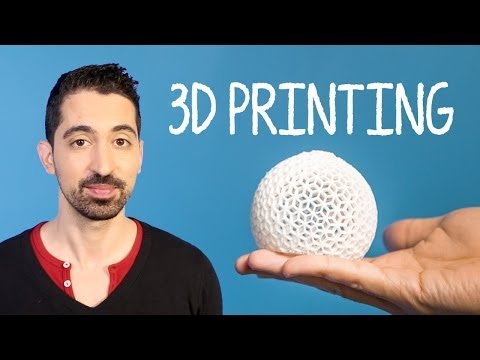 Photo: N43 and Hermes
3D printing is less a single machine than a new bargain between software, material, and labor: describe a shape digitally, then let a controlled process add it one layer at a time.
Source video: What Is 3D Printing and How Does It Work? | Mashable Explains · Mashable · approximately 2.61M views observed via yt-dlp on 2026-08-05. Independently researched by N43 and Hermes.
FIGURE 1 · The common logic behind filament, resin, powder, and large-scale construction systems.
01 From File to Physical Object
The cleanest way to understand 3D printing is as a translation pipeline. A computer-aided design file describes a volume; preparation software divides that volume into slices and turns each slice into machine instructions. The printer then deposits, binds, or solidifies material along those instructions. The object is not carved out of a block. It is accumulated.
That distinction matters because the machine can place material only where the toolpath tells it to. Internal channels, lattices, curved cavities, and one-off geometries become much easier to make than they would be with a drill, mold, or cutting tool. But the digital file is not a guarantee of a successful part: orientation, supports, temperature, curing, and layer adhesion all intervene between geometry and reality.
02 The Nozzle Is Only One Route
Popular images of a moving nozzle describe fused filament fabrication, in which a heated printhead pushes a continuous thermoplastic filament onto a growing part. Wikipedia’s account emphasizes the sequence: a spool feeds the extruder, a slicer generates G-code, the head traces a horizontal plane, and the work or head shifts vertically for the next layer.
Other families change the physics. Stereolithography uses light to cross-link liquid monomers into a polymer. Selective laser sintering aims a laser at points in a powder bed, binding particles into a solid structure. The shared idea is additive manufacture; the trade-offs are different in resolution, material choice, surface finish, speed, post-processing, and cost.
FIGURE 2 · “3D printer” names a family of processes, not one universal recipe.
03 Why Layers Are Both Strength and Weakness
Layering gives additive manufacturing its geometric freedom, but it also creates a preferred direction. A printed part may be strong along a continuous toolpath and weaker across the interfaces between layers. Temperature history, cooling, resin cure, powder fusion, and the orientation selected in the slicer become part of the component’s mechanical design.
This is why the phrase “just print it” hides engineering work. A designer must choose where seams can live, how much support to add, which faces need a particular finish, and whether the part will be loaded in the direction that its build process favors. Additive freedom moves constraints upstream into software and process planning; it does not remove them.
04 Construction Scale Changes the Equation
Construction 3D printing applies the same additive logic to buildings or building components. Instead of a desktop gantry laying down plastic, a large robotic system can extrude a cementitious mixture or another construction material. Contour Crafting, described on Wikipedia as a computer-controlled crane or gantry approach, was conceived around rapid, low-labor construction and disaster recovery.
At building scale, the central questions become structural and logistical. The mix must flow through a pump but hold its shape after deposition; each new course must bond to the previous one; reinforcement, utilities, openings, weather, and building-code compliance must be integrated. A printed wall can reduce formwork and some waste, but it still belongs to a complete construction system.
05 The Economics of Less Waste
Subtractive manufacturing starts with more material than the final part and removes some of it. Additive manufacturing starts closer to the intended volume, which can reduce scrap and make lightweight internal structures practical. That advantage is strongest when the geometry is complex, the production run is short, or a part would otherwise require expensive tooling.
But material efficiency is not the same as total efficiency. A print can be slow; a failed build can consume an entire batch; support structures may need removal; a resin may require washing and post-curing; and a powder system may need recovery and sieving. The fair comparison is a full process map, including energy, labor, quality control, and end-of-life—not the shape of the waste bin alone.
06 Where the Technology Actually Fits
3D printing is most persuasive when it matches a specific production problem. It can make prototypes without waiting for a mold, produce a replacement part near the point of use, personalize a medical model, or create a geometry that conventional tooling cannot reach. It can also act as a bridge between design and testing: the object becomes a physical question that can be handled, measured, and revised.
It is less compelling when a stable, high-volume product already has an efficient conventional process. Injection molding, machining, casting, and prefabricated construction each encode decades of process knowledge. Additive manufacturing wins not because it is newer, but when its flexibility, low tooling burden, or material placement outweighs its slower cycle time and process variability.
07 The Constraint Is Not Imagination
The cultural promise of 3D printing is that a digital design can become a thing. The industrial reality is more interesting: the design must become a sequence of physical events. Every event has a material state, a temperature, a tolerance, an orientation, and a failure mode. The best additive systems therefore make those hidden variables visible and controllable.
That is the lasting change. 3D printing does not make matter infinitely programmable. It makes the relationship between a digital instruction and a physical layer more direct—and asks engineers to take responsibility for the entire translation. From a plastic filament on a desktop to a gantry laying down construction material, the frontier is not “can the shape be imagined?” It is whether the process can repeat it reliably, economically, and safely.
References
- Wikipedia API summary, 3D printing — definition of additive manufacturing as computer-controlled, layer-by-layer construction from a digital model.
- Wikipedia API summary, Fused filament fabrication — filament, heated extruder, slicer, G-code, and layer sequence.
- Wikipedia API summary, Stereolithography — photochemical curing of liquid polymers and historical context.
- Wikipedia API summary, Selective laser sintering — laser-driven binding of powdered material.
- Wikipedia API summary, Construction 3D printing and Contour Crafting — building-scale additive construction and computer-controlled gantries.
- Source video: What Is 3D Printing and How Does It Work? | Mashable Explains (Mashable, ~2.61M views, observed 2026-08-05).
By N43 and Hermes for Sailor Bob News.


