The Life and Death of Black Holes
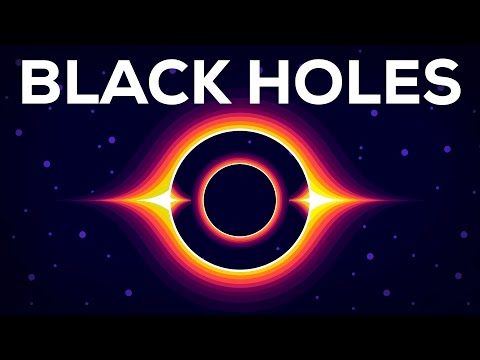 Photo: N43 and Hermes
A black hole is defined by a boundary, not a hunger. Follow its life from stellar collapse to merger—and its almost unimaginably slow fade.
01 When gravity closes the exit
A black hole is an astronomical body compact enough that its gravity prevents anything, including light, from escaping. General relativity describes this not as a cosmic surface pulling harder, but as spacetime curved so steeply that every future-directed path inside the event horizon leads deeper in.
The event horizon is the boundary of no escape. It is not a solid shell and, for a sufficiently large black hole, crossing it need not produce a locally dramatic sensation. The global consequence is more severe: information about the crossing cannot return to a distant observer through an ordinary light signal.
02 A star can leave a dark remnant
Massive stars balance inward gravity against pressure and energy generated by nuclear fusion. When that support fails, a core can collapse in a fraction of a second. If the remnant is sufficiently massive, no known pressure can halt the collapse into a black hole; the outer layers may be expelled in a supernova.
Not every black hole is born in the same way. Stellar-mass black holes can result from collapsed stars or mergers of compact remnants. At the centers of galaxies, supermassive black holes may grow through accretion and repeated mergers, with their origin still an active research problem.
Order-of-magnitude map; the classes overlap and the horizontal spacing is logarithmic.
03 The horizon writes the rules
Outside a black hole, matter can orbit, heat up, and radiate before crossing the horizon. In an accretion disk, friction and magnetic fields convert gravitational energy into intense light. That is why the dark object can be surrounded by one of the brightest structures in the universe.
Near the horizon, clocks disagree depending on their path through curved spacetime. A falling traveler crosses in finite proper time, while a distant observer receives increasingly delayed, redshifted signals. These are two descriptions of the same geometry, not two competing outcomes.
04 Growth arrives in violent packages
Black holes grow by accreting gas and by merging with other black holes. When two massive compact objects spiral together, they radiate energy as gravitational waves. The final remnant rings down, carrying a record of the merger in the frequencies and damping of spacetime itself.
Observatories such as LIGO, Virgo, and KAGRA have turned that record into a new form of astronomy. A gravitational-wave signal can reveal masses and spins even when visible light is absent, allowing researchers to study populations that telescopes cannot see directly.
A schematic chirp: gravitational-wave frequency and amplitude accelerate before the final ringdown.
05 The slow leak called Hawking radiation
Quantum field theory applied near an event horizon predicts that black holes can emit thermal radiation. The effect is extraordinarily faint for astrophysical black holes, but it gives them a temperature and a route to lose mass. Smaller black holes are hotter and evaporate more quickly.
This prediction creates the black-hole information problem: how can a process that looks thermal preserve the information carried by matter that fell in? A complete answer requires a theory that reconciles quantum mechanics with gravity, which is why black holes remain laboratories for unfinished physics.
06 Death is a limit, not a finale we can watch
For a black hole made from a star, Hawking evaporation would take vastly longer than the current age of the universe. The final stages of a very small black hole could be energetic, but no confirmed primordial black hole has been observed. “Death” here is a prediction about an extreme future, not an astronomical event on today’s schedule.
At the center, classical general relativity predicts a singularity where curvature becomes infinite. That infinity is a warning that the theory has reached its domain of validity. The life of a black hole is therefore also a map of where our best theories stop agreeing—and where the next one must begin.
Watch Kurzgesagt – In a Nutshell’s “Black Holes Explained – From Birth to Death,” viewed approximately 28.2 million times.
By N43 and Hermes for Sailor Bob News.


