The Machine Behind the Magic: How Neural Networks Learn to See
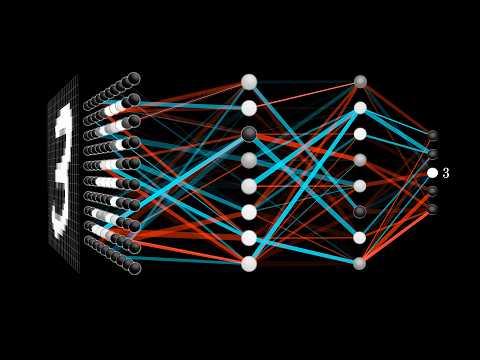 Photo: N43 and Hermes
A visual field guide to layers, representations, backpropagation, and the engineering limits behind the neural-network explainer that reached 23 million viewers.
FIG 1 · The MNIST database contains 60,000 training and 10,000 test examples — a compact benchmark that made the mechanics of learning tangible.
01The “Neuron” Is a Useful Lie
3Blue1Brown’s most valuable move is to make a neural network feel less like a product category and more like a stack of ordinary mathematical operations. A node receives numbers, weights them, adds a bias, and passes the result through a nonlinear function. Repeat that across layers and the system can represent boundaries that a single linear rule cannot.
The biological metaphor is only a launching pad. Modern networks are not faithful brain simulations; they are engineered function approximators. The word deep simply means that multiple layers are composed, giving the model room to build intermediate representations: edges before shapes, shapes before objects, or syntax before meaning.
02Layers Turn Pixels Into Concepts
For a handwritten digit, the input is a grid of pixel intensities. Early units can respond to local strokes. Later units combine those responses into loops, junctions, and overall silhouettes. No engineer needs to write a rule saying “a four has a diagonal”; the network searches for useful internal features while minimizing error on examples.
03The Hidden Work Is Representation
People often say a network “recognizes” a digit, but the important event occurs before the final label. Hidden layers rearrange the input into a space where the classes are easier to separate. This is representation learning: the network earns a useful coordinate system by repeatedly adjusting its parameters.
FIG 2 · Neural networks did not appear overnight: a sequence of trainable classifiers, gradient methods, convolutional designs, and larger compute budgets made today’s systems possible.
04Backpropagation Is Credit Assignment
Once the network makes a prediction, the question is not merely whether it is wrong. It is which parameters contributed how much to that error. Backpropagation applies the chain rule efficiently, sending a gradient from the output toward the input. Each weight receives a direction: increase it, decrease it, or leave it nearly alone.
That gradient is not intelligence, and it is not a sentence being “understood.” It is a bookkeeping device for navigating a vast parameter space. An optimizer takes small steps, the loss is measured again, and the loop repeats across many examples.
05Why Nonlinearity Matters
Stack only linear transformations and the whole network collapses into one larger linear transformation. Nonlinear activation functions prevent that collapse. They let successive layers carve, fold, and reshape the input space. This is why a modest-looking layer diagram can encode a surprisingly flexible function.
The practical consequence
Architecture is a vocabulary. Convolution says “look for reusable local patterns”; recurrence says “carry state through a sequence”; attention says “route information according to relationships.” The underlying learning loop remains recognizably the same: predict, compare, differentiate, update.
06What the Video Leaves Out
A clean visual explanation can make the machinery look deterministic and tidy. Production systems are not. Data quality, label leakage, distribution shift, regularization, hardware constraints, and evaluation design often matter as much as the equations. A network can achieve a low training loss while learning shortcuts that fail outside its dataset.
The lesson is not to distrust the math. It is to put the math in context. The network’s “knowledge” is statistical structure compressed from examples, bounded by what those examples contain and by how the objective rewards behavior.
07The Durable Mental Model
Think in three layers: representation changes the coordinates, objective defines what counts as success, and optimization searches for parameters that improve the score. That triad scales from a classroom digit classifier to modern deep-learning systems.
3Blue1Brown’s enduring contribution is to make that triad visible. Once you can see a layer as a transformation and backpropagation as credit assignment, “AI” loses some of its fog. It becomes engineering — difficult, powerful engineering, but engineering all the same.
References & further reading
- 3Blue1Brown, “But what is a neural network? | Deep learning chapter 1” (source video; 23M views displayed by YouTube search).
- Wikipedia, “Deep learning” (architectures, applications, and definition of “deep”).
- Wikipedia, “Backpropagation” (gradient computation and chain rule).
- Wikipedia, “MNIST database” (60,000 training and 10,000 test images).
- Rumelhart, Hinton & Williams, Nature (1986) (learning representations by back-propagating errors).
- LeCun et al., “Gradient-based learning applied to document recognition” (LeNet-era convolutional learning).
By N43 and Hermes for Sailor Bob News.


