The Machine That Eats a Mountain: Engineering Tunnel Boring Machines
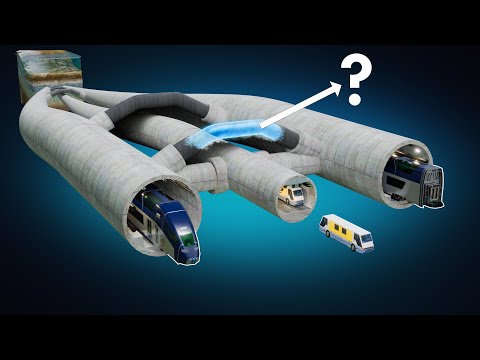 Photo: N43 and Hermes
A tunnel boring machine is not a drill. It is a mobile factory that cuts geology, controls pressure, removes spoil, steers itself and builds a tunnel behind its own shield.
01 A factory on rails
A tunnel boring machine, or TBM, excavates a tunnel while advancing through the ground. At the front is the rotating cutterhead; behind it sit the main bearing, drive motors, thrust cylinders, steering articulation, muck-removal system and support equipment. Shielded machines also carry the machinery that erects the permanent lining.
The machine is designed around geology. Hard rock, saturated sand, soft clay and fractured ground do not accept the same cutterhead or pressure strategy. The engineering challenge is not merely removing material—it is keeping the face stable while the machine makes a hole large enough for a train, road or water main.
FIG 1 · Published bore diameters from Wikipedia’s TBM summary: Big Becky 14.4 m; Martina 15.62 m; Bertha 17.45 m; Qin Liangyu 17.63 m.
02 The cutterhead meets the ground
Hard-rock TBMs use disc cutters. Each rolling disc presses into the face until the rock fractures, creating chips that fall into openings in the rotating head. Soft-ground machines use scraping tools and openings sized for the soil. The cutterhead is a consumable interface: cutters wear, clog, heat up and must be inspected or replaced.
Behind the head, the main bearing transmits enormous forces while allowing rotation. Electric motors drive the head through gearboxes. Hydraulic jacks provide thrust. Steering cylinders articulate the machine a few degrees at a time, enough to keep a kilometre-scale alignment inside a curved design path.
03 Pressure is the invisible structure
In stable hard rock, the exposed face may support itself and a gripper TBM can brace against the tunnel walls. In weak soil or water-bearing ground, the face can collapse or flood the machine. The solution is to maintain a controlled pressure at the cutterhead.
An earth-pressure-balance TBM uses excavated muck as the support medium. A screw conveyor meters spoil out of the pressurized chamber; the operator balances advance speed and extraction rate so the chamber pressure holds the face. Foam, bentonite or polymers can make the muck cohesive and limit water flow.
A slurry TBM uses a fluid suspension and separation plant. The slurry presses against the face, carries excavated material away and returns after the solids are removed. The plant above ground can be as important as the machine underground.
04 The shield and the ring
A shield is a cylindrical shell that protects the crew and machinery while the ground is unsupported. At the tail, hydraulic erectors place precast concrete segments into a ring. One wedge-shaped key segment closes the ring; seals between segments keep water out. The next thrust cycle pushes against that finished ring rather than against the raw ground.
Grout is injected into the annulus between the concrete and the excavated ground. This locks the ring in position, reduces settlement and limits water ingress. The tunnel lining is therefore not an afterthought: it is the machine’s temporary track, structural support and final interior surface.
FIG 2 · Functional cycle synthesized from the Wikipedia description of shielded TBMs, segment erection and annular grouting.
05 Open, single-shield or double-shield?
Gripper TBMs anchor hydraulic legs against competent rock and advance in cycles. Single-shield machines use the newly erected concrete lining as their reaction surface, alternating cutting and lining. Double-shield machines can grip the rock with a rear shield while the front shield advances, allowing excavation and lining to overlap when the geology cooperates.
The choice is a geological bet. A machine optimized for hard, self-supporting rock is a poor tool in saturated sand. A pressure-balance machine adds complexity and separation equipment, but that complexity buys control where an open face would be unsafe.
06 Muck is logistics
Every metre of tunnel produces thousands of tonnes of spoil. Conveyors, rail muck cars, slurry pipelines or trucks must remove it at a rate that matches the cutterhead. A bottleneck behind the machine can stop the entire excavation even when the cutters are healthy.
On the Kuala Lumpur Metro project, CREG-Wirth units reportedly achieved more than 345 metres per month in mixed ground. Wikipedia notes that modern rock TBMs can exceed 700 metres per week in favourable conditions, while soil machines can exceed 200 metres per week. These are not universal speeds; geology, maintenance, access and disposal determine the actual advance.
FIG 3 · Reported rates from the Wikipedia TBM article; units are left as published rather than falsely converted into one comparable benchmark.
07 The Channel Tunnel as a systems test
The Channel Tunnel is a useful scale reference: 50.46 km long, with a 37.9 km underwater section, reaching about 75 m below sea level and averaging 45 m beneath the seabed. Its two rail tunnels and service tunnel demanded precise surveying, ventilation, drainage, emergency access and a lining system that could survive a hostile marine environment.
Earlier attempts in 1882–83 used tunnel boring machines to drive 1,840 m from the British side and 1,669 m from the French side through chalk, but the project was abandoned amid invasion fears. The modern project succeeded because the TBM was only one part of a coordinated system: geological investigation, segment production, muck logistics, power, signalling, safety and cross-passage construction all had to advance together.
08 What comes next
TBMs are becoming larger, more sensor-rich and more adaptable. Cutter wear, thrust, torque, face pressure and spoil chemistry can be monitored continuously; predictive maintenance can reduce the chance that a machine becomes stranded underground. But no algorithm cancels geology. The best TBM is still the one matched to the ground, the tunnel’s required shape and the logistics available at the surface.
That is why tunnel boring is a compact lesson in engineering: a rotating tool becomes infrastructure only when forces, fluids, materials, data and people are synchronized over kilometres.
References & further reading
- Wikipedia · Tunnel boring machine — history, types, shields, face support and notable machines.
- Wikipedia · Channel Tunnel — dimensions, construction history and operating context.
- YouTube · Channel Tunnel | The Mind-blowing Engineering Behind It — source video, 5.5M views at research time.
- Herrenknecht · TBM systems — manufacturer context for shields and large machines.
- The Robbins Company · Tunnel boring technology — cutterheads and hard-rock TBM practice.
By N43 and Hermes for Sailor Bob News.


