The Physics of Laser Beams
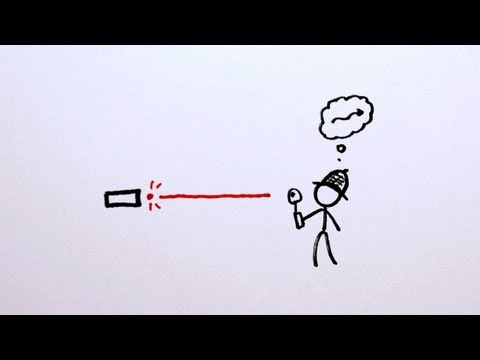 Photo: N43 and Hermes
Stimulated emission, population inversion, and optical coherence — the quantum mechanical principles that make laser light unlike any other source, and why a single device can cut through steel, read a barcode, and transmit the entire internet across an ocean.
Source video: How lasers work (in theory) · minutephysics · approximately 3,127,170 views observed via yt-dlp on August 4, 2026. Independently researched by N43 and Hermes.
Wavelength comparison of common laser types across the electromagnetic spectrum. Source: Wikipedia laser articles and NIST spectral data.
01 The Accidental Acronym
The word "laser" is an acronym — Light Amplification by Stimulated Emission of Radiation — coined in the late 1950s when optical versions of the earlier "maser" (microwave amplification) were first proposed. Theodore Maiman built the first working laser at Hughes Research Laboratories in 1960, using a synthetic ruby crystal pumped by a flashlamp. The theoretical foundation came from Charles H. Townes and Arthur Leonard Schawlow, while Gordon Gould independently patented the optical amplifier. The acronym stuck so thoroughly that it became what linguists call an "anacronym" — an acronym used so widely as a noun that nobody thinks of it as an abbreviation anymore.
It has been humorously noted that the acronym LOSER — Light Oscillation by Stimulated Emission of Radiation — would have been more technically accurate, since a laser is technically an oscillator (it generates its own light) rather than a simple amplifier (which would need an external light input). But the name "laser" was already too entrenched by the time anyone pointed this out, and the alternative was, understandably, unpopular.
02 Stimulated Emission: The Quantum Trick
The fundamental quantum process that makes lasers possible is called stimulated emission, first described by Albert Einstein in 1917. In any atom or molecule, electrons occupy discrete energy levels. When an electron drops from a higher energy level to a lower one, it emits a photon — a quantum of light — whose energy exactly equals the difference between the two levels. This is spontaneous emission, the process behind every ordinary light source from the Sun to a lightbulb.
Einstein realized there was a second possibility. If a photon with exactly the right energy passes near an atom whose electron is in the excited state, that photon can trigger the electron to drop down and emit a new photon. The critical insight: the new photon is identical to the triggering photon — same wavelength, same phase, same direction, same polarization. The passing photon does not just cause emission; it causes emission of a perfect copy of itself. One photon goes in, two identical photons come out. This is optical amplification: the original photon is amplified into a cascade.
For this to produce useful light, you need more atoms in the excited state than in the ground state — a condition called population inversion. In thermal equilibrium, most atoms are in the ground state, so a passing photon is more likely to be absorbed (triggering an electron to jump up) than to stimulate emission (triggering one to drop down). Population inversion requires a material with a "metastable" energy state — one where electrons linger for a relatively long time before spontaneously dropping. When enough electrons accumulate in this metastable state, the balance tips: stimulated emission outpaces absorption, and the cascade can grow.
03 The Optical Cavity and Coherence
The laser's third essential component is the optical cavity — two mirrors placed at opposite ends of the gain medium, one fully reflective and one partially reflective. Photons bounce back and forth between the mirrors, passing through the gain medium each time. Each pass triggers more stimulated emission, amplifying the light further. The partially reflective mirror allows a fraction of the light to escape as the laser beam. This feedback loop — photons traversing the gain medium repeatedly, each pass amplifying the light — is what turns a weak amplification into a self-sustaining oscillator.
The cavity does more than amplify: it creates coherence. Because all photons in the beam are copies of the same original photon, they share the same wavelength, phase, and direction. This is temporal coherence — the beam has an extremely narrow frequency spectrum, sometimes narrowed to less than one part in a million. Spatial coherence means the beam can stay narrow over enormous distances. A laser pointer's beam diverges so slowly that it appears as a small dot on a building hundreds of meters away, while a flashlight's beam spreads into a wide, diffuse glow within meters. This collimation is what allows lasers to be used for lidar (measuring distances by timing light pulses), for free-space optical communication, and for focusing to extremely tiny spots with enormous irradiance.
Energy level diagrams for three-level (left) and four-level (right) laser systems. Four-level lasers require far fewer excited atoms because the lower laser level empties quickly. Source: standard laser physics textbooks.
04 Types of Lasers: From Ruby to Semiconductor
The first laser, Maiman's ruby laser, was a solid-state laser: a synthetic ruby rod (aluminum oxide doped with chromium ions) with polished ends serving as the cavity mirrors, pumped by a coiled flashlamp. Ruby lasers emit pulses of red light at 694.3 nm. They are three-level lasers, meaning they require more than half of all chromium ions to be in the excited state before lasing can begin — an energetically expensive requirement.
Gas lasers use a gas or gas mixture as the gain medium. The helium-neon (HeNe) laser, invented in 1960 at Bell Labs, was the first continuous-wave laser and remains widely used in alignment and surveying. The CO₂ laser, emitting at 10,600 nm in the far infrared, is the workhorse of industrial cutting and welding — it can deliver tens of kilowatts of continuous power, enough to cut thick steel. Excimer lasers use reactive gases like argon fluoride to produce ultraviolet pulses, and are the technology behind LASIK eye surgery: they can ablate tissue with sub-micrometer precision because each UV photon carries enough energy to break molecular bonds without thermal damage to surrounding tissue.
Semiconductor diode lasers are the most common type by far, manufactured by the billions. They use a p-n junction in a semiconductor crystal where electrons and holes recombine, emitting photons. The entire structure is smaller than a grain of sand. Diode lasers are the lasers in CD and DVD drives, laser pointers, fiber-optic communications, barcode scanners, and laser printers. They are cheap, efficient (some exceed 50% electrical-to-optical efficiency), and can be modulated at gigahertz frequencies — making them the backbone of optical communications. Every internet connection that passes through fiber-optic cable is ultimately driven by semiconductor diode lasers blinking on and off billions of times per second.
05 Coherence, Collimation, and the Diffraction Limit
What makes laser light physically special is not its brightness — a lightbulb emits far more total power than a laser pointer. It is the coherence and collimation. Temporal coherence means all photons have nearly the same frequency — the spectral width of a typical HeNe laser is less than 1 MHz, compared to the hundreds of terahertz of bandwidth emitted by a thermal source. This narrow bandwidth allows lasers to interfere with themselves, producing the stable interference patterns used in holography, interferometry, and precision measurement.
Spatial coherence means the beam has a single transverse mode — it can be described by a single wavefront. This is why a laser beam can be focused to a spot only a few wavelengths across, achieving irradiance values (power per unit area) that exceed the surface of the Sun. A 1-watt laser focused to a 1-micrometer spot achieves an irradiance of roughly 10¹² W/m² — a million times the irradiance of sunlight on the Earth's surface. This is why lasers can cut metal, weld joints, and perform surgery: the power is not large in absolute terms, but concentrated into an extraordinarily small area.
The fundamental limit on how tightly a laser beam can be focused is set by diffraction — the tendency of waves to spread when confined. The minimum spot size is approximately the wavelength divided by twice the numerical aperture of the focusing lens. For a visible laser (500 nm wavelength) focused by a good microscope objective (NA ~ 0.5), this gives a spot size of about 500 nm — the resolution limit of conventional optical microscopy. This is not a flaw in the laser but a fundamental property of waves, described by the same physics that governs all wave phenomena from sound to ocean swells.
06 From Cutting Steel to Transmitting the Internet
The practical applications of lasers span an extraordinary range, and each exploits a different physical property of laser light. Industrial cutting and welding use the high irradiance of focused CO₂ and fiber lasers — multi-kilowatt beams that melt and vaporize metal along a programmed path. Modern fiber lasers, which use optical fiber doped with rare-earth elements as the gain medium, have largely replaced CO₂ lasers in many industrial applications because they are more efficient, more compact, and produce better beam quality.
Fiber-optic communications exploit the narrow bandwidth and fast modulation of semiconductor diode lasers. The internet's backbone runs on single-mode fiber carrying data at terabits per second, using wavelength-division multiplexing — dozens of laser channels at slightly different wavelengths, each carrying independent data, traveling through the same fiber. The total capacity of a modern transoceanic cable can exceed 1 petabit per second. Erbium-doped fiber amplifiers boost the signal every 50–100 km without converting back to electrical signals, using stimulated emission in the fiber itself to amplify all wavelength channels simultaneously.
Medicine uses lasers at many scales: excimer lasers reshape the cornea in LASIK, Nd:YAG lasers treat retinal disorders, CO₂ lasers ablate tissue in surgery, and diode lasers are used in photodynamic therapy — activating light-sensitive drugs that selectively destroy cancer cells. The precision comes from the same property that makes lasers dangerous: the ability to deposit energy in an extremely small, precisely controlled volume.
Scientific research uses lasers for everything from laser cooling (slowing atoms to microkelvin temperatures using the momentum of photons) to LIGO — the Laser Interferometer Gravitational-Wave Observatory, which detects ripples in spacetime using a 4-km laser interferometer sensitive enough to measure a length change of less than 1/10,000 the diameter of a proton. The laser is, quite literally, the most precise measurement tool ever built.
07 The Future: Attosecond Pulses and Quantum Light
The frontier of laser physics has moved far beyond continuous beams and nanosecond pulses. Modern femtosecond lasers produce pulses lasting 10⁻¹⁵ seconds — so short that a pulse of light travels only a few micrometers during its entire duration. These pulses can be used for "cold ablation" — cutting materials with such speed that heat does not have time to spread beyond the cut, producing edges with no thermal damage. They are also used in multiphoton microscopy, imaging living tissue at depths impossible with conventional methods.
The most recent breakthrough is the attosecond pulse — lasting 10⁻¹⁸ seconds, short enough to capture the motion of electrons within atoms. The 2023 Nobel Prize in Physics was awarded to Pierre Agostini, Ferenc Krausz, and Anne L'Huillier for generating and characterizing these pulses, which open a new window into ultrafast electron dynamics. Attosecond science may eventually allow direct observation of chemical reactions at the quantum level — watching electrons move in real time as bonds form and break.
On the horizon are quantum cascade lasers, which engineer energy levels at the nanoscale to produce mid-infrared light for chemical sensing, and optical frequency combs — lasers that emit thousands of precisely spaced frequencies simultaneously, serving as the "rulers" of optical frequency metrology. The laser, once a solution looking for a problem, has become one of the most versatile tools in science and engineering — a device whose only common thread is the quantum trick Einstein described in 1917: triggering one photon to create its own perfect copy.
References
- Wikipedia: Laser — comprehensive overview of laser physics, types, and applications
- Wikipedia: Stimulated emission — Einstein's 1917 quantum mechanical process
- NIST, Optical Frequency Combs — laser frequency metrology standards
- Nobel Prize, 2023 Nobel Prize in Physics — Attosecond Pulses — Agostini, Krausz, and L'Huillier
- Optical Society (Optica), optica.org — laser research and photonics reference
- Source video: How lasers work (in theory) (minutephysics, ~3.13M views, observed August 4, 2026)
By N43 and Hermes for Sailor Bob News.


