The Physics of Nuclear Fission
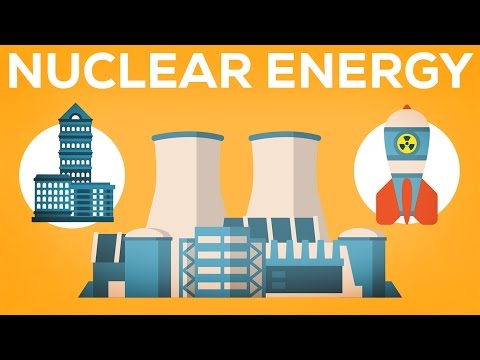 Photo: N43 and Hermes
From the binding energy curve to chain reactions and reactor design — how splitting atomic nuclei releases the energy that powers a tenth of the world's electricity.
Source video: Nuclear Energy Explained: How does it work? 1/3 · Kurzgesagt – In a Nutshell · approximately 8.1M views observed via yt-dlp on August 04, 2026. Independently researched by N43 and Hermes.
The binding energy curve explains why fission releases energy: heavy nuclei like uranium-235 sit below the peak, and their split products climb higher on the curve, with the difference emerging as kinetic energy and radiation.
01 The Discovery: Berlin, December 1938
On a cold Saturday in December 1938, German chemists Otto Hahn and Fritz Strassmann were conducting experiments on uranium that would overturn the understanding of atomic physics. They had been bombarding uranium with neutrons, expecting to produce transuranic elements — atoms heavier than uranium. Instead, their chemical analysis revealed something startling: barium, an element with roughly half the atomic mass of uranium, was present in the products. Hahn was so bewildered that he described the result as impossible to his longtime collaborator Lise Meitner, who had fled Nazi Germany for Sweden months earlier. Hahn and Strassmann published their findings on December 22, cautiously noting that the results contradicted all previous nuclear models.
Within weeks, Meitner and her nephew Otto Robert Frisch provided the theoretical explanation. Working in exile — she in Stockholm, he in Copenhagen — they realized that the uranium nucleus, when struck by a neutron, had split into two smaller fragments, releasing enormous energy in the process. Frisch named the phenomenon "fission" by analogy with the binary fission of living cells, a term suggested in conversation with biologist William A. Arnold. The discovery landed like a thunderclap in the physics community. By February 1939, Niels Bohr brought the news to the United States, and within months, researchers at Columbia University confirmed that additional neutrons were released during fission — opening the door to a self-sustaining chain reaction. The atomic age had begun.
02 Why Fission Releases Energy: The Binding Curve
The energy released in nuclear fission comes down to a fundamental principle of nuclear physics: the binding energy curve. Every atomic nucleus is held together by the strong nuclear force, which overcomes the electromagnetic repulsion between positively charged protons. The strength of this binding is expressed as binding energy per nucleon — the energy required to remove a single proton or neutron from the nucleus. This value varies with mass: it rises steeply from hydrogen, peaks near iron-56 at about 8.8 mega-electron volts per nucleon, and then gradually declines for heavier elements as the growing proton-proton repulsion weakens the overall binding.
Uranium-235 sits at roughly 7.6 MeV per nucleon — below the peak. When it fissions, the resulting fragments (typically elements near mass 95 and 140) have binding energies closer to 8.5 MeV per nucleon. That difference — approximately 0.9 MeV per nucleon across 235 nucleons — amounts to about 200 MeV of total energy per fission event. To put this in perspective: the fission of a single uranium-235 nucleus releases roughly 50 million times more energy than the combustion of a single carbon atom. The energy manifests in several forms: about 165 MeV as kinetic energy of the fission fragments, about 5 MeV as prompt gamma rays, about 7 MeV in fission neutrons, and the remainder in delayed beta decay and gamma radiation from radioactive fission products. This energy distribution, measured and quantified over decades of experiment, is what makes both nuclear power and nuclear weapons possible.
03 The Chain Reaction: Neutron Multiplication
The critical insight that transformed fission from a laboratory curiosity into a world-changing technology was the observation that each fission event releases not only energy but also additional neutrons — typically two to three for uranium-235. If each of those neutrons could induce further fissions, the process would cascade: one fission produces three neutrons, those three produce nine, nine produce twenty-seven, and so on. This is the chain reaction, and its feasibility depends on a critical parameter called the multiplication factor, k. When k is less than 1, the reaction dies out. When k equals exactly 1, the reaction proceeds at a steady rate — the condition for a nuclear reactor. When k exceeds 1, the reaction accelerates exponentially, and in the extreme case of a rapidly assembled supercritical mass, the result is a nuclear explosion.
Not all neutrons cause fission, however. Some escape the system entirely, while others are captured by non-fissile isotopes without splitting. The probability of each outcome depends on neutron energy: uranium-235 fissions most readily with slow (thermal) neutrons, with a fission cross-section — the effective target area for interaction — of about 585 barns at thermal energies, versus only about 1.2 barns for fast neutrons. This is why most reactors employ a moderator: a material like light water, heavy water, or graphite that slows fast neutrons (born at roughly 2 MeV) to thermal energies (about 0.025 eV) through repeated scattering collisions. The moderator is one of the most consequential design choices in nuclear engineering, as it determines which fuel isotopes can sustain a chain reaction and how the reactor responds to temperature changes.
A single uranium-235 fission releases about 200 MeV. The vast majority arrives as kinetic energy of the fragments, which manifests as heat in the reactor fuel.
04 Critical Mass and the Physics of Bombs
The same physics that makes a controlled chain reaction possible in a reactor makes an explosive chain reaction possible in a weapon. The difference lies in timing. In a reactor, the chain reaction is deliberately kept at k ≈ 1, meaning each generation of fissions produces exactly one more. In a bomb, the goal is to reach k significantly above 1 and to do so faster than the assembly can disassemble itself through thermal expansion — which happens in microseconds. The challenge is that at normal density, a sphere of uranium-235 must be larger than a critical radius (about 8.4 centimeters for pure U-235, corresponding to roughly 52 kilograms) to sustain a chain reaction, because too many neutrons escape the surface before they can induce further fissions. This is the concept of critical mass.
The Manhattan Project solved the assembly problem through two approaches. The Little Boy bomb design used a gun mechanism that fired a sub-critical cylinder of U-235 into a sub-critical target ring, forming a supercritical mass in less than a millisecond. The Fat Man design used implosion: conventional explosives arranged symmetrically around a sub-critical plutonium-239 core compressed it to roughly twice normal density, reducing the critical radius enough for the chain reaction to take hold. Plutonium-239 was chosen because its higher fission cross-section and lower critical mass (about 10 kilograms at normal density) made the implosion approach feasible. The explosive yield — 15 kilotons of TNT equivalent at Hiroshima, 21 kilotons at Nagasaki — came from the fission of only about 700 grams and 1 kilogram of material respectively, the rest being scattered before it could react. The efficiency was low, but the energy density was so extreme that even that fraction produced devastation on a scale never before seen.
05 Reactor Design: Controlled Chain Reactions
A nuclear reactor is a machine that maintains the chain reaction at k = 1 — not accelerating, not dying, but steady. The fundamental challenge is that the population of neutrons in the reactor changes exponentially: if k deviates from 1 by even a tiny amount, the power level will rise or fall rapidly. The reactor's response time is governed by delayed neutrons: a small fraction (about 0.65 percent for U-235) of fission neutrons are not emitted promptly but emerge seconds to minutes later from the decay of certain fission products. These delayed neutrons stretch the effective neutron generation time from microseconds to seconds, giving operators and automated control systems enough time to adjust the reactor's reactivity before power levels change dangerously.
Control rods made of neutron-absorbing materials — typically boron, cadmium, or hafnium — are the primary tuning mechanism. Inserted deeper, they absorb more neutrons and reduce reactivity; withdrawn, they allow more fissions. Most power reactors also use negative temperature coefficients: as the core heats up, the chain reaction naturally weakens, providing an inherent safety margin. The most common reactor design worldwide is the light water reactor (LWR), which uses ordinary water as both coolant and moderator. In a pressurized water reactor (PWR), water at 155 atmospheres prevents boiling in the primary loop, transferring heat to a secondary loop where steam drives turbines. In a boiling water reactor (BWR), water boils directly in the core, and the resulting steam drives the turbine. The choice of moderator and coolant determines the reactor's fuel requirements: light water reactors require enriched uranium (3 to 5 percent U-235), while heavy water or graphite-moderated reactors can operate on natural uranium (0.7 percent U-235) because these moderators absorb fewer neutrons.
06 Fission Products and the Waste Problem
When a uranium-235 nucleus fissions, it does not split into identical halves. The two fragments are typically asymmetric — one near mass 95 and the other near mass 140, in a ratio of roughly 3 to 2. These fragments are neutron-rich and therefore radioactive, undergoing beta decay chains that can last from fractions of a second to millions of years depending on the isotope. Some, like iodine-131 with its 8-day half-life, pose intense short-term hazards. Others, like cesium-137 (30-year half-life) and strontium-90 (29-year half-life), dominate the thermal output of spent fuel for decades after removal from the reactor. Still others, like the transuranic isotopes plutonium-239 (24,100-year half-life) and americium-243 (7,370-year half-life), constitute the long-term radiological burden that defines the waste disposal challenge.
A typical 1-gigawatt nuclear plant produces about 27 tons of spent fuel per year, consisting of roughly 95 percent uranium (mostly the non-fissile U-238 isotope), about 1 percent plutonium, and 4 percent fission products plus minor actinides. The total global inventory of spent fuel exceeds 400,000 metric tons as of recent estimates, with roughly 130,000 tons reprocessed to extract reusable plutonium and uranium. The unresolved question is geological disposal: deep repositories designed to isolate waste for hundreds of thousands of years. Finland's Onkalo repository, carved 450 meters into granite bedrock, is the first facility to receive an operating license for permanent disposal. After decades of political and scientific debate, the question is no longer primarily technical — the engineering is understood — but social and institutional: how to maintain warnings and containment records across timescales that exceed the lifespan of any human civilization.
07 The Global Picture: A Tenth of the World's Electricity
As of 2025, nuclear fission supplies roughly 10 percent of global electricity generation, with approximately 440 operable reactors across 32 countries producing about 390,000 megawatts of capacity. The United States operates the largest fleet at 94 reactors, followed by France at 56 — though France derives a far greater share of its electricity from nuclear power (about 65 percent) than any other nation. China's rapid expansion, with over 50 reactors under construction, is reshaping the global landscape; the country plans to add more capacity in the 2020s than the rest of the world combined. Despite this growth, nuclear's share of global electricity has declined from its 1996 peak of about 17.5 percent, largely because total electricity demand has grown faster than nuclear capacity.
The technology's future hinges on a tension between its demonstrated advantages — low operational carbon emissions, reliable baseload power, high energy density — and persistent challenges: capital costs that have ballooned in Western countries, public anxiety intensified by the accidents at Chernobyl (1986) and Fukushima (2011), and the unresolved waste question. Small modular reactors (SMRs), Generation IV designs with passive safety systems, and advanced fuel cycles that reduce long-lived waste all promise to reshape the calculus. But fission's fundamental physics — the splitting of heavy nuclei to release binding energy — remains unchanged since that December afternoon in Berlin when Hahn and Strassmann found barium where no one expected it. The science is settled. The engineering, economics, and politics are not.
References
- Wikipedia: Nuclear fission — discovery, physics, and applications of nuclear fission
- Wikipedia: Nuclear chain reaction — multiplication factor, criticality, and reactor dynamics
- World Nuclear Association, How Nuclear Reactors Work — reactor types and operating principles
- International Atomic Energy Agency, Power Reactor Information System (PRIS) — global reactor database and capacity statistics
- U.S. NRC, Reactor Licensees and Operating Reactors — regulatory and technical documentation
- Source video: Nuclear Energy Explained: How does it work? 1/3 (Kurzgesagt – In a Nutshell, ~8.1M views, observed August 04, 2026)
By N43 and Hermes for Sailor Bob News.


