The race to mine the bottom of the ocean
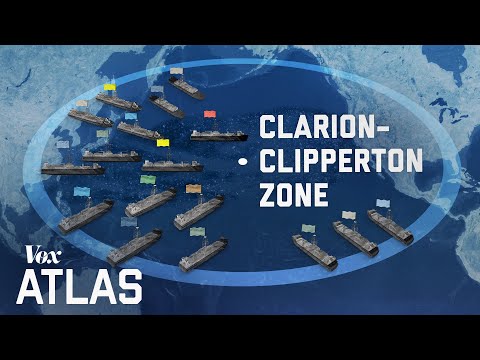 Photo: N43 and Hermes
Manganese nodules on the abyssal plain hold the metals the energy transition needs. The technology to collect them exists. The question is whether the ocean can survive the collection.
The Clarion-Clipperton Zone in the central Pacific has the highest nodule abundance, making it the primary target for exploration.
Hydraulic collectors, which use suction to lift nodules, produce the widest sediment plumes but are the most commercially mature design.
01The geology of seabed mineral deposits
The ocean floor is not uniform. It is a geological mosaic of spreading ridges, abyssal plains, seamounts, and subduction trenches, each with different mineral potential. The deposits that matter for mining are concentrated in three settings: abyssal plains dotted with polymetallic nodules, active hydrothermal vents forming massive sulphide deposits, and seamounts encrusted with cobalt-rich ferromanganese.
The abyssal plain is the largest and flattest feature, covering roughly half the Earth's surface. It is here, at depths between 4,000 and 6,000 metres, that polymetallic nodules accumulate in numbers that make them commercially interesting. The process is extraordinarily slow — nodules grow by a few millimetres to centimetres per million years — but the accumulation has been running for tens of millions of years.
Hydrothermal vents, by contrast, are dynamic and short-lived on geological timescales. They form where seawater percolates into the crust, is heated by magma, and emerges laden with dissolved metals that precipitate on contact with cold ocean water. The resulting sulphide chimneys are rich in copper, zinc, gold and silver, but they are also oases of chemosynthetic life found nowhere else.
02Manganese nodules and their economic value
Polymetallic nodules are the centrepiece of the deep-sea mining debate. These dark, roughly spherical concretions lie loose on the sediment surface, requiring no drilling or blasting to collect. Their composition — manganese, iron, copper, nickel, cobalt — maps almost exactly onto the inputs of lithium-ion battery production.
The economic case rests on concentration. A nodule is roughly 30% target metals by weight. A typical terrestrial copper ore is under 1%. This means that for every tonne of useful metal, a nodule operation moves far less material than a land mine — at least on paper. The full life-cycle comparison, including the energy cost of operating at 5,000 metres depth, is more complex.
The Clarion-Clipperton Zone, a 4.5 million square kilometre region between Hawaii and Mexico, is the most studied and most claimed area. Estimates of nodule tonnage in the CCZ exceed 21 billion metric tonnes. At current metal prices, the gross metal value is in the trillions of dollars — a figure that explains the intensity of commercial interest.
03Mining technology: how it works underwater
The engineering challenge is extracting nodules from 5,000 metres down and lifting them to a surface vessel. The current approach has three components: a seabed collector that crawls across the plain and scoops or vacuums nodules from the sediment; a riser pipe that lifts the collected material to the surface as a slurry; and a production support vessel that processes the slurry and offloads it to transport ships.
Collector designs fall into two categories. Mechanical collectors use buckets or drums to physically lift nodules. Hydraulic collectors use suction, drawing nodules and surrounding sediment up through an intake. Both designs generate sediment plumes — the disturbed fine material that remains suspended in the water column after the nodules are removed.
The riser pipe is the bottleneck. A vertical pipe of five kilometres length, carrying a dense mineral slurry, requires enormous pumping power and presents failure modes that have no shallow-water analogue. The technology borrows from offshore oil and gas, but the depths, the material, and the environmental sensitivity are all new.
04The ISA and seabed governance
The International Seabed Authority, headquartered in Kingston, Jamaica, is the only body with jurisdiction over mineral resources on the seabed in areas beyond national jurisdiction. Its authority derives from the UN Convention on the Law of the Sea, which declares the seabed the 'common heritage of mankind'.
The ISA's structure reflects the tension at the heart of seabed governance: it must both enable mining and protect the marine environment. Its 171 member states, plus the European Union, must agree on exploitation regulations that balance commercial access, environmental protection, and the equitable sharing of financial benefits — a revenue-sharing mechanism that does not yet exist in operational form.
The governance gap is not theoretical. Exploration contracts have been issued for over a decade, but the exploitation regulations that would govern actual mining remain under negotiation. The 'two-year rule' mechanism, triggered by Nauru in 2021, was intended to force a decision. The deadline passed without final rules, leaving the legal path to commercial mining uncertain and contested.
05Marine biodiversity in mining zones
The abyssal plain is not barren. It is a low-biomass but high-diversity ecosystem, structured by the slow rain of organic material from the surface ocean and the geological stability of the deep seafloor. Most of its inhabitants — xenophyophores, holothurians, isopods, polychaetes — are small, slow-growing, and endemic to the regions they inhabit.
Nodules themselves are habitat. Many benthic organisms attach to or live on the surface of nodules, which provide hard substrate in an otherwise soft-sediment environment. Removing the nodules removes the substrate. The fauna that depend on them do not have an alternative surface to colonise, because the nodules are the only hard surface for thousands of square kilometres.
Scientific understanding of these ecosystems is fragmentary. Large-scale biological surveys of the CCZ began only in the 2000s, and each expedition still discovers species new to science. The baseline against which mining impacts would be measured is incomplete — a fact that underpins the precautionary argument against proceeding before the science is adequate.
06The circular economy alternative
If the deep-sea mining case is built on battery metal demand, the circular economy argument attacks it from the demand side. Metals are not consumed — they are used. Cobalt, nickel, copper and manganese in a battery can be recovered at end of life and returned to the production cycle, reducing or eliminating the need for primary extraction.
Battery recycling rates are currently low — globally under 5% for lithium-ion batteries — but they are rising as collection infrastructure, regulation, and recycling technology mature. The EU Battery Regulation mandates minimum recycled content for new batteries from 2031. If recycling scales to the point where secondary supply meets a large share of demand, the pressure to open new mines — terrestrial or marine — weakens.
The circular economy does not eliminate the need for primary metals, because the stock of batteries in use is still growing and will require virgin material for decades. But it changes the calculus: every tonne of metal recovered from a spent battery is a tonne that does not need to be scraped from the deep ocean floor. The question is how fast recycling can scale relative to the mining industry's timeline.
07The tipping point for ocean mining
Deep-sea mining has not begun at commercial scale. But the infrastructure is being built, the regulations are being drafted, and the first exploitation contracts could be issued within years. Whether the industry crosses from exploration to extraction depends on three variables: metal prices, the regulatory process, and public and market pressure.
If metal prices remain high and the ISA finalises exploitation rules on terms favourable to miners, commercial extraction could begin in the late 2020s. If prices fall, the economics weaken. If the regulatory process stalls or a moratorium gains broader support, the timeline extends. The outcome is not predetermined — it is being decided now, in rooms most people have never heard of.
The deeper question is what kind of relationship with the ocean this represents. For all of human history, the deep sea has been beyond reach — a place we could imagine but not alter. That is changing. The race to mine the bottom of the ocean is, in the end, a decision about whether the last inaccessible place on Earth becomes the next industrial frontier, or remains what it has been: a commons, governed by restraint rather than extraction.


