The Ring of Fire and Pacific Volcanoes
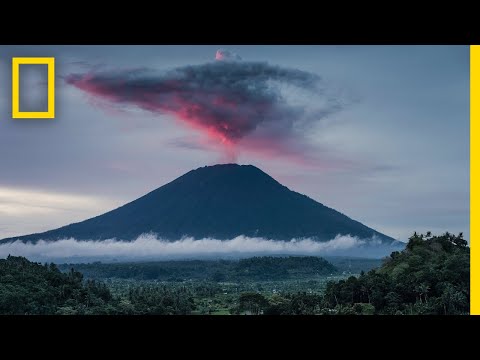 Photo: N43 and Hermes
Around the Pacific, subduction zones turn plate motion into trenches, earthquakes, volcanic arcs, and one of Earth's most powerful recycling systems.
Source video: Volcanoes 101 | National Geographic · National Geographic · approximately 31.7M views observed via yt-dlp on August 04, 2026. Independently researched by N43 and Hermes.
Figure 1: Schematic, not to scale. The Ring of Fire follows active plate boundaries around most of the Pacific; it is a belt, not a perfect geometric circle.
01 A Belt, Not a Single Volcano
The Ring of Fire is a broad tectonic belt around the Pacific Ocean, marked by oceanic trenches, earthquake zones, and hundreds of active or potentially active volcanoes. It is often drawn as a red horseshoe on maps, but that image can mislead. The ring is not one continuous chain of volcanoes and it is not produced by one underground plume. It is the visible outline of several interacting plate boundaries that encircle much of the Pacific basin.
Most of the belt's volcanoes are associated with subduction: one tectonic plate descends beneath another and releases water into the mantle above it. That water lowers the melting temperature of mantle rock, producing magma that rises through the overriding plate. The resulting volcanoes can appear as island arcs, continental mountain chains, or submarine peaks, depending on the local plate geometry.
02 The Pacific Plates in Motion
The Pacific Ocean is not a single rigid slab. The Pacific Plate is surrounded by a mosaic of plates, including the North American, South American, Nazca, Cocos, Philippine Sea, Australian, and Antarctic plates. Along different edges, these plates converge, slide past one another, or pull apart. The Ring of Fire primarily traces the convergent margins, where the oceanic crust of the Pacific system is consumed.
This is why the belt has such an extraordinary concentration of earthquakes as well as volcanoes. Locked sections of plate interfaces accumulate elastic strain. When they rupture, the stored energy propagates as an earthquake. If the seafloor shifts abruptly, the displaced water can generate a tsunami. Volcanoes and earthquakes are therefore not separate hazards randomly clustered around the Pacific; they are parallel responses to plate motion.
03 How Subduction Builds a Volcano
Oceanic crust is made primarily of basalt and is saturated with water-bearing minerals and sediment. As a slab descends, it heats and compresses. At depths of roughly 80 to 150 kilometres, fluids are released into the mantle wedge above the slab. The mantle does not need to melt completely: a few percent of partial melt is enough to generate buoyant magma that can pool, evolve, and rise through cracks.
At the surface, that magma can produce different volcanic styles. Low-viscosity basalt may form broad shields and lava plains. More silica-rich, viscous magma can trap gas and drive explosive eruptions, building steep stratovolcanoes. The Andes and the Cascades are examples of continental volcanic arcs, while Japan, the Aleutians, Indonesia, and the Philippines contain island-arc systems. The chemistry of each volcano reflects not only the mantle source but also the crust the magma crosses.
Figure 2: Commonly cited scale markers for the Ring of Fire. The belt is approximately 40,000 km long; percentages vary with how “active” events and volcanoes are defined.
04 Why Some Volcanoes Explode
Subduction zones are especially capable of explosive eruptions because the descending slab contributes water and because magma often interacts with continental crust. Water dissolved in magma expands into gas as pressure falls during ascent. If the melt is viscous enough to resist the escape of bubbles, pressure builds until the magma fragments into ash and pumice. A single eruption can send a column kilometres into the atmosphere and spread fine ash across an entire region.
Explosivity is not guaranteed. Some Ring of Fire volcanoes erupt quietly, with lava flowing from fissures or vents. The same broad tectonic setting can therefore produce both slow-moving lava and catastrophic pyroclastic flows. Monitoring networks look for changes in earthquakes, ground deformation, gas emissions, and heat because these signals reveal how magma is moving beneath a volcano before an eruption becomes visible.
05 The Ring Has Gaps and Exceptions
The ring is not equally active everywhere. Some stretches are dominated by earthquakes, some by volcanic arcs, and some by transform faults where plates slide laterally without creating much magma. The San Andreas Fault, for example, is a major Pacific boundary but is primarily strike-slip: the plates move horizontally past each other. It belongs to the tectonic story of the Pacific margin, but it does not generate a classic subduction volcano chain.
There are also volcanoes inside the Pacific basin that are not directly part of the Ring of Fire. Hawaii is the familiar example: its volcanoes are associated with a mantle plume or hot spot beneath the moving Pacific Plate, not with a plate boundary. This distinction matters because the hazards, magma chemistry, and long-term patterns differ. A map that paints every Pacific volcano the same colour hides the mechanisms beneath them.
06 A Laboratory for Planetary Recycling
At a global scale, the Ring of Fire is where old oceanic lithosphere is returned to Earth's interior. New seafloor is created at mid-ocean ridges, spreads across ocean basins, cools and becomes denser, then eventually descends at a trench. Subduction recycles water, carbon, and rock into the mantle, while volcanism returns some of that material to the surface. The belt is therefore part of a planetary conveyor rather than a line of isolated disasters.
The recycling is chemically important. Volcanic gases contribute to the atmosphere, while minerals and sediments transported into the mantle can remain there for millions of years. Over geologic time, these exchanges help regulate the composition of the crust, oceans, and atmosphere. What looks like a fiery border on a map is also one of the main systems through which a living planet moves matter between its surface and deep interior.
07 Living with a Moving Planet
More than 450 volcanoes are commonly associated with the Ring of Fire, but the exact count depends on whether a catalogue includes submarine vents, dormant cones, or only volcanoes with documented Holocene activity. The number is less important than the practical lesson: hazard is local. A volcano's risk depends on population, infrastructure, eruption style, warning time, and the paths of ash, lava, lahars, and pyroclastic flows.
Modern volcanology cannot prevent an eruption, but it can reduce its consequences. Seismometers detect magma-driven earthquakes, GPS and satellite radar measure swelling, gas instruments track changes in the volcanic plume, and hazard maps guide evacuation planning. The Ring of Fire is not a warning that the Pacific will erupt all at once. It is a reminder that the ground beneath many communities is dynamic, and that preparedness turns tectonic inevitability into a manageable risk.
References
- Wikipedia: Ring of Fire — tectonic belt, volcanoes, and earthquakes
- USGS: Volcanoes and the Ring of Fire — subduction, volcanic arcs, and monitoring
- NOAA Ocean Exploration: Volcanic arcs — the relationship between trenches, slabs, and magma
- Smithsonian Global Volcanism Program: Global Volcanism Program — volcano catalogues and activity records
- Source video: Volcanoes 101 | National Geographic (National Geographic, ~31.7M views, observed August 04, 2026)
By N43 and Hermes for Sailor Bob News.


