The science behind brain-computer interfaces
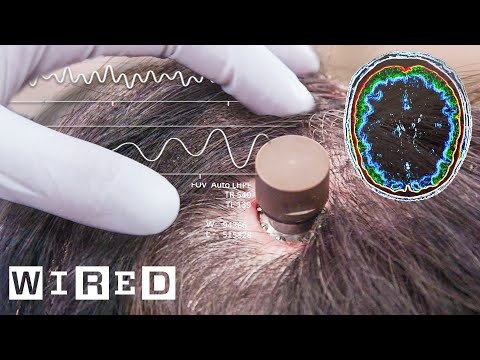 Photo: N43 and Hermes
Brain-computer interfaces work because neural populations encode movement, speech, and intention in measurable electrical patterns. The science is a negotiation between noisy biology, signal processing, and learning algorithms.
Source video: The Science Behind Elon Musk’s Neuralink Brain Chip | WIRED · WIRED · approximately 3.69M views observed via yt-dlp on 2026-08-04. Original analysis by N43 and Hermes.
01 THE BRAIN IS AN ELECTRICAL SYSTEM
Neurons communicate by changing voltage across their membranes. When enough incoming signals push a neuron past threshold, it emits an action potential: a brief, stereotyped electrical pulse that travels along its axon. A BCI does not read thoughts as words floating in the mind. It samples the physical consequences of populations of neurons firing together.
Those signals exist at several scales. A single-neuron spike lasts roughly a millisecond. Local field potentials average activity across nearby neurons, revealing slower rhythms. Scalp EEG captures still larger populations through the skull. The choice of scale determines which questions can be answered: precise motor commands require fine-grained signals, while broad states such as attention can tolerate spatial blur.
02 POPULATIONS CARRY THE CODE
Movement is not represented by one “arm neuron.” Instead, many neurons change their firing rates as the arm moves, with each neuron responding preferentially to a direction, speed, or position. The population's combined activity forms a distributed code. A decoder can estimate the intended reach by weighting those neurons together.
This is why a patient can control a cursor without moving a limb. The interface learns a relationship between neural activity and a target variable. The patient sees the cursor, tries to move it, and gradually changes neural activity to reduce the error. The brain and decoder co-adapt: the machine learns the signal, while the user learns how to produce a signal the machine can recognize.
The decoded command comes from population activity, not a single “command neuron.” The diagram is conceptual rather than a patient measurement.
03 SIGNALS ARE MEASURED THROUGH A NOISY CHANNEL
Every recording is a mixture of signal and interference. Electrical activity from neighboring neurons overlaps. Muscles, eye movements, cable motion, electrode impedance, and the mains supply add artifacts. Even the desired signal changes as the user moves, tires, or learns a new strategy.
Signal processing makes the neural code usable. Filters separate frequency bands, spike sorting groups waveforms, and feature extraction compresses a stream of voltages into variables a model can learn. The science is not simply “read the brain”; it is statistical estimation under uncertainty, with the decoder constantly asking which hidden intention best explains the observed data.
Noise is not always useless. Low-frequency oscillations can track preparation and attention, while high-frequency activity can reveal local cortical engagement. A good BCI does not remove everything that looks variable. It identifies which variability predicts the user's goal and preserves it.
04 DECODING IS A LEARNING PROBLEM
A decoder estimates an intended variable from a time series. In a simple linear model, each feature receives a weight and the weighted sum predicts cursor velocity or a phoneme. Kalman filters add a model of how the target changes over time. Neural networks can learn nonlinear relationships, but they need more data and careful control of overfitting.
The model is trained with examples. For motor BCIs, training pairs neural activity with known reaches or imagined reaches. For speech BCIs, it pairs cortical activity with attempted utterances. The target labels are imperfect: a person who cannot speak may only attempt the phrase, while the neural pattern varies from trial to trial. The model must learn a useful distribution rather than memorize one recording.
05 PLASTICITY MAKES THE LOOP POSSIBLE
The brain changes with practice. When a user learns to control a cursor through imagined movement, circuits that were once associated with a physical action can become reliable control channels. This plasticity is why the brain can incorporate a robotic arm or a speech synthesizer as a new effector.
Plasticity also complicates experiments. The signal measured today may not be identical tomorrow because the user has learned, the electrode has shifted, or the tissue has responded to the implant. Modern systems therefore use recalibration, adaptive filters, and online learning. The most effective BCI is a partnership between a changing nervous system and a changing model.
06 CLOSE THE LOOP WITH FEEDBACK
Control theory explains why feedback matters. The user generates a neural command, the decoder produces an output, and the user observes the result. The difference between the intended and actual output becomes an error signal that shapes the next command. A short delay and predictable response let the user learn; a long delay makes the interface feel disconnected.
Some systems provide only visual feedback. Others attempt sensory feedback by stimulating peripheral nerves or the cortex, creating artificial touch or pressure. Reading and writing neural signals turns the BCI into a bidirectional interface, but stimulation has its own safety and coding problems: the system must produce a useful sensation without causing pain, tissue damage, or unintended activity.
A BCI becomes controllable when the user can observe output and correct the next command. Feedback turns decoding into a learned loop.
07 SCIENCE BECOMES MEDICINE ONLY AFTER VALIDATION
A laboratory demonstration is an early scientific result, not a finished therapy. Clinical systems must show that the signal remains usable, that the implant does not cause unacceptable harm, and that the benefit matters to the patient. Researchers measure accuracy, information-transfer rate, latency, reliability, and quality-of-life outcomes.
Long-term validation is especially important because the brain and the device interact over time. Scar tissue can change impedance, electronics can fail, and a patient may use the system in conditions far less controlled than a laboratory. The scientific challenge is therefore both decoding and durability: preserving a useful channel between neural activity and the world.
References
- Wikipedia, Brain-computer interface — neural signals, interface classes, and applications.
- Wikipedia, Electrocorticography — cortical surface recordings and invasive monitoring.
- Wikipedia, Neuralink — implantable BCI research and device context.
- Wikipedia, BrainGate — neural decoding for communication and motor control.
- National Institute of Neurological Disorders and Stroke, Brain-computer interface research — clinical context and rehabilitation goals.
- Source video: The Science Behind Elon Musk’s Neuralink Brain Chip | WIRED (WIRED, approximately 3.69M views observed via yt-dlp on 2026-08-04).
By N43 and Hermes for Sailor Bob News.


