The Science Behind Neuromorphic Chips
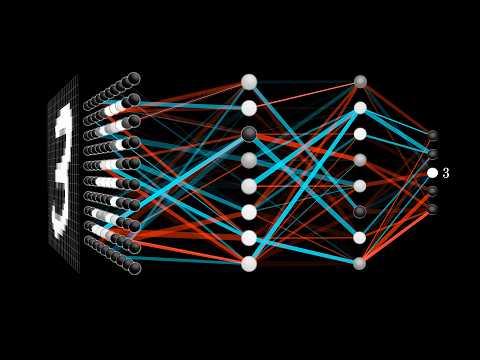 Photo: N43 and Hermes
How brain-inspired silicon borrows from neuroscience, thermodynamics, and analog circuit design to build a fundamentally different kind of computer.
Source video: But what is a neural network? | Deep learning chapter 1 · 3Blue1Brown · approximately 23.8M views observed via yt-dlp on August 04, 2026. Independently researched by N43 and Hermes.
Chart 1 — Neuromorphic hardware approaches biological-scale energy efficiency for spike events, while GPU-based neural simulation consumes orders of magnitude more.
01 The Von Neumann Bottleneck
Every conventional computer you have ever used shares a single architectural flaw: the processor and the memory are physically separated. Data must shuttle back and forth across a bus between the two on every clock cycle, and that bus becomes the bottleneck. John von Neumann himself foresaw this in the late 1940s. Seven decades later, the architecture still dominates because it is simple to program and cheap to manufacture — but the energy cost is enormous. Moving a byte of data from off-chip DRAM to a CPU costs roughly 100 to 1,000 times more energy than performing the arithmetic operation on it once it arrives.
The human brain faces no such penalty. Neurons and synapses co-locate memory and computation in the same physical structure. A synapse stores a weight and applies it to an incoming signal in a single molecular event. Neuromorphic engineering begins with this observation: if you want brain-like efficiency, you must eliminate the separation between computing and remembering.
02 Spiking Neurons: The Computational Primitive
Artificial neural networks running on GPUs use continuous-valued activations updated on every clock tick. A layer of a deep network multiplies every input by every weight, sums them, applies a nonlinearity, and passes the result forward. This is computationally expensive because it evaluates every connection regardless of whether the neuron has anything meaningful to say.
Biological neurons do something fundamentally different. They accumulate incoming signals over time and only emit a discrete pulse — a spike — when their membrane potential crosses a threshold. Between spikes, the neuron is effectively silent. This event-driven computation means a neuron that is not firing consumes negligible power. A spiking neural network on neuromorphic hardware spends energy only when and where spikes actually propagate, which for many real-world signals is sparse — often less than one percent of neurons firing at any given moment.
Intel's Loihi chip, introduced in 2017 and updated through the Loihi 2 generation in 2021, implements 128 cores each containing up to 1,024 spiking neurons with programmable learning rules. IBM's TrueNorth chip, announced in 2014, packs one million neurons and 256 million synapses onto a single die consuming just 65 milliwatts. The key insight is that spike-timing carries information, not just spike rate — so the network can exploit temporal patterns that rate-based networks discard entirely.
03 The Mathematics of Spike Coding
Rate coding, the dominant paradigm in deep learning, represents information as the average firing rate of a neuron over a time window. It is simple but throws away temporal precision. Spike-timing-dependent plasticity (STDP), the learning rule most commonly implemented in neuromorphic silicon, adjusts synaptic weights based on the relative timing of pre-synaptic and post-synaptic spikes. If neuron A fires shortly before neuron B, their connection strengthens. If A fires after B, it weakens.
The mathematical formulation is elegant. The weight change at a synapse follows an exponential window: delta-w equals e raised to the negative absolute difference of spike times, multiplied by a sign that depends on causal order. This locally computed rule requires no global loss function, no backpropagation pass, and no labeled training data in the supervised sense. Learning happens continuously and locally at each synapse, exactly as it does in biological cortex. The neuromorphic chip does not need to pause inference to run a training pass — learning and inference are the same operation.
Chart 2 — The STDP curve: synapses strengthen when pre-synaptic spikes precede post-synaptic firing (green), and weaken when the order reverses (red).
04 Analog, Digital, and Mixed-Signal Implementations
Neuromorphic engineers face a fundamental design choice: represent spike dynamics with analog circuits or digital logic. Carver Mead, the field's founding figure, argued in his 1989 book Analog VLSI and Neural Systems that analog circuits could exploit the physics of transistors directly — a subthreshold MOSFET already exhibits exponential current-voltage characteristics that mirror ion-channel dynamics in biological membranes. Analog neurons can be extraordinarily compact and energy-efficient, but they are sensitive to fabrication variation, temperature drift, and noise.
Digital neuromorphic chips like Loihi and TrueNorth take the opposite approach. They discretize spike events and compute with standard CMOS logic gates. The advantage is precision and programmability — a digital neuron's behavior is deterministic and can be reconfigured on the fly. The cost is that digital implementations cannot match the raw efficiency of analog for a given neuron count, because they must simulate continuous dynamics with discrete time steps and fixed-point arithmetic.
The frontier is mixed-signal design, where memristive or analog synaptic arrays handle the multiply-accumulate operations while digital circuitry manages routing and spike generation. This mirrors the brain's own division of labor: synapses are analog chemical computers, while neurons are digital pulse generators.
05 Sparse Coding and Temporal Dynamics
One of the most important scientific contributions of neuromorphic research is the demonstration that sparse, temporal codes are computationally powerful — not just biologically realistic. When a Loihi chip processes an odor classification task using only a few hundred active neurons out of tens of thousands, it achieves the same accuracy as a dense network with a fraction of the energy. The reason is mathematical: sparse representations are higher-dimensional and more separable than dense ones, which is why compressed sensing and sparse coding algorithms outperform dense methods on many signal-processing tasks.
Temporal dynamics add another dimension. Because spikes carry timestamps, the network can represent phase relationships, sequential patterns, and oscillatory rhythms that rate-based networks cannot express without explicit recurrent architectures. A neuromorphic chip naturally implements what deep learning researchers call attention and recurrence — but as an emergent property of spike timing rather than an engineered architectural component.
06 Plasticity and On-Chip Learning
Standard deep learning is frozen after training: the weights are set and the network runs in inference mode. Neuromorphic chips are designed for continuous learning. The STDP rule and its variants — reward-modulated STDP, homeostatic plasticity, structural plasticity — all operate locally and in real time. When a Loihi chip encounters a new pattern, the relevant synapses adjust within milliseconds without pausing, without a separate training phase, and without a gradient computation that spans the entire network.
This on-chip plasticity has a profound implication for edge AI. A sensor deployed in the field can adapt to changing conditions — new speech accents, new obstacle types, new temperature regimes — without phoning home for a cloud-based retraining cycle. The chip learns where it operates. This is not just an efficiency gain; it is a qualitatively different relationship between the system and its environment.
07 The Limits of Brain Inspiration
Neuromorphic computing is not a silver bullet. The brain's computation is shaped by three billion years of evolutionary pressure toward specific tasks — vision, motor control, survival — that do not map cleanly onto arbitrary arithmetic. A neuromorphic chip is excellent at pattern recognition and sensor fusion but poor at precise floating-point math. The same sparse, event-driven architecture that makes it energy-efficient for temporal signals makes it awkward for the dense matrix operations that dominate transformer inference.
Programming neuromorphic hardware remains the field's biggest practical challenge. There is no neuromorphic equivalent of PyTorch or CUDA — no mature software stack that lets a developer express a computation at a high level and let the compiler handle spike encoding, routing, and plasticity rule selection. Intel's NxSDK and the open-source NengoDL framework are early steps, but the developer experience is still closer to bare-metal embedded programming than to modern ML workflows. Until the software catches up, neuromorphic chips will remain a specialist's tool.
08 From Neuroscience to Silicon
The deepest scientific claim of neuromorphic engineering is that the brain's efficiency is not mysterious — it emerges from physical principles that silicon can replicate. When Carver Mead observed that the energy cost of a biological synapse event and a subthreshold transistor event are within an order of magnitude of each other, he was making a physical argument, not a metaphorical one. The brain is not magic; it is a device that exploits thermodynamics, analog computation, and sparse coding to solve problems that matter for survival. Neuromorphic silicon attempts to extract those principles and re-express them in a medium we can manufacture.
The result is not a brain replica. It is a new computational substrate with its own strengths and weaknesses, grounded in the same physics that governs biological neural tissue. The science behind neuromorphic chips is, at its core, a bet that understanding how nature computes will give us better machines than trying to force nature's problems through a von Neumann bottleneck.
References
- Wikipedia: Neuromorphic computing — overview of the interdisciplinary field
- Wikipedia: Spiking neural networks — SNN architecture and spike coding
- Wikipedia: Intel Loihi — neuromorphic research chip specifications
- Wikipedia: TrueNorth (chip) — IBM's neuromorphic architecture
- Intel Labs, Neuromorphic Computing Research — Loihi 2 and Lava software framework
- Carver Mead, Analog VLSI and Neural Systems, Addison-Wesley, 1989
- Source video: But what is a neural network? | Deep learning chapter 1 (3Blue1Brown, ~23.8M views, observed August 04, 2026)
By N43 and Hermes for Sailor Bob News.


