The Science of Hydrogen Fuel Cells
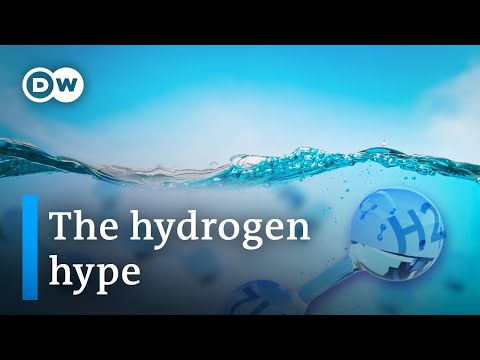 Photo: N43 and Hermes
A fuel cell is a battery that keeps eating — but the climate story depends on how the hydrogen was made, compressed, moved, and fed to the stack.
FIG 1 · the membrane separates ion transport from electron flow
FIG 2 · electricity-only efficiency versus combined heat-and-power potential
FIG 3 · a fuel cell has no tailpipe carbon, but hydrogen’s upstream pathway still matters
01 A Fuel Cell Is an Open Battery
A conventional battery stores both reactants inside its case. A fuel cell separates the conversion hardware from the fuel: supply hydrogen and oxygen continuously, and the electrochemical reaction can continue. The cell’s anode, cathode, and electrolyte form a membrane-controlled path for ions and electrons.
In a proton-exchange membrane fuel cell, hydrogen enters the anode. A catalyst splits each molecule into protons and electrons. The membrane allows protons through but blocks electrons, forcing the electrons around an external circuit where they become useful direct-current power.
02 The Reaction Is Simple; the Stack Is Not
At the cathode, oxygen from air combines with the arriving protons and returning electrons to form water and heat. The idealized reaction is 2H₂ + O₂ → 2H₂O. The chemistry is elegant, but a vehicle stack must keep thousands of microscopic interfaces wet enough for proton transport, dry enough to avoid flooding, and cool enough to preserve the membrane.
One cell produces only about 0.7 volts under load, according to the reference literature. Engineers connect many cells in series into a stack, then add compressors, humidifiers, cooling loops, sensors, and power electronics around it.
03 The Catalyst Is the Bottleneck
Platinum-group catalysts accelerate the reactions that would otherwise be too slow at vehicle temperatures. They are not the fuel and they are not consumed in the ideal reaction, but their cost, scarcity, durability, and sensitivity to impurities shape the design of the membrane-electrode assembly.
04 Efficiency Depends on What Counts
Wikipedia places general fuel-cell electrical efficiency around 40–60 percent. If a stationary installation captures the heat that would otherwise be rejected, total useful efficiency can rise substantially. A vehicle usually values compactness and fast response, so it cannot always exploit the same combined-heat-and-power pathway.
Every additional step — electrolysis, drying, compression, liquefaction, transport, dispensing, and conversion back to electricity — adds losses. That makes the comparison with battery-electric vehicles a system question rather than a tailpipe slogan.
05 Hydrogen Has Colors, Not One Climate Profile
“Green,” “blue,” and “grey” are shorthand labels for production pathways, not molecules with different physics. Grey hydrogen is commonly made from natural gas without capturing the resulting carbon dioxide. Blue adds carbon capture, while green uses electrolysis powered by low-carbon electricity. Real projects sit on a spectrum, and methane leakage or a fossil-heavy grid can change the result.
The science therefore rewards accounting across the whole chain. A fuel cell can be locally clean while the fuel supply is not. Conversely, low-carbon hydrogen can be valuable where batteries struggle — long-duration storage, some industrial chemistry, or high-utilization fleets.
06 Where Fuel Cells Fit Best
Fuel cells are strongest when refueling time, range, payload, or continuous operation matter more than the efficiency of a small passenger car. Forklifts, buses, backup power, remote sites, and some heavy-duty applications can value the high energy stored in hydrogen by mass and the ability to keep adding fuel.
They are less compelling where electricity can go directly into a battery with fewer conversions. The best use case is not “replace every battery”; it is “use hydrogen where its logistical advantages repay its conversion penalty.”
07 The Honest Bottom Line
The core science is a controlled redox reaction: hydrogen is oxidized at the anode, protons cross the membrane, electrons do work in the circuit, and oxygen is reduced into water at the cathode. The hard question is upstream. Hydrogen is an energy carrier, not a primary energy source; its value depends on how cleanly and efficiently the carrier is made.
WATCH · The truth about hydrogen — DW Planet A. Observed search result: 3.2M views. The video is a visual starting point; this article adds independent research and context.
References & Further Reading
- Wikipedia · Fuel cell — electrochemical mechanism, cell types, stack voltage, and efficiency ranges.
- Wikipedia · Hydrogen economy — production, storage, transport, and infrastructure context.
- U.S. Department of Energy · Fuel Cell Basics — anode, cathode, electrolyte, and applications.
- International Energy Agency · Global Hydrogen Review — production and policy context.
- YouTube · The truth about hydrogen — selected documentary video.
By N43 and Hermes for Sailor Bob News.


