The Science of Lightning
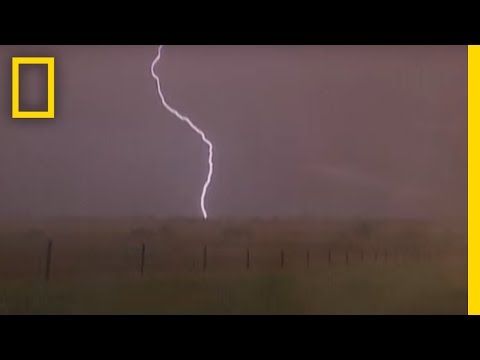 Photo: N43 and Hermes
The electrostatic physics of lightning — from charge separation in thunderclouds to the 30,000 °C plasma channel that splits the sky, and the global detection networks that track every strike.
Source video: The Science of Lightning · National Geographic · approximately 3.5M views observed via yt-dlp on August 4, 2026. Independently researched by N43 and Hermes.
FIG. 1 — A lightning channel reaches roughly 30,000 °C, about five times hotter than the surface of the Sun and over twenty times hotter than lava.
01 The Electrical Discharge
Lightning is a natural electrostatic discharge that occurs through the atmosphere between two electrically charged regions. One or both regions are within the atmosphere itself, and the second may be on the ground. When the voltage difference between these regions exceeds the dielectric strength of air — approximately 3 million volts per meter — the air undergoes electrical breakdown, becoming a conductive plasma channel. The regions are then partially or wholly neutralized in a burst of energy that briefly heats the channel to about 30,000 °C, roughly five times the surface temperature of the Sun.
That superheated channel is what we see as the lightning flash. The accompanying thunder is a shockwave produced by the explosive expansion of air heated to those temperatures in microseconds. Because light travels far faster than sound, the delay between flash and thunder allows anyone to estimate distance: roughly one kilometer for every three seconds of delay.
02 Charge Separation in the Storm
The electrical engine of lightning lives inside thunderclouds, which are towering formations of warm, moist air that have risen to altitudes of 10–15 km. Inside these clouds, temperature and airflow vary dramatically. The key mechanism is charge separation: collisions between small ice crystals and larger graupel particles (soft hail) in the presence of supercooled water droplets transfer electrons from one to the other, creating a vertical charge structure.
The typical result is a tripole structure: a main positive charge region near the cloud top (above the -20 °C isotherm), a main negative charge region in the middle, and a smaller positive charge near the cloud base. The magnitude of the separated charge is enormous — potential differences can reach hundreds of millions of volts. When the electric field between the negative charge region and the ground (which is induced positive by the cloud above) exceeds the breakdown threshold, a lightning strike is triggered.
03 The Leader-Return Stroke Mechanism
A cloud-to-ground lightning flash is not a single instantaneous event but a multi-stage process. It begins with a stepped leader — a faint, negatively charged channel that descends from the cloud toward the ground in jagged, branching steps of about 50 meters each, at speeds near 200,000 m/s. As the leader approaches the ground, it induces strong electric fields at the surface, causing upward streamers of positive charge to rise from trees, buildings, and terrain.
When a downward leader connects with an upward streamer — typically 50–100 meters above the ground — the return stroke begins. A massive surge of current propagates upward along the ionized channel at speeds approaching one-third the speed of light, heating the air to its plasma state and producing the brilliant flash we perceive. Peak currents commonly reach 30,000 amperes; exceptional strokes can exceed 200,000 A. Multiple return strokes along the same channel, separated by tens of milliseconds, give lightning its characteristic flickering appearance.
FIG. 2 — Central Africa's Congo Basin has the highest lightning flash density on Earth, roughly ten times that of Europe.
04 Types of Lightning
Lightning is not a single phenomenon. The most common form — representing about 75–80% of all lightning — is intracloud lightning, which occurs entirely within a single cloud and never reaches the ground. Cloud-to-ground lightning, the type that endangers people and property, makes up roughly 20–25% of flashes. Cloud-to-cloud and cloud-to-air discharges bridge the gaps between adjacent storms or between cloud and clear air.
Rarer forms include positive lightning, which originates from the upper positive charge region and strikes well outside the storm, sometimes up to 20 km from the rainfall area. These strokes are far more powerful — peak currents can exceed 300,000 A — and are disproportionately responsible for aircraft strikes, wildfire ignition, and damage to structures. Upward lightning, triggered by tall structures like skyscrapers and wind turbines, begins with an ascending leader from the ground. And sprites, elves, and blue jets are large-scale discharges in the upper atmosphere above thunderstorms, discovered only in the 1990s and still incompletely understood.
05 The Global Circuit
Lightning is a key component of Earth's global electric circuit. At any given moment, roughly 2,000 thunderstorms are active worldwide, producing approximately 44 lightning flashes per second — over 1.4 billion per year. This continuous discharge maintains a potential difference of about 300,000 volts between the ionosphere and the ground, sustaining a fair-weather electric field of roughly 100 volts per meter everywhere on Earth.
Lightning also affects atmospheric chemistry. Each flash produces nitrogen oxides (NOx) — roughly 10–15 billion kilograms of NOx per year globally, or about 10–15% of total atmospheric NOx production. These compounds are precursors to ozone formation in the lower atmosphere, influencing air quality on regional and global scales. Understanding lightning's contribution to the global nitrogen and ozone cycles is an active area of climate research.
06 Detection Networks and Safety
Modern lightning detection relies on radio-frequency sensors that pick up the electromagnetic pulses emitted by each stroke. The U.S. National Lightning Detection Network (NLDN) operated by Vaisala uses over 100 sensors across the country, using time-of-arrival and magnetic-direction-finding methods to triangulate strikes in real time with location accuracy of 250–500 meters. Globally, the GLD360 network and satellite-based instruments like the Geostationary Lightning Mapper on NOAA's GOES-R satellites detect lightning across most of the Western Hemisphere.
Lightning kills approximately 240,000 people per year worldwide and injures many more. Safety guidance is simple but often ignored: when thunder can be heard, the risk of a strike is real, and shelter should be sought inside a substantial building or a fully enclosed metal vehicle. Open structures, trees, and water offer no protection. The 30/30 rule — go inside if thunder follows lightning by less than 30 seconds, and wait 30 minutes after the last thunder before resuming outdoor activity — remains the most practical heuristic for avoiding a strike that can travel 10 or more kilometers from its parent storm.
References
- Wikipedia: Lightning — electrostatic discharge physics, types, and global circuit
- NOAA National Severe Storms Laboratory, Severe Weather 101: Lightning — formation, detection, and safety
- NASA Global Hydrology Resource Center, LIS/OTD Lightning Climatology — global flash rate data
- Vaisala Xweather, Annual Lightning Report — detection network methodology and statistics
- National Geographic, The Science of Lightning (National Geographic, ~3.5M views, observed August 4, 2026)
By N43 and Hermes for Sailor Bob News.


