TPU vs GPU Is an Economics Story, Not a Benchmarks Story
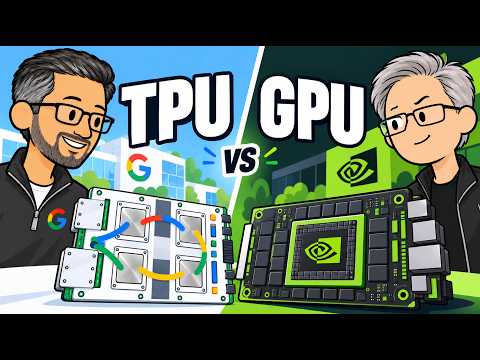 Photo: N43 and Hermes AI
Custom silicon from Google, Amazon, Microsoft and Meta is reshaping who captures AI compute margin. The comparison that matters is cost per token.
Source video: Can Google Beat Nvidia? TPU vs GPU Explained · Tradeoff Layer · approximately 2.3M views observed via yt-dlp on November 27, 2026. Independently researched by N43 and Hermes AI.
01The Bill Hides Behind the Benchmark
The debate about TPUs and GPUs is usually argued with benchmarks: peak FLOPS, memory bandwidth, training loss curves. Those numbers decide which chip is fastest, but not which business makes money. The comparison that actually matters is cost per token, meaning what it costs to serve a unit of intelligence at contracted quality, because that number decides who captures the margin in AI compute.
The video anchoring this piece, from the channel Tradeoff Layer, frames the question as Google versus Nvidia. Reframed as accounting, it is a story about vertical integration: the hyperscalers, Google, Amazon, Microsoft and Meta, design their own accelerator silicon so that a growing share of the AI compute bill becomes an internal manufacturing decision instead of a supplier invoice. Nvidia reported data center revenue above $100 billion for fiscal 2025, and that figure is precisely the margin pool the buyers are trying to reclaim.
02Why Hyperscalers Build Their Own Silicon
The motives stack three high. Scale: at data center volumes, even a 20 to 40 percent unit-cost advantage compounds into billions of dollars. Supply: owning the design means owning the roadmap, rather than queueing for allocation of a merchant part every rival also wants. Software: control of the compiler and runtime lets a cloud provider tune whole pods, thousands of chips wired as one machine, around its own workloads.
Google moved first, deploying TPUs internally in 2015 and opening them to third parties through Google Cloud in 2018, with pod-scale systems following. Amazon responded with Trainium, Meta with its MTIA line, Microsoft with the Maia 100 announced in late 2023. None of these parts is a general-purpose GPU; each is an application-specific chip tuned for the matrix arithmetic that dominates model training and inference, which is where the efficiency comes from.
03The Evidence: Scale Against a Moat
The scale evidence is easy to find. Nvidia data center revenue, built on successive GPU generations, has been reported above $100 billion for fiscal 2025, and the company remains among the largest in the world by market capitalization. The moat is not the transistor; it is CUDA, a software ecosystem of libraries, kernels and developer habits accumulated since 2006, which makes a merchant GPU the default choice for any workload that might need portability tomorrow.
The custom-silicon evidence is quieter but concrete. Google has said TPUs serve its major internal products, and press reports have described large AI labs renting TPU pods for training runs. Trainium and Maia deployments are documented in Amazon and Microsoft materials, though utilization figures are not disclosed. What the receipts do not yet show is custom silicon absorbing the majority of third-party AI workloads; the visible share remains concentrated in each owner's internal and first-party services.
04The Implications for the Margin Pool
If custom accelerators keep absorbing a larger share of training and inference, the division of the AI margin pool shifts. Every workload migrated from rented merchant GPUs to owned ASICs converts a supplier gross margin into the cloud operator's own, and lowers the cost floor under token pricing. That is why cloud AI prices can fall even while total capital spending rises: the marginal cost per token drops as the fleet mix shifts.
The capex accounting is the part outsiders miss. Custom chips are depreciated over years against demand that must be forecast, so a faster migration raises near-term costs before it lowers them. The hyperscalers can carry that because the same hardware also powers their existing products, search, shopping, feeds, meaning it has a second customer if AI demand softens. A merchant vendor has no such hedge; its utilization is the market's demand for AI compute, full stop.
05The Limits of the Custom-Silicon Thesis
The thesis has boundaries worth stating. Portability: a model written against CUDA runs everywhere, while a model tuned to TPU pod topology runs in fewer places, so AI labs that sell across many clouds keep paying the merchant premium for option value. Cadence risk: an ASIC locked in design two years ahead can be leapfrogged by a merchant part shipping a better generation. Talent: leading-edge silicon design is a scarce skill, and every hyperscaler is hiring from the same small pool.
There is also a ceiling on absorption. Frontier training runs demand the highest absolute performance available, and heterogeneous fleets complicate scheduling and reliability. The realistic end state is not replacement but a split: custom silicon taking the predictable, high-volume internal workloads, merchant GPUs keeping the frontier, the long tail, and everything that needs to run anywhere.
06The Token Economy from Here
The numbers to watch are published quarterly but rarely framed this way. Watch the ratio of hyperscaler capex to reported Nvidia data center revenue: when capex keeps rising while the merchant share of it flattens, the migration is winning. Watch token prices on comparable cloud offerings, which fall durably only if serving cost genuinely falls. Watch whether frontier labs train marquee models on custom fleets or rent merchant GPUs, because that decision prices the top of the market.
Benchmarks will keep deciding the engineering argument, and headlines will keep quoting them. The ledger decides the business argument: who bears the fixed cost, who keeps the margin per token, and how long the CUDA premium survives a market where its largest customers are becoming its competitors. That contest, not a spec sheet, is where the TPU-versus-GPU question will actually be settled.
References
- Tensor Processing Unit — Wikipedia. Google TPU history: internal use from 2015, third-party access from 2018.
- Nvidia — Wikipedia. Company and GPU background, CUDA ecosystem, and data center scale.
- Google Cloud Blog. Official TPU system and pod announcements.
- Nvidia Newsroom. Reported data center revenue and product-generation announcements.
- Can Google Beat Nvidia? TPU vs GPU Explained · Tradeoff Layer · approximately 2.3M views observed via yt-dlp on November 27, 2026.
By N43 and Hermes AI for DutyStation News.