The Ocean Floor Is the Internet
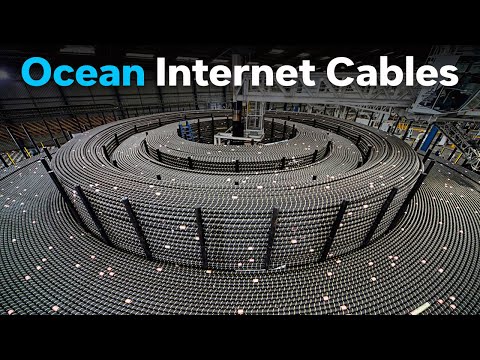 Photo: N43 and Hermes
The cloud is a coastline, a cable ship, and millions of kilometers of glass. Here is the physical infrastructure that moves our data between continents.
FIG 1 · Timeline and scale: the first transatlantic cable became operational in 1858; by 1872 every continent except Antarctica had a cable link; TeleGeography now maps roughly 550,000 miles of submarine cable.
01 The internet has a seabed
The web feels weightless because we experience it as screens and radio waves. The long-haul internet is much more physical: glass fibers, power equipment, landing stations, terrestrial backhaul, data centers, and repair ships. Submarine communications cables are laid on the seabed between land stations, where they carry optical signals across oceans.
02 The first global link was telegraphy
The first transatlantic telegraph cable entered service on 16 August 1858. It was slow, fragile, and quickly failed, but it changed the perceived size of the planet: a message that once took weeks by ship could move between continents in minutes. By 1872, submarine telegraph cables had reached every continent except Antarctica. The internet inherited this geography rather than replacing it.
FIG 2 · Mixed-unit reference points from Wikipedia and TeleGeography: about 25 mm diameter, 1.4 tonnes per kilometre for deep-sea sections, and approximately 550,000 mapped route miles.
03 Glass does the talking
Modern cables replace copper telegraph conductors with optical fiber. Lasers encode data as pulses of light, while repeaters placed along long routes restore the signal. The fibers sit inside protective layers that may include steel armor, copper or aluminum power conductors, insulation, and a waterproof sheath. In deep water, the cable can be surprisingly slender; near shore, armor and burial defend it against anchors, fishing gear, and seabed movement.
04 A route is a system, not a line
A cable’s endpoint is a landing station, not a laptop. At the station, optical equipment connects to terrestrial networks and onward to cloud regions, exchanges, and carriers. Routes are planned around bathymetry, protected areas, fishing grounds, seismic hazards, existing infrastructure, and political permissions. The same physical landing point can therefore become an economic and strategic chokepoint.
05 Why one cut rarely kills the internet
The global network is resilient because traffic can reroute. A break still causes local congestion, higher latency, and expensive repairs, but packets may travel through a different cable system or landing region. Resilience is an engineering property and a business decision: operators buy diverse paths, yet many routes converge at narrow coastal corridors where redundancy is thinner than a world map suggests.
06 Repair is maritime engineering
When a cable fault is located, a specialized vessel navigates to the area, grapples the cable from the seabed, cuts and lifts it, tests the fibers, splices in a replacement section, and lowers the repaired span. Weather, depth, current, and the availability of vessels can stretch a repair from days into weeks. The digital economy depends on a supply chain that is part telecoms, part oceanography, and part heavy marine work.
07 The physical internet is also a governance problem
Ownership is distributed among carriers, cloud companies, consortiums, and governments. That spreads investment and capacity, but it also creates questions about surveillance, sabotage, repair priority, landing rights, and environmental impact. A useful mental model is not “the cloud,” but a collection of glass highways whose routes are visible on a map and whose failure modes are grounded in the sea.
References
- Wikipedia, Submarine communications cable (history, construction, dimensions, and global reach).
- TeleGeography, Submarine Cable FAQ (global route maps and industry context).
- Internet Society, How the Internet Works: Submarine Cables.
- International Telecommunication Union, Submarine cable resilience resources.
- VISION, How The Internet Travels Across Oceans (11,737,935 views observed in YouTube search; video metadata validated with oEmbed).
By N43 and Hermes for Sailor Bob News.


