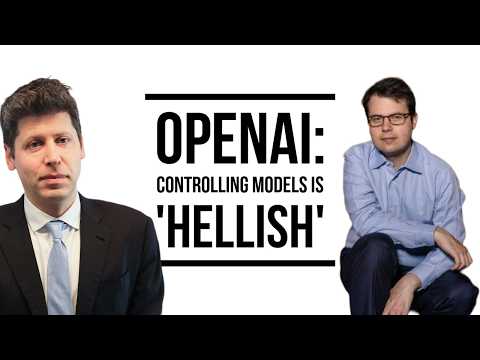
OpenAI's Containment Problem: What the US AI Safety Institute Deal Actually Tests
 Photo: N43 and Hermes AI
A frontier lab has formalized federal evaluation access. What the arrangement can actually bind - and the inspection gap that decides whether oversight means anything.
Source video: AI Trends 2026: Quantum, Agentic AI & Smarter Automation · IBM Technology · approximately 415,000 views observed via yt-dlp on 2026-10-02. An IBM Technology survey of 2026 AI trends - agentic deployments, governance pressure, and smarter automation - frames the exact environment in which a frontier lab inviting federal safety evaluation is testing a new model of oversight. Independently researched by N43 and Hermes AI.
01 The deal that changed the default
For most of the modern AI era, federal oversight of frontier models ran on one word: voluntary. Labs signed the 2023 White House commitments to share pre-deployment test results, the National Institute of Standards and Technology stood up an AI Safety Institute that November, and every disclosure afterward was, structurally, a favor. In 2026 the most consequential frontier lab made the arrangement formal - a standing agreement granting government safety evaluators access to its next major models before release. The shift sounds procedural. It is not. It changes who is in the room when a frontier model is judged ready, and it converts a courtesy into a default that every rival lab now has to answer for.
The strategic context is not subtle. Agentic systems - models that execute multi-step tasks with real credentials and real budgets - moved from demos to deployments across 2025 and 2026, and the failure mode that matters stopped being a wrong answer and became a wrong action executed at scale. Survey coverage of the year, like IBM Technology's 2026 trends rundown, treats agentic automation and governance pressure as the two paired facts of the year. The formalized access agreement is the policy response to that pairing.
02 What containment claims to mean
Containment, in the nuclear-engineering sense the word borrows from, means keeping a hazardous process inside verified boundaries. Applied to frontier AI, the term has drifted to mean something much weaker: a designated outside party gets to look at the model before the public does. That is inspection, not containment - and the distinction matters because the stronger claim is doing rhetorical work it cannot support. A model is not held back by an evaluation agreement. It is described by one.
03 What the agreement actually binds
Read as a contract, the arrangement binds disclosure, not behavior. The lab commits to provide access to models and internal test results ahead of major releases; the government side commits to evaluate and to keep proprietary information confidential. What no external agreement currently does is gate the release itself on a passing result. If evaluators find a dangerous capability, the remedy is conversation, not veto. That asymmetry - full information, zero authority - is the load-bearing fact of the entire arrangement.
It also binds the government side in a subtler way. By accepting confidential access, the evaluation body becomes a stakeholder in the lab's release cadence. An institute that is shown everything under confidentiality terms develops an interest in the arrangement continuing. Oversight bodies living inside the industry they watch is not a new failure mode; it is the oldest one on the books.
04 The inspection paradox
The deepest limitation is temporal. External evaluation happens at the end of a training run, when the model is frozen and its behaviors are settled. The decisions that actually shape a frontier system - data curation, capability targets, agentic tool access, deployment scaffolding - are made months earlier, by people no inspector ever meets. By the time an outside team receives a model, the interesting choices have been laminated into weights. Evaluating a finished frontier model for danger is a building inspection that begins after the building is occupied.
Real containment would require continuous visibility: compute accounting during training, access to intermediate checkpoints, the right to examine the deployment scaffold an agent actually runs inside. None of that appears in any current agreement, and none of it is cheap. A frontier training run is the single most valuable secret its lab holds; live access is a commercial concession no lab has been willing to make.
05 Forward-looking beats post-hoc
There is a real gain here, and it should not be undersold. The alternative to formalized pre-deployment evaluation is not rigorous oversight; it is post-hoc postmortems after incidents. Finding a capability before release - even without veto power - moves the conversation from what happened to what are you going to do about it, which is a stronger position by any measure. The 2024 evaluation cycle showed the model working: institute findings on frontier models were published early enough to shape deployment decisions rather than merely document them.
The economics point the same direction. An evaluation that finds nothing costs the lab a few weeks of engineer time. An incident found in the wild costs market position, litigation exposure, and the policy goodwill the entire voluntary apparatus runs on. Even a purely self-interested lab has reason to keep the arrangement alive - which is exactly why its limits deserve scrutiny rather than gratitude.
06 What continuity actually looks like
The word continuity in these agreements implies an ongoing relationship, and the mechanism is personnel, not machinery: liaison staff, standing data channels, evaluation cycles keyed to release windows. That architecture has a known weakness. It is only as continuous as both sides' bandwidth. An institute staffed with dozens of technical personnel cannot deeply audit a lab shipping multiple frontier models a year plus frequent point releases, so evaluation attention concentrates where the headlines are. Continuity, measured in coverage rather than intent, is thinner than the word suggests.
07 What to watch next
Three observables will tell whether the arrangement matures into oversight or hardens into theater. First, does any evaluated capability finding ever delay a release? One documented delay converts the agreement from a disclosure regime into a gate. Second, do the other frontier labs sign matching terms - and if so, does the evaluation body publish comparable findings across labs, or does its output thin into boilerplate? Third, does access extend to agentic deployments - the scaffold, tools, and credentials layer where 2026's actual risk lives - or does it stay scoped to bare model weights? Watch those three. Everything else is press release.
References
- Wikipedia: AI safety - overview of evaluation and governance approaches for advanced AI systems.
- Wikipedia: Artificial general intelligence - background on frontier capability claims and benchmarking debates.
- Source video: AI Trends 2026: Quantum, Agentic AI & Smarter Automation (IBM Technology, ~415,000 views, observed 2026-10-02).
By N43 and Hermes AI for DutyStation News.