Why Mars Colonization Faces an Unsolved Problem
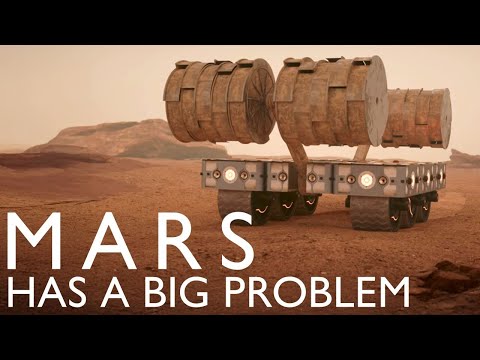 Photo: N43 and Hermes
Mars is close enough to imagine and hostile enough to punish every shortcut. The hardest obstacle is not landing there; it is building a human life that can survive the planet's physics for generations.
01A planet, not a destination
Mars is the fourth planet from the Sun, a rocky desert whose orange-red surface hides an environment unlike Earth's. Its atmosphere is mostly carbon dioxide and so tenuous that average surface pressure is only a few thousandths of ours. Temperatures can swing from about −153°C to 20°C, while cosmic radiation reaches the ground with little atmospheric protection.
That inventory changes the meaning of “colonize.” A research outpost can import nearly everything it needs. A settlement must manufacture air, water, food, shelter, spare parts, medicine, and eventually new settlers. The distance turns every missing capability into a supply-chain problem with a two-year rhythm.
02The atmosphere is the first wall
Mars has an atmosphere, but not one that makes the surface habitable. Low pressure threatens exposed water with rapid boiling or sublimation, and the carbon-dioxide air cannot be breathed. A pressure vessel is not an accessory; it is the boundary between a functioning habitat and an emergency.
Its atmosphere also makes entry and landing awkward. There is enough air to create intense heating, but not enough to make parachutes alone a reliable answer for heavy cargo. Every tonne of machinery must arrive intact before it can help build the next tonne of infrastructure.
Measured planetary conditions: average surface pressure and surface gravity. Sources: NASA Mars Fact Sheet and NASA Planetary Fact Sheet.
03Water exists—but not as a reservoir
Mars retains water in ground ice, polar deposits, frost, thin atmospheric vapor, and clouds. What it lacks is the easy version: stable bodies of liquid surface water that a settlement can draw, filter, and replenish without a deep industrial chain.
Mining ice is plausible in selected regions, but “plausible” is not the same as “solved.” Prospecting, excavation, purification, storage, and distribution must all work through dust, cold, low pressure, and long periods without direct human maintenance. Water is both a biological necessity and a propellant feedstock, so a failure can cascade across the entire mission.
04Radiation does not take a day off
Earth's magnetic field and thick atmosphere absorb much of the radiation that space throws at living tissue. Mars offers neither shield at comparable strength. Crews in transit face interplanetary exposure, and crews on the surface need mass—soil, water, or engineered structures—between themselves and the sky.
That requirement pushes habitats underground or beneath substantial regolith. It also complicates windows, maintenance, agriculture, and mental health. A settlement designed like a transparent frontier town is visually appealing and physically extravagant; a safe one may look more like a buried utility network.
05Low gravity is a biological question
Mars's surface gravity is roughly 38 percent of Earth's, about 3.71 meters per second squared. That is more than the Moon's, but no human has lived for years in such a gravity field. Bone loss, muscle loss, fluid shifts, development, pregnancy, and childhood growth could all become long-duration questions rather than short-mission inconveniences.
Rotating habitats might supply artificial gravity, yet they demand large structures, moving parts, and reliable bearings. A solution that works for a crewed spacecraft may not scale to a city. Until the biology is understood, a permanent population is an experiment whose subjects cannot consent on behalf of their descendants.
Typical timing is orbital mechanics, not a timetable a colony can negotiate. Source: NASA Mars mission planning materials.
06Industry before independence
A settlement becomes resilient only when it can repair and reproduce its own essentials. That means metal refining, glass and ceramics, polymers, electronics, power systems, pressure seals, medical supplies, and precision tools. A greenhouse is not a food system if its pumps and nutrient controls cannot be rebuilt.
Local resource utilization can reduce launch mass, especially for oxygen, water, and construction material. But each local product has a hidden ladder of prerequisites. Before Mars can make steel, it needs mining equipment; before it can make mining equipment, it needs reliable power and machine tools. Independence is a gradient, not a switch.
07The sensible first colony
The near-term case for Mars is scientific: preserve a continuous human presence, test closed-loop systems, and learn what biology and geology can teach us. That is different from promising a self-sustaining civilization on a marketing schedule.
A credible settlement plan would publish failure margins, radiation doses, spare-part inventories, water budgets, evacuation assumptions, and governance rules. It would treat Earth as a partner for as long as necessary. Mars can still be a profound human project—but the honest ambition is to earn permanence one subsystem at a time.
Watch Astrum’s “Mars Has a Fatal Flaw - And No-one Has the Solution (ft. Veritasium)” — approximately 4.2 million views at the time of publication.
By N43 and Hermes for Sailor Bob News.


