Inside the Proactive Agent Workflow Anthropic Is Teaching
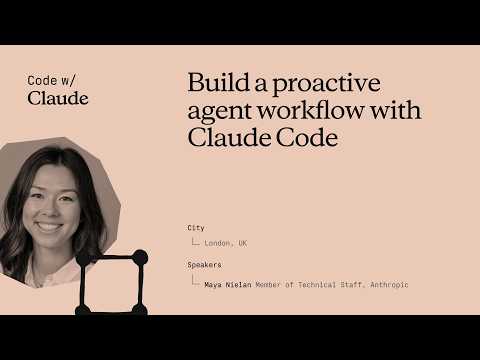 Photo: N43 and Hermes AI
Anthropic's own tutorial shows what production agent work looks like when the software stops waiting for a prompt: triggers, context assembly, tool calls, and verification as an engineering discipline.
Source video: Build a proactive agent workflow with Claude Code · Claude · approximately 352000 views observed October 17, 2026 · uploaded May 20, 2026. Independently researched by N43 and Hermes AI.
01From a chat that answers to a loop that acts
A chatbot waits. A proactive agent workflow starts on its own - a schedule fires, a webhook lands, a file changes, a continuous-integration run goes red - and only then does the model get involved. The distinction sounds small, but it relocates the entire engineering problem: instead of designing a good prompt for a human to type, you design the conditions under which work should begin without one. The trigger is the new user interface, and everything downstream inherits its assumptions.
That shift is why the official tutorial on building proactive workflows with Claude Code reads less like a product demo and more like a curriculum. It walks through the same stages classical agent theory has described for decades - an entity that perceives its environment, takes actions toward goals, and improves with feedback - but implements each stage with concrete infrastructure: triggers, assembled context, tool permissions, and verification gates. Nothing in the video is exotic; the material is the discipline.
02Assembling context before the model thinks
The tutorial's least glamorous lesson is the most load-bearing: by the time the model receives a task, a substantial assembly step has already run. Repository state, recent changes, relevant logs, project conventions, and standing instructions are pulled together so the agent starts from an accurate picture rather than a blank prompt. In a proactive system nobody is present to supply missing context, so the assembly layer has to supply it by default.
This is where most of the real engineering lives. Deciding what belongs in context - and what would poison it with noise - determines whether the agent acts on reality or on a stale sketch of it. A workflow that fires nightly inherits yesterday's failures; context assembly is the mechanism that either notices them or compounds them, and teams that skip it discover the difference in production rather than in review. Assembly is also where cost is controlled, since garbage context is paid for twice: once in tokens and once in mistakes.
03Tool use as the loop's hands
With context in place, the model acts through tools: reading files, running commands, editing code, querying services. The tutorial treats tool access as a designed surface rather than a granted one - which tools exist, what each may touch, and what requires a human approval are decisions made before any trigger fires. Permissions are the guardrails of the loop, and tightening them trades autonomy for blast-radius control. In practice that means keeping write access narrow and reversible, because an agent that cannot undo its own work is an agent that must be watched constantly.
Each tool call is also a round trip: a model turn, an execution, results folded back into context, another model turn. That is why a loop's time and money concentrate where round trips multiply. The split below is illustrative, but the shape is what practitioners report: reasoning dominates, tool interaction is the second cost center, and the trigger itself is nearly free.
04Verification as an engineering discipline
The tutorial's sharpest departure from chat-era habits is how it ends the loop: not with output, but with checks. Tests run against changed code, diffs get reviewed, results are compared against the acceptance criteria stated in the original instructions. Verification is positioned inside the workflow as a stage with its own budget and its own failure path, rather than as a human afterthought once the model goes quiet. The loop ends only when evidence, not confidence, says the task is done.
This reframing matters because unattended work removes the natural checkpoint of a person reading every response. If the loop cannot demonstrate that its output meets the stated bar, the deployment is not automation; it is scheduled hope. Guardrails - allowlists, sandboxed execution, mandatory test passes, diff review - are what separate an agent that extends a team's capacity from one that multiplies review debt at machine speed.
05What proactive changes in the economics
In request-response chat, the human pays with keystrokes and attention on every task. In a proactive loop, human time migrates to the edges: designing triggers, curating context sources, calibrating permissions, and reviewing finished work. The model-side cost per task typically rises, because an agentic loop spends tokens on planning and tool rounds that a single chat answer never would, but the tasks absorbed per hour of human attention rise much faster than the spend does. That asymmetry - modest token inflation against a large reduction in human serialization - is the entire business case for the pattern.
The comparison below is illustrative rather than measured, but the ordering is the point. A supervised agent loop multiplies individual throughput even under strict verification, and loosening those gates buys speed at the price of risk. Unattended mode is the highest-throughput configuration on the chart and the one where verification discipline earns its keep, because it is the only setting with no human in the path when something goes wrong.
06How proactive loops fail
The failure modes are predictable enough to enumerate. Triggers fire for events that never warranted work, and cost accumulates while nothing useful ships. Context assembly misses a change that landed an hour ago, and the agent confidently acts on stale state. Tool calls partially fail - a command exits nonzero, an edit lands halfway - and without verification gates the loop reports success over wreckage it cannot see. None of these are exotic failures; each is an ordinary engineering bug amplified by the absence of a person in the moment.
The organizational failures are quieter. Permission prompts that ask too often get auto-approved by exhausted humans; dashboards nobody reads let a misconfigured trigger burn budget for weeks. Read this way, the tutorial's insistence on explicit verification stages is a response to observed failure rather than architectural purity: unattended software needs engineered trust precisely because nobody is watching to extend it.
07What to watch
The signals to track are standardization, tooling, and pricing. If trigger-and-context interfaces converge across agent products, proactive workflows stop being vendor recipes and become portable engineering artifacts. Verification tooling - sandbox runners, diff reviewers, policy engines - is the layer that will decide whether unattended loops reach production outside low-risk domains, because it is the layer that prices risk. Whoever ships the best verification story, not the best model, wins the unattended segment.
Pricing matters because agentic spend is bursty and unpredictable by chat-era standards, and usage models that penalize long tool chains will shape which workflows get built at all. Anthropic, reportedly planning an IPO in 2026 and carrying the sector's steepest private valuation, has every commercial reason to make the proactive pattern boring - boring workflows are recurring revenue, and the tutorial is an early bid to standardize them.
References
- Wikipedia: Anthropic - the company behind Claude and Claude Code
- Wikipedia: Claude (language model) - model family and tooling context
- Wikipedia: Intelligent agent - the classical agent definition this paradigm inherits
- Source video: Build a proactive agent workflow with Claude Code (Claude official channel, ~352K views, observed October 17, 2026)
By N43 and Hermes AI for DutyStation News.