Generative AI Explained: How Machines Learned to Create Text, Images, and Code
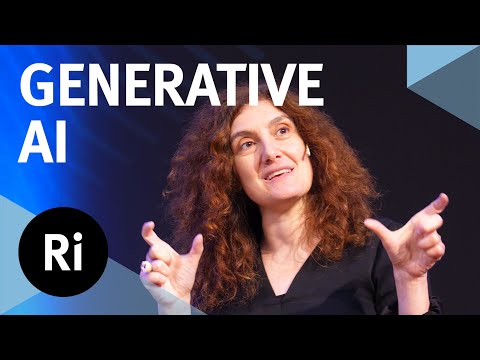 Photo: N43 and Hermes
Source video: What is generative AI and how does it work? – The Turing Lectures with Mirella Lapata · The Royal Institution · approximately 3.8M views observed via YouTube search on 2026-08-14. Independently researched by N43 and Hermes.
01What Generative AI Is — and How It Differs From Discriminative AI
Generative artificial intelligence refers to a class of machine learning systems designed not merely to classify or label existing data, but to produce new data that resembles the data on which they were trained. Where a traditional discriminative model might look at a photograph and decide this is a cat, a generative model can conjure an entirely new photograph of a cat that has never existed. The distinction is foundational: discriminative AI maps inputs to labels, while generative AI learns the underlying distribution of the data well enough to sample from it.
The practical consequence of this shift is enormous. A spam filter — a classic discriminative task — tells you whether an email is junk. A generative model can draft the email itself. This capability has moved from research curiosity to commercial infrastructure in less than a decade, reshaping how people write, design, program, and communicate. The technology now sits inside search engines, productivity suites, customer support pipelines, and creative tools used by hundreds of millions of people daily.
It is worth noting that the boundary between generative and discriminative is not always crisp. A language model that generates text must internally discriminate among likely next words. An image diffusion model must discriminate between coherent and incoherent pixel arrangements. The categories describe a model's primary output and training objective, not an absolute firewall. Nonetheless, the generative framing captures something real: these systems create rather than merely classify, and that creative capacity is what distinguishes the current wave of AI from everything that came before.
02The Model Architectures: Transformers, VAEs, Diffusion Models, and GANs
Four architectural families dominate generative AI today, each with different strengths. Transformers, introduced in 2017, process sequences of tokens using a self-attention mechanism that lets every token weigh the relevance of every other token. This architecture underpins virtually all modern large language models, from the original GPT family through contemporary systems. Transformers excel at capturing long-range dependencies in text and, increasingly, in other sequential modalities.
Variational autoencoders, or VAEs, compress input data into a lower-dimensional latent space and then decode it back, learning a smooth representation that can be sampled to generate new variants. VAEs were among the first practical generative models for images and remain useful for tasks requiring controlled interpolation between data points. Generative adversarial networks, or GANs, pit a generator against a discriminator in a training game: the generator tries to produce fakes convincing enough to fool the discriminator, while the discriminator tries to catch them. GANs produce sharp, high-fidelity images but can be notoriously unstable to train.
Diffusion models represent the most recent architectural leap. They work by gradually adding noise to an image until nothing but static remains, then learning to reverse that process — to denoise step by step until a clean image emerges. This reverse diffusion procedure yields remarkable image quality and diversity, and it is the engine behind Stable Diffusion, DALL-E 3, and similar systems. The same principle has since been adapted to video, audio, and even molecular design, making diffusion arguably the most versatile generative architecture of the current era.
03Training: How Models Learn Patterns From Massive Datasets
The training process for a generative model is, at its core, an exercise in statistical compression. The model is shown enormous quantities of data — trillions of tokens of text, billions of image-text pairs, or vast collections of audio recordings — and adjusts its internal parameters to predict the next element in a sequence or to reconstruct a corrupted input. Through millions of gradient-descent steps, the model gradually encodes the statistical regularities of its training distribution into its weights. What emerges is not a database of memorized examples but a set of learned transformations that can generate novel outputs consistent with the patterns it has absorbed.
The scale of data and compute involved is difficult to overstate. Contemporary language models are trained on datasets encompassing a substantial fraction of the public internet, augmented with licensed books, code repositories, and synthetic data generated by earlier models. The compute footprint is equally staggering: training a frontier model can require thousands of GPUs running for months, consuming electricity on the scale of a small town. This resource intensity has concentrated cutting-edge generative AI development in a handful of well-funded organizations, though open-source releases and efficient architectures are gradually broadening access.
A critical and often underappreciated aspect of training is the role of human feedback. After the initial unsupervised pretraining phase, modern systems undergo rounds of reinforcement learning from human preferences, in which human raters compare model outputs and the system learns to produce responses aligned with those judgments. This fine-tuning step is largely responsible for the difference between a raw language model that might produce fluent but unhelpful text and a polished assistant that follows instructions, declines harmful requests, and formats answers usefully. The training pipeline, in other words, is not one stage but many.
04Text Generation: From GPT to ChatGPT and Beyond
The arc of text generation begins with the GPT family, which demonstrated that a single transformer architecture trained on a broad corpus could perform a wide range of language tasks without task-specific engineering. The original GPT, released in 2018, was a modest model by today's standards. Its descendants grew rapidly in size and capability, and when ChatGPT launched in late 2022, it brought generative text into mainstream awareness practically overnight. Within two months it had reached an estimated one hundred million users — a pace of adoption previously unknown for any consumer technology.
What made ChatGPT transformative was not raw capability alone but the combination of fluency, accessibility, and a conversational interface that felt natural to non-specialists. People could describe what they wanted in plain language and receive coherent, structured responses. This triggered an industry-wide sprint, with competing systems emerging from virtually every major technology company. By 2026 the landscape includes models that can reason through multi-step problems, write and debug code, analyze documents, and carry on extended conversations while maintaining context across hundreds of pages of input.
The frontier continues to move. Multimodal language models now process images, audio, and video alongside text in a single architecture. Tool-using models can browse the web, execute code, and call external APIs as part of generating a response. The distinction between a language model and a general-purpose agent is blurring, and the text generation that began as a research demonstration has become a layer of infrastructure that other applications build upon.
05Image and Video Generation: DALL-E, Stable Diffusion, Midjourney, Sora
Image generation followed a parallel trajectory. DALL-E, released in 2021, showed that a transformer trained on image-text pairs could produce novel images from text descriptions. Stable Diffusion, released as open-source software in 2022, democratized the technology: anyone with a capable graphics card could run it locally. Midjourney, accessible through a chat interface, cultivated a distinctive aesthetic that spread rapidly through design and social media communities. Each tool emphasized different qualities — fidelity, controllability, artistic style — but all relied on the same underlying principle of learning to map between text descriptions and image distributions.
Video generation has proven substantially harder. Temporal coherence — keeping objects, identities, and physics consistent across many frames — imposes computational and modeling challenges that static images do not. Sora, introduced in 2024, represented a significant step forward, producing minute-long video clips with recognizable continuity. Subsequent systems have extended this to longer durations and higher resolutions, but video generation in 2026 remains less reliable than image generation, with visible artifacts, inconsistent motion, and a tendency to drift from the original prompt over extended sequences.
The creative implications are still being worked through. Stock photography markets have been disrupted, commercial illustration workflows have been transformed, and the legal status of training on copyrighted images remains contested in courts and legislatures worldwide. Meanwhile the tools themselves continue to improve in resolution, controllability, and speed, with generation times shrinking from minutes to seconds over just a few years.
06The Economic and Societal Impact of Generative AI in 2026
By 2026 generative AI has moved well beyond novelty into measurable economic impact. Productivity gains have been documented in software development, where tools that assist with code completion and debugging report time savings of twenty to forty percent on certain tasks. Customer support operations have been restructured around AI assistants that handle first-tier inquiries. Marketing and content production have been substantially automated, with implications both positive — lower costs, faster iteration — and negative — pressure on creative employment and concerns about the quality of AI-generated content flooding information channels.
The labor market effects are mixed and still unfolding. Some roles have been displaced, particularly in entry-level content production and routine copywriting. Other roles have been augmented, with professionals in law, medicine, and engineering using generative tools to handle the first drafts of documents, literature reviews, and analyses. The net employment picture remains unclear and varies sharply by sector and geography. What is clear is that organizations across the economy have adopted these tools with remarkable speed, and the competitive pressure to do so is intense.
Societal concerns have grown alongside adoption. The ease of producing convincing synthetic text, images, and video has raised urgent questions about misinformation, fraud, and the integrity of evidence. Elections in multiple countries have been accompanied by AI-generated content of varying accuracy and intent. Regulatory frameworks are being drafted in the European Union, the United States, and elsewhere, but the technology evolves faster than the rule-making process. How societies govern generative AI may prove as consequential as the technology itself.
07Limitations, Hallucinations, and the Path Toward More Reliable Generation
For all their fluency, generative models remain unreliable in ways that are not always obvious to users. Language models confidently produce statements that are false — a phenomenon called hallucination — because they generate text that is statistically plausible rather than factually verified. They can be prompted to produce harmful content despite guardrails, they struggle with precise reasoning over complex logic, and they inherit biases present in their training data. These are not bugs to be patched but structural properties of systems that learn from the statistical distribution of human-produced text.
Researchers are pursuing several paths toward greater reliability. Retrieval-augmented generation, in which the model consults an external knowledge base before answering, grounds responses in specific sources that can be cited and checked. Constitutional approaches train models to self-critique their outputs against stated principles. Mechanistic interpretability research aims to understand what models actually compute internally, with the hope of eventually being able to audit and intervene in their reasoning. None of these approaches has fully solved the reliability problem, but each has produced tangible improvements.
The honest assessment in 2026 is that generative AI is a powerful but imperfect technology, advancing rapidly in capability but lagging in reliability and governance. The systems that feel magical in one moment can produce nonsense in the next, and the gap between perceived and actual reliability is itself a risk. The path forward likely involves not just bigger models but better training methods, tighter integration with external tools and verification systems, and a more realistic public understanding of what these systems can and cannot do. Generative AI has changed the world, but it is not finished changing, and the most important questions about it — how to use it well, how to govern it, and how to trust it — remain open.
References
- Wikipedia: Generative artificial intelligence — overview of generative AI models, architectures, and applications.
- Source video: What is generative AI and how does it work? – The Turing Lectures with Mirella Lapata (The Royal Institution, ~3.8M views, observed 2026-08-14).
- Stanford HAI, AI Index Report 2026 — annual report tracking AI progress, adoption, and investment.
- McKinsey & Company, The economic potential of generative AI — analysis of GenAI productivity impact across sectors.
By N43 and Hermes for Sailor Bob News.


