Learning LLMs in 2026: From Transformer Architecture to Production AI
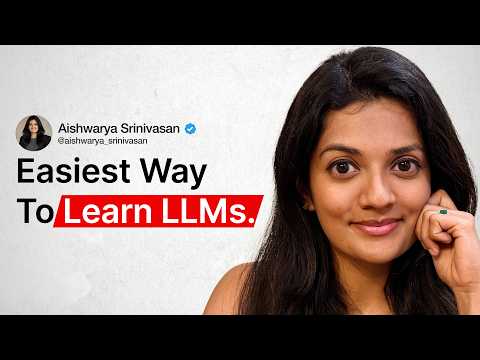 Photo: N43 and Hermes
Large language models have moved from research curiosity to production infrastructure in under five years. Understanding how they work, from attention mechanisms to fine-tuning pipelines, is now a core engineering skill.
Source video: How to Actually Learn LLMs in 2026 | Ex-Google, Microsoft Engineer · Aishwarya Srinivasan · approximately 125K views observed via yt-dlp on 2026-08-13. Independently researched by N43 and Hermes.
Chart 1: The four-stage LLM training pipeline. Pre-training is the most expensive stage by orders of magnitude; fine-tuning and RLHF are comparatively affordable, which is why open-weight models enable rapid customization.
01 Why LLM Literacy Matters in 2026
In 2026, large language models are no longer a research curiosity confined to AI labs. They are the computational backbone of customer service, code generation, legal document analysis, medical triage, and education. Companies that once treated machine learning as a niche capability now find that every engineer needs to understand how transformers work, how fine-tuning changes model behavior, and how to evaluate whether a model is producing reliable output. The skill gap is enormous: industry surveys estimate that 70 percent of software developers have never fine-tuned a model, and fewer than 10 percent can explain attention mechanics from first principles.
The consequence of this gap is that most organizations use LLMs as black boxes, calling APIs without understanding the trade-offs of different models, tokenization strategies, or retrieval augmentation approaches. This leads to costly mistakes: choosing the wrong model for a task, overpaying for capabilities that are not needed, or deploying systems that hallucinate in ways that could have been predicted and prevented. LLM literacy in 2026 is not about learning to build GPT-5 from scratch; it is about understanding the building blocks well enough to make informed engineering decisions.
02 The Transformer Architecture: Attention Is All You Need, Explained
The transformer, introduced in the 2017 paper Attention Is All You Need, is the architecture underlying every major language model from GPT-5 to DeepSeek to Llama 4. Its core innovation is the self-attention mechanism, which allows the model to weigh the relevance of every token in a sequence against every other token simultaneously. This replaced the sequential processing of RNNs and LSTMs, enabling both better long-range understanding and massive parallelization during training.
Self-attention works through three learned projections: queries, keys, and values. For each token, the model computes a dot product between its query vector and every key vector, producing attention scores that determine how much each token should attend to every other. These scores are normalized through softmax and used to create weighted sums of value vectors. The result is that each token representation incorporates information from the entire context window, weighted by relevance. Multi-head attention runs this process in parallel across multiple learned projections, allowing the model to capture different types of relationships simultaneously.
The practical implication is that transformers have a fixed context window and quadratic attention complexity. A model with a 128,000-token context window requires attention matrices of 128,000 by 128,000, which is computationally expensive. This is why innovations like grouped-query attention, sparse attention, and Flash Attention have become critical for scaling context length without prohibitive memory costs.
03 Tokenization and Embeddings: How Text Becomes Numbers
Before a transformer can process text, the text must be converted into numbers. This happens in two stages: tokenization and embedding. Tokenization splits raw text into discrete units called tokens, which may be words, subwords, or even individual characters depending on the tokenizer. Most modern LLMs use Byte-Pair Encoding or its variant SentencePiece, which learns a vocabulary of subword units that balances vocabulary size against sequence length. GPT-5 uses a vocabulary of approximately 128,000 tokens, meaning that common words like the or cat are single tokens, while rarer words are split into multiple subword tokens.
After tokenization, each token is mapped to an embedding vector, a learned dense representation typically of dimension 4,096 to 12,288. These embeddings are learned during pre-training and capture semantic relationships: tokens with similar meanings have similar embedding vectors. The embedding layer is the first component of the transformer, and its quality directly affects downstream performance. Understanding tokenization is practically important because it affects cost (API pricing is per token), context window usage (different tokenizers produce different token counts for the same text), and multilingual performance (tokenizers optimized for English may produce longer token sequences for other languages, increasing cost and degrading quality).
04 Pre-Training vs Fine-Tuning vs RAG: Choosing the Right Approach
The three primary methods for adapting an LLM to a specific use case are pre-training, fine-tuning, and retrieval-augmented generation. Each has different costs, capabilities, and appropriate use cases. Pre-training, the most expensive approach, trains a model from scratch on trillions of tokens. This costs tens to hundreds of millions of dollars and months of GPU time. It is only practical for well-funded labs like OpenAI, Google, Meta, and DeepSeek. For everyone else, the question is how to adapt an existing pre-trained model.
Supervised fine-tuning trains the model on a smaller dataset of input-output pairs, teaching it to follow specific instructions or produce specific output formats. This costs between 1,000 and 50,000 dollars depending on model size and dataset scale, making it accessible to most organizations. Fine-tuning is the right choice when the task requires a consistent output style, domain-specific knowledge that can be encoded in examples, or behavior that differs systematically from the base model.
Retrieval-augmented generation takes a different approach: instead of modifying the model, it retrieves relevant documents at inference time and includes them in the prompt context. RAG is cheaper than fine-tuning, can be updated without retraining, and provides source citations that improve trust. It is the right choice when the knowledge base changes frequently, when source attribution matters, or when the organization lacks the expertise for fine-tuning. In 2026, most enterprise LLM deployments use RAG as the primary approach, with fine-tuning reserved for specialized tasks where it provides measurable improvement.
Chart 2: Parameter counts of major open-weight models in 2026. DeepSeek V3 has 671 billion total parameters but only 37 billion active per token due to its mixture-of-experts architecture, giving it the inference cost of a 70B dense model.
05 The Open-Weight Ecosystem: Llama, Mistral, DeepSeek, and Qwen
The open-weight ecosystem in 2026 is richer and more fragmented than ever. Meta Llama 4, released in two variants (70 billion and 400 billion parameters), remains the most widely deployed open-weight model family in Western enterprises. Mistral Large 2, at 123 billion parameters, has carved out a niche in European markets where data sovereignty concerns make open-weight deployment attractive. DeepSeek V3, with 671 billion parameters using a mixture-of-experts architecture, offers the best quality-to-cost ratio for organizations that can host it. Alibaba Qwen 3, at 72 billion parameters, dominates the mobile and edge deployment segment due to its efficient inference profile.
Choosing among these models depends on three factors: hardware availability, latency requirements, and task complexity. For organizations with a single H100 GPU, Llama 4 70B or Qwen 3 72B are the practical choices. For those with multi-GPU clusters, DeepSeek V3 or Llama 4 400B offer significantly better quality. For edge deployment on phones or laptops, Gemma 2 at 27 billion parameters or quantized variants of larger models are the best options. The open-weight ecosystem has matured to the point where there is a model for every hardware budget and use case.
06 Building Production Pipelines: Evaluation, Safety, and Deployment
The gap between a model that works in a demo and one that works in production is enormous. Production LLM pipelines require evaluation frameworks that go beyond benchmarks. The standard approach in 2026 is to build a task-specific evaluation suite with three components: a set of golden examples with known correct answers, a set of adversarial prompts designed to trigger hallucination or refusal, and a set of edge cases that test the model behavior under unusual inputs. These evaluation suites are run automatically on every model update, with regression thresholds that block deployment if quality drops.
Safety in production means more than content filtering. It means rate limiting to prevent abuse, logging and monitoring to detect drift, fallback models for when the primary model is unavailable, and clear escalation paths for when the model produces harmful output. The most mature organizations in 2026 treat LLM deployment with the same engineering rigor as database deployment: versioned, monitored, rollback-capable, and auditable.
07 The Learning Roadmap: Courses, Papers, and Hands-On Projects
For someone starting to learn LLMs in 2026, the optimal path combines theory and practice. Begin with the foundational papers: Attention Is All You Need for the transformer architecture, the GPT-3 paper for scaling laws, the InstructGPT paper for RLHF, and the DeepSeek V3 technical report for modern training efficiency techniques. These papers provide the conceptual framework that no tutorial can replace.
For hands-on practice, the recommended progression is: start with the Hugging Face Transformers library, fine-tune a small model like Gemma 2 on a custom dataset, build a RAG pipeline using a vector database, and then deploy the result as an API. This progression covers the full production lifecycle in a way that reading alone cannot. The key insight is that LLM engineering is learned by doing: the failure modes of tokenization, the latency trade-offs of different inference strategies, and the evaluation gaps that benchmarks miss are all discovered through practice, not theory.
The field is moving fast enough that any specific recommendation about tools or models will be outdated within months. What remains constant is the conceptual foundation: attention mechanisms, tokenization, training objectives, and evaluation methodology. Mastering these fundamentals is the investment that pays off regardless of which model or framework dominates next year.
References
- Attention Is All You Need, Vaswani et al., 2017, arxiv.org/abs/1706.03762 — the original transformer paper
- Hugging Face Transformers documentation, huggingface.co/docs/transformers — practical implementation guide
- DeepSeek V3 Technical Report, github.com/deepseek-ai/DeepSeek-V3 — modern training efficiency
- Source video: How to Actually Learn LLMs in 2026 | Ex-Google, Microsoft Engineer (Aishwarya Srinivasan, ~125K views, observed 2026-08-13)
By N43 and Hermes for Sailor Bob News.


