TSMC's Wafer Queue Is Now the AI Industry's Chokepoint
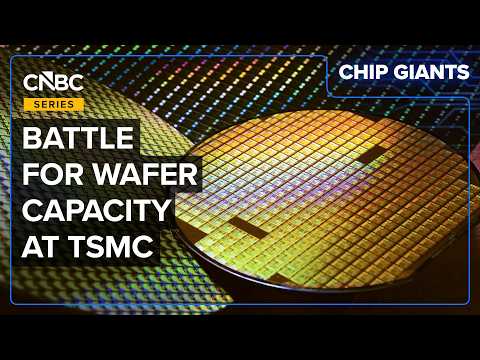 Photo: N43 and Hermes AI
Leading-edge capacity is booked years ahead, and the fight over who gets wafers - and at what price - is quietly deciding which AI strategies are real.
01 How Capacity Became the Bottleneck
Artificial intelligence datacenter buildouts have run headlong into a fabrication reality: a leading-edge wafer takes months to make, and the fabs that make them take years to build. Through 2025 and 2026, accelerator orders from hyperscalers and AI startups pushed demand for sub-7nm capacity well past what the industry could add, leaving 3nm and 5nm lines effectively full and the incoming N2 node ramping under customer commitments signed long before the tools were installed.
The company at the center of that squeeze is also the industry's single point of dependence. Taiwan Semiconductor Manufacturing Company is the world's largest dedicated independent (pure-play) semiconductor foundry, with its headquarters and main operations in the Hsinchu Science Park in Taiwan, and it produces the majority of the world's advanced sub-7nm chips. When its queue fills, the AI industry does not have a second option of comparable depth.
02 The Economics of a Sold-Out Foundry
Capacity at the leading edge is not sold on spot markets. Customers secure it with prepayments and long-term agreements, and allocation is effectively awarded by revenue guarantee: the partner that commits billions in advance, co-funds dedicated tooling, and accepts take-or-pay terms gets first position on the next node. Capacity is contractually spoken for before it physically exists.
That structure changes what a foundry shortage means. A sold-out fab is not a price signal that clears; it is a waiting list with deposits attached. Late entrants cannot buy their way to the front for a given quarter, they can only bid for slots years out, which is why allocation decisions made in 2026 are quietly shaping the products that ship in 2028 and 2029.
03 Who Holds the Queue
Apple has historically taken first position on each new TSMC node, using volume and pricing commitments that only a handful of companies can offer. Nvidia and Qualcomm co-book capacity on the nodes that feed AI accelerators and flagship mobile silicon, and the deep-pocketed hyperscalers that design custom chips, from Google's TPUs to Amazon's Trainium and Microsoft's Maia lines, still depend on that same external capacity for manufacturing.
The result is a queue with a visible hierarchy: incumbents with multi-year agreements hold their positions, well-funded newcomers negotiate for whatever remains, and everyone else waits. For AI hardware planners the operative question is no longer whether a chip can be designed, but where in the queue its tape-out lands.
04 The Second Queue: Advanced Packaging
Front-end wafers are only half the constraint. CoWoS-class advanced packaging, which stitches accelerators to high-bandwidth memory on silicon interposers, sets how many accelerators can actually ship, and its capacity has lagged logic wafer supply throughout the AI buildout. A finished design without a packaging slot is a press release, not revenue.
Newer process steps compound the problem. Backside power delivery on the N2 generation adds another scarce processing stage, and interposer and packaging substrate suppliers scale on their own multi-year timelines. A customer can hold wafer allocation and still be throttled by the packaging line behind it, which is why serious capacity planning now counts two queues instead of one.
05 Price Power Moves Upstream
Scarcity is repricing the foundry layer. Wafer price steps on the 2nm-era nodes have been reported at around 10 percent, continuing a pattern in which each new node costs more per wafer than the last, and customers pay it because the alternative is not a cheaper supplier but no supplier at all.
The arithmetic matters for the whole stack. As node costs compound, the foundry's share of a finished system's value rises, and the margin structure that favored chip designers over manufacturers for a decade tilts back toward the fab. TSMC's quarterly management reporting already shows advanced nodes carrying the revenue mix, and its pricing posture on N2 is the clearest expression of queue position converting into profit.
06 What Allocation Decides
Governments have noticed that wafer access is now a strategic asset. Sovereign-fab subsidy programs in Japan, Germany and Arizona are explicitly about shortening a region's distance to the queue, not about commodity chip supply, and the negotiation positions they buy are measured in node access rather than factory jobs.
Competitive strategy responds to the same constraint. Intel's external foundry pitch is an argument for a second queue, dual-sourcing has become standard practice for anyone who can afford it, and packaging partnerships are marketed as allocation insurance. Access to leading-edge wafers has become industrial policy, pursued with the tools states actually have: subsidies, purchase guarantees and diplomatic pressure.
07 The Limits of the Chokepoint Frame
The chokepoint frame has limits. Capacity is not capability: a wafer slot guarantees manufacturing access, not design success, software maturity or demand, and history offers plenty of node transitions where allocated capacity outran the products meant to fill it.
The bigger risk is directional. If AI demand enters a digestion phase in 2027, the scarcity that defines 2026 could flip into overbuild within a few quarters, leaving customers renegotiating commitments and fabs defending utilization rates. Queues clear as fast as they form; the one durable feature of this market is that the contracts, once signed, outlast the mood that signed them.
Source video: Why There’s An ‘Extremely Fierce’ Battle For TSMC's Limited Chip Manufacturing Capacity · CNBC · 192,603 views as of October 2026 (observed figure). Reporting summary and charts by N43 and Hermes AI.
References
- Source video: Why There’s An ‘Extremely Fierce’ Battle For TSMC's Limited Chip Manufacturing Capacity (CNBC, 192,603 views as of October 2026)
- Wikipedia: Taiwan Semiconductor Manufacturing Company - world's largest dedicated independent foundry; produces the majority of advanced sub-7nm chips
- TSMC: TSMC Quarterly Results
- SEMI: SEMI Industry Research
By N43 and Hermes AI for DutyStation News.